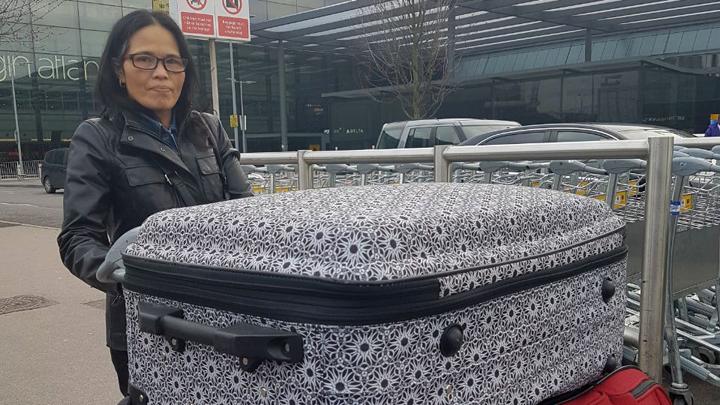

After suffering through an unimaginable ordeal, Parinah, a 50-year-old Indonesian woman who left her homeland nearly two decades ago and was not allowed to return to or talk with her family in all of that time, will finally arrive in Indonesia and be reunited with her family today.
Parinah, who was rescued in Brighton, England, on April 5 after being forced to work for an Egyptian family for 18 years without pay and in prison-like conditions, said that she had mixed feelings about finally returning home.
“I feel happy and sad. Happy to be reunited with my family and children. Mixed together. I’m sad to have no money,” Parinah said at London’s Heathrow International Airport in an interview with Tempo done with the assistance of staff members from the Indonesian Embassy in London on Wednesday.
1/Setelah menanti selama 18 tahun, Parinah, tenaga kerja Indonesia asal Banyumas yang disekap oleh majikannya di Inggris akhirnya kembali ke tanah air. @Kemlu_RI @BNP2TKI_ pic.twitter.com/oKIhsVCwBi
— Indonesian Embassy London (@KBRILondon) April 10, 2018
Read also: We all need to stop using the terms ‘maid’ and ‘helper’ | Opinion
Parinah left Banyumas, Central Java, in 1999 to work in Saudi Arabia for the family of an Egyptian doctor. In 2001, the family moved to England and took Parinah with them illegally.
While in England, Parinah was forced to keep laboring long hours for the family but never received any payment. She was also forbidden from contacting her family or anybody outside of her employer’s home, and could only leave the house accompanied by a member of the family.
Earlier this year, Parinah managed to secretly send a letter to her family in Indonesia through a local post office. Her son, who had not heard from her in decades, was eventually able to get in contact with the Foreign Ministry in Jakarta who then contacted the Indonesian Embassy in London.
Working together with the British Police, Parinah was finally rescued on April 5. Her captors, including the physician, his wife and their two children, were all arrested by the police. Their identities have no been revealed.
With the assistance of the Indonesian Embassy, Parinah left London yesterday on a Garuda Indonesia flight to Jakarta that is scheduled to arrive in the capital today, when she will finally be reunited with the family that she last saw so long ago.
Embassy officials said that there is a possibility that Parinah may have to return to England to testify against her captors. It is not yet clear what charges the family will face but we can only hope that part of their punishment will include restitution for Parinah’s many years of unpaid labor on top of financial compensation for the abuse and captivity suffered.
As shocking and sad as Parinah’s tale is, stories of Indonesian domestic workers being abused and exploited are common, and even decades long ordeals are not unheard of.
https://www.facebook.com/CoconutsJakarta/posts/2099156013705010
Last year, an Indonesian woman who had been forced to work as a slave in Saudi Arabia for 22 years was finally rescued and returned to her family. Authorities were able to get her captor to agree to give her Rp 586 million in “back pay” – the equivalent of 44,000 USD (or about 166 USD per month) but it is not clear if her captor faced any criminal charges.
https://www.facebook.com/Coconuts/posts/1504873046243326
Common reasons why migrant workers continue to work for employers that abuse them or withhold their pay include threats or acts of violence, threats of having them jailed, the withholding of passports and isolation from families or friends they could ask for help.
A Saudi man, Homaidan Al-Turki has been imprisoned in the United States since 2006, for raping and enslaving an Indonesian domestic worker in the US. During his trial, he and his defense lawyer claimed that withholding pay and forbidding their worker contact with the outside world were aspects of Saudi culture that the US justice system was biased against.
The judge didn’t buy that argument and he was sentenced to 28 years in prison, but Saudi Arabians took to social media last year saying that his conviction was unjust and that he should be paroled and returned to his home country.