
There are plenty of unique sights to be seen and captured in Indonesia, from the country’s many spectacular natural wonders to local architecture to simple snaps showing the diversity of Indonesia’s people and cultures. But these days, with the advent of Instagram and the competition to share ever cooler photos on your timeline, such sights no longer seem hip enough for many.
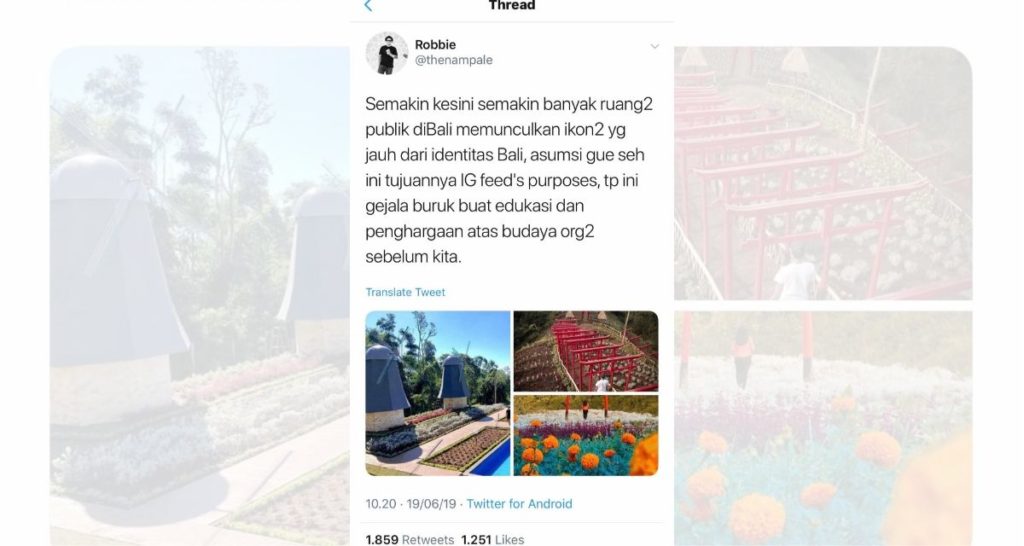
A critique along those lines entered the Bali Twitterverse on Wednesday courtesy of Indonesian user @thenampale, who sparked a pretty interesting discussion on the number of public spaces in Bali that are increasingly borrowing “icons” that are far removed from the island’s own cultural identity.
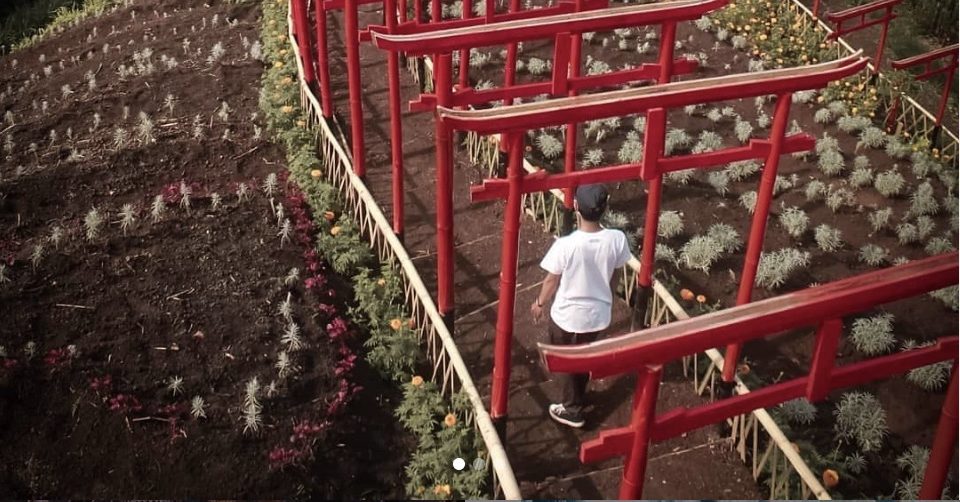
The user, who goes by Robbie Baria, starts the thread with several examples, which features what appears to be Dutch-inspired windmills in Bedugul and a string of Torii (traditional Japanese gates) that might remind you of the original from Kyoto, Japan’s Fushimi Inari Taisha in Taman Jinja Bali in Besakih (although if Torii is what you’re looking for, you can apparently find another at Taman Edelweiss in Rendang, Karangasem).
(In a brief message, Robbie told Coconuts Bali he accidentally deleted his first tweet to the thread. A screenshot of the tweet shows that it was retweeted more than 1,800 times.)
A fellow Twitter user, @gustiarya_, responded to Robbie’s tweet by claiming that following those trends is typical of Indonesian.
https://twitter.com/gustiarya_/status/1141209698231676928
“This so typically Indonesian. Forcing something to be something that it’s not. An identity crisis. Even in agriculture, it’s the same, we keep on importing materials that we can produce ourselves,” he tweeted.
Another user, @sitikarimah, expressed disappointment that Bali is “stealing what belongs to others, when Bali is rich itself.”
Ngapain ya ambil punya orang. Bali sendiri udah kaya banget kok :” https://t.co/xNdP1i7ks2
— Kαrimαh (@sitikarimah) June 19, 2019
Robbie said he was moved to say something on Twitter because he was concerned with the trend in tourism, where such photo spots become a prominent feature in a place that already has its own unique cultural identity.
“My tweet came out of personal concern for an island that has given me life… maybe ‘selfie tourism’ sounds like a joke and small thing, but in five years when we see that the face of Bali on Instagram looks so much like everywhere else, only then people are going to start saying ‘save Bali,’” Robbie told Coconuts Bali, adding that he’s been living on the island since he was a young kid.
So-called ‘selfie tourism’ has grown in popularity across the country, and it didn’t necessarily begin with Bali. In March of last year, a self-describe “selfie tourism” spot, Rabbit Town,” was accused of plagiarizing iconic designs from abroad for its art installations, including Chris Burden’s “Urban Lights” at the LA County Museum of Art (LACMA) in the United States.
It’s not hard to figure out why developers build these copycats of iconic spots — the more popular a spot is on Instagram, the more people come to take photos in that location, leading to even more photos and visitors etc. It’s simple math, no doubt, but at what cost?
In another tweet, Robbie also pointed out how Balinese culture has long been a point of attraction for visitors.
Gue ud begah bgt dgn serbuan ayunan dan block signage yg ga penting dan alay bgt di bnyk tmpt dibali, blm lg instalasi gajel sarang burung lah, love2 lah.. Paan seh sanusi?? pic.twitter.com/5WelKX2Kmw
— Robbie (@thenampale) June 19, 2019
“… Balinese culture is what makes people eager to come here, just because you see a ‘selebgram’ post a photo on a swing somewhere and they get 10k likes, you end up building swings everywhere,” Robbie tweeted, referring to the local portmanteau for Instagram influencer.
Twitter user @Ferferifer, also in response to Robbie’s thread, pointed out how the efforts might have initially been an effort to attract tourists from outside of the island, but ends up failing hard.
Gimana ya niatnya pengen narik wisatawan luar bali dengan cara menarik dan unik tapi jatuhnya malah kampungan dan membosankan. Penggunaan kata kata yang di cetak besar besar dengan background pemandangan atau apapun. Malah nutupin pemandangan itu sendiri. Sedih sih
— Gepenk (@Ferferifer) June 19, 2019
“If they are trying to capture the local millennial market, who are predominantly users of Instagram, why not create an installation mixing the contemporary and the traditional? It might even attract the foreign market as well,” Robbie, who is an entrepreneur in tour and travel services, suggested.
At the end of his Twitter thread, he expressed hopes that more and more young people would become aware of these problematic trends and act as agents of change by learning about the island’s history and its rich culture.