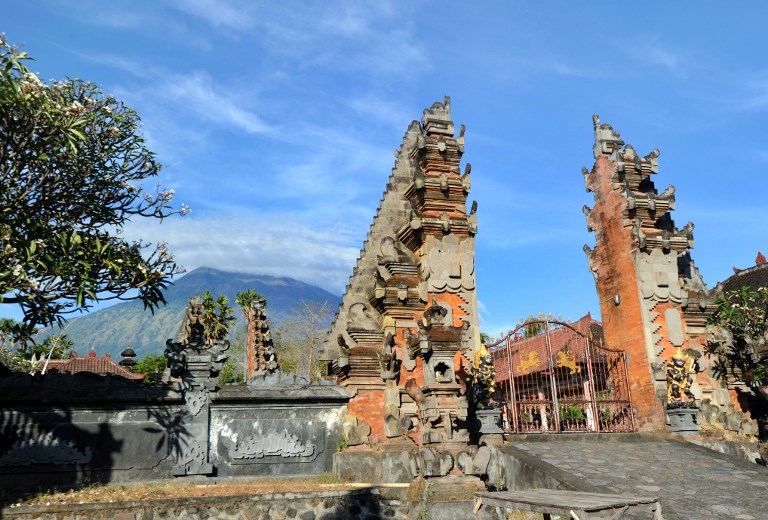

Declining seismicity at Bali’s notorious Mount Agung have authorities considering a reevaluation of the volcano’s alert status.
Indonesia’s Volcanology and Geological Disaster Mitigation Center (PVMBG) director Gede Suantika says the volcano, which is currently at the maximum alert level IV “awas” (danger), has seen a drastic drop in activity in the past month.
“In terms of seismicity, the volcanic activity of Mount Agung has decreased dramatically when compared to December 2017.
“Meaning, at the end of January, the seismicity at Mount Agung decreased dramatically and there were even no earthquakes recorded by our monitoring equipment in the past few days,” Suantika said on Monday.
“The chances are very good that Mount Agung will go back to normal. Previously, the seismic data pointed to eruptions, there were a lot of shallow earthquakes and there were blasts. But, suddenly, in late January, it declined. There were 50 earthquakes per day, but that continued to fall to 10 earthquakes per day. And now, there are none on record (today),” Suantika said.
In addition to seismicity, volcanologists are also looking at Mount Agung’s deformation as an indication of its status. The volcano’s structure is no longer swelling up and the shape is deflating, while the amount of gas being emitted is down, according to Suantika.
“We are going to conduct a reevaluation in the near future,” he said.
In a reevaluation meeting, it will be decided if Mount Agung’s alert status can be downgraded.
The alert status does not refer to the whole of Bali, but rather to a designated exclusion zone set at a radius of six kilometers from the volcano’s crater.
But although the volcano’s alert level remains at the max, evacuated villagers with homes inside the danger zone have started to trickle back in.
The number of villagers evacuated from Mount Agung was estimated to be at about 20,291, spread out across 181 evacuation points on Monday, but that number was already down to 19,968, as of Tuesday, according to an update from the Tanah Ampo Post, the headquarters of the evacuation.
Mount Agung, located in East Bali’s Karangasem, about 75 kilometers from the tourist hub of Kuta, stirred back to life in late 2017, beginning to erupt in November for the first time since 1963.
Following, the volcano has erupted several times in 2018, including most recently four small consecutive eruptions on Jan. 23–so the decline that Suantika’s talking about must be referring to after this string of minor activity.
The volcano’s “awas” status has been in place since Nov. 27, 2017 and had been on “awas” for a previous stretch from Sept. 22 to Oct. 29.
A downgrade would be welcome news for the Balinese economy, which has taken a serious hit as tourists have been canceling their trips or traveling to alternative holiday destinations for fear of getting stranded by a volcanic eruption, if ash were to blow in the Ngurah Rai Airport flight path–as it went down at the end of November.