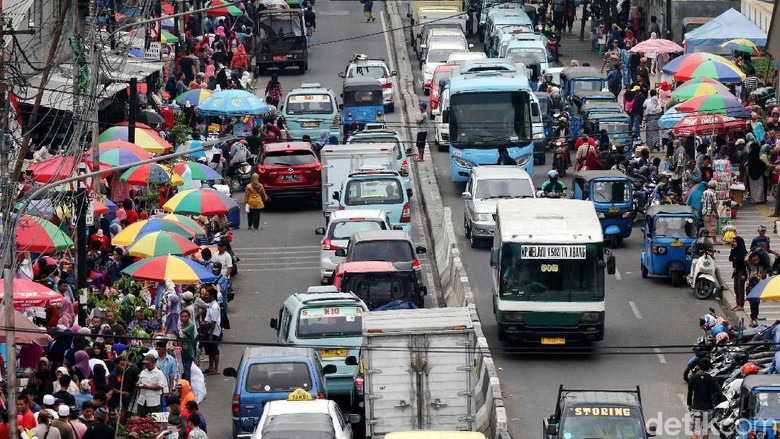

In a city known for its terrible traffic, Tanah Abang in Central Jakarta stands out as especially infamous for its macet. One of the greatest achievements of the previous Jakarta administration was reducing the congestion by keeping the sidewalks of the mercantile district free from illegal street vendors, but in recent months the sidewalks sellers have returned and brought the macet back with them.
This has created a thorny political problem for the administration of recently inaugurated Governor Anies Baswedan and Vice Governor Sandiaga Uno. In line with their other numerous attempts to overturn or reverse the policies of their predecessor, Basuki “Ahok” Tjahaja Purnama, Anies and Sandi said they want to tackle Tanah Abang’s traffic but at the same time seem reluctant to evict the illegal street vendors.
Recently, Sandiaga got into hot water over some particularly questionable statements he made regarding the main causes of traffic in Tanah Abang. He said that, based on drone images of the area, they had discerned that the illegal street vendors were not, in fact, one of the main causes of congestion in the area.
“The findings showed that the (cause) of congestion (in Tanah Abang) is number one, road construction, number two, the pedestrians spilling out of Tanah Abang Station, and third, public transportation that is illegally parked or randomly stops on the road,” Sandi said at City Hall on Monday as quoted by Kompas.
While Sandi admitted that street vendors did have some impact on Tanah Abang’s chaos, he said it was not significant because the number of street vendors was actually relatively small compared to other areas of the city.
Governor Anies backed up Sandi’s statements, saying they were based on government research.
Many were understandably puzzled and even upset by the implication that law-abiding pedestrians were being blamed for the congestion rather than the illegal street vendors (who most seems to believe are, clearly, the true cause of the traffic).
Alfred Sitorus, the head of Koalisi Pejalan Kaki (Pedestrian Coalition), a group which stands up for Jakartans’ right to walk easily and safely throughout the city, said he actually agreed with Sandi’s statement about pedestrians being a major cause of traffic. But he said that the reason so many walkers had to crowd the area’s streets is that they can’t use the sidewalks that are dominated by street vendors.
“If you say that (pedestrians cause traffic jams), well if you brought a kindergartener here and asked them who was causing the traffic, they’d say it’s because of pedestrians. However, the problem is why pedestrians go into the streets, right? It’s because the sidewalks are being used by vendors,” Alfred said yesterday.
The pedestrian rights advocate said you didn’t need a drone to figure out what was causing the congestion in Tanah Abang, the real cause was obvious to those who actually come there.
After the backlash, Sandi walked back his statements, reiterating that construction and public transport behaving badly were the main traffic-causers but also sticking to the idea that the 300,000 pedestrians emerging from Tanah Abang station was also a factor (though they somehow went from 2nd to 3rd on his cause list). But this time ,he was careful to say that he was not blaming pedestrians.
“We’re not accusing pedestrians of causing the congestion. Pedestrians should be prioritized,” he said as quoted by Tribunnews.
Of course, there’s only one way that can be done. Sandiaga was finally forced to admit that the illegal street vendors should be disciplined so that the sidewalks can function as they were meant to.
But he stopped short of saying that they would outright evict the illegal vendors, as Ahok’s administration did.
Tanah Abang is notorious for being controlled by preman (thugs) and organized criminals who make money off of the illegal street vendors, parking and other activities. While Sandiaga had previously suggested that the government had to clamp down on preman in the area, after a meeting with “community leaders” from the neighborhood (who declared there were no preman in Tanah Abang) the vice governor seemed reluctant to use the term again.
Previously, the Jakarta Ombudsman office said that preman had been directly bribing the area’s civil service police (Satpol PP) to keep the street vendors on the road.
Obviously, there are a lot of competing interests involved in Tanah Abang, and Anies and Sandiaga are not going to be able to please everybody with whatever plan they come up with, no matter how hard they try.