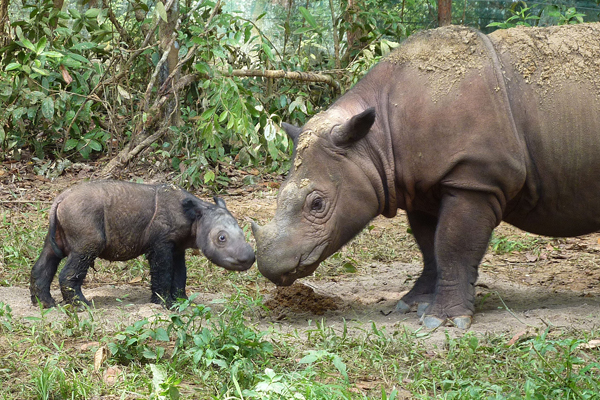

Ratu and her then four-day-old calf Andatu at the Sumatran Rhino Sanctuary in Indonesia. Photo courtesy of the International Rhino Foundation
By Philip Jacobson for Mongabay
The last Sumatran rhinoceros in the Malaysian wild has died, the latest grim milestone for a species on the brink of extinction.
No more than 100 of the creatures are thought to remain in the forests of Indonesia, with nine more in captivity across Indonesia, Malaysia and the U.S.
Scientists have found no sign of the creature in the wild in Malaysia since 2007, save for two females captured for breeding in 2011 and 2014, and they now consider it extinct in the wild there, according to a new paper in Oryx, a quarterly journal of biodiversity conservation.
Soon, the last Sumatran rhino (Dicerorhinus sumatrensis) at the Cincinnati Zoo in the U.S. will be moved to Indonesia, shifting the species’ hopes for survival squarely to the neighboring Southeast Asian nations whose cooperation in regard to the animals has not always gone smoothly.
In 2009, the two governments agreed to treat the Bornean and Sumatran subspecies as a single species and bring the few remaining individuals together for breeding. But the initiative has struggled to get off the ground, and the Bornean rhinos remain separate from their Sumatran counterparts.
“It is vital for the survival of the species that all remaining Sumatran rhinos are viewed as a metapopulation, meaning that all are managed in a single program across national and international borders in order to maximize overall birth rate,” Rasmus Gren Havmøller, the paper’s lead author and a Ph.D student from the Center for Macroecology, Evolution and Climate, said in a statement. “This includes the individuals currently held in captivity.”
Five of the captive rhinos reside in Indonesia’s Sumatran Rhino Sanctuary, while three more are at a facility in Malaysia’s Sabah State. Bukit Barisan Selatan National Park is home to about 50 of the creatures and Way Kambas National Park to between 25 and 35. Some also live in Gunung Leuser National Park.
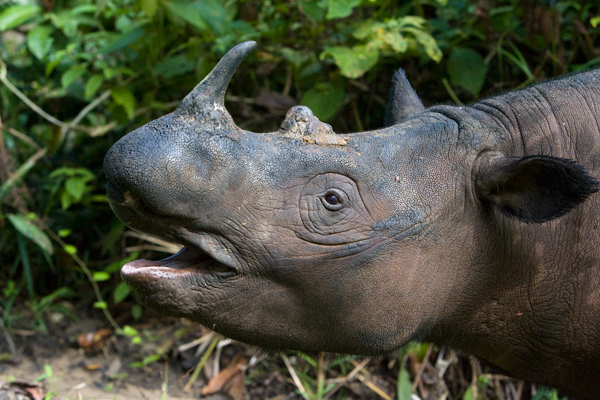
A Sumatran rhino. Photo: IRF
Despite the long odds, a rebound for the species seems not out of the question. Christy Williams, co-author and coordinator of the WWF Asian and Rhino and Elephant Action Strategy, pointed out that other countries have managed to save embattled megafauna.
“The tiger in India was saved from extinction due to the direct intervention of Mrs. Gandhi, the then prime minister, who set up Project Tiger,” she said. “A similar high level intervention by President Joko Widodo of Indonesia could help pull the Sumatran rhinos back from the brink.”