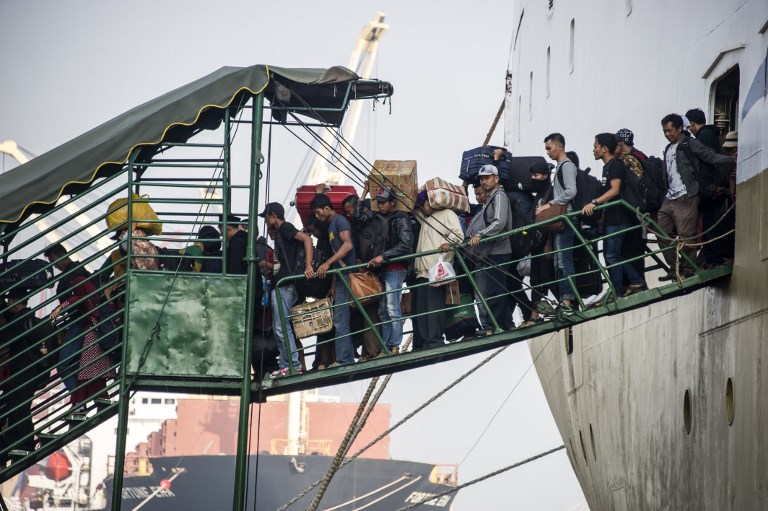

Millions of Asia’s Muslims were on the move Wednesday as they headed for home towns to celebrate with relatives the Eid al-Fitr holiday marking the end of the holy fasting month of Ramadan.
From Karachi to Kuala Lumpur, highways, airports and train stations were jam-packed in an annual exodus that made Indonesia’s usually traffic-clogged capital Jakarta look like a ghost town.
Some 70 percent of its residents — about eight million people — headed for other cities and villages across the vast archipelago, home to the world’s biggest Muslim-majority population.
READ MORE: Indonesian government extends Eid holiday in bid to reduce traffic
About 32 million Indonesians were estimated to be on the move this week, while some 50 million in Bangladesh were thought to be heading home.
“This year some 11.5 million people will leave the capital Dhaka to go back to their villages to celebrate Eid,” said Mozammel Hoque Chowdhury, general secretary of the Passengers Welfare Association.
Afghans, meanwhile, were hoping for a peaceful Eid after the Taliban announced their first ceasefire since the 2001 US invasion.
The group agreed to stop attacking Afghan security forces for the first three days of the holiday, overlapping with the government’s week-long halt to hostilities against the militants.
In the capital Kabul, traffic was worse than usual as families defied the threat of suicide attacks ahead of the holiday to stock up on dried fruits, nuts, sweets and cookies.
Pakistanis were also complaining of congestion as authorities said they expect road traffic to more than double ahead of the holiday.
The country’s railways have announced special “Eid trains” with extra carriages and discounts to tackle the rush.
In Malaysia, traffic slowed to a crawl on major roads out of Kuala Lumpur, with traffic expected to soar by some 70 percent over the usual volume.
India, which has a 180 million-strong Muslim minority population, does not see a huge annual mass migration.
But Delhi bank clerk Shakir Khan is among those who will be headed home for the holiday.
“We live in a very fast-paced world and Eid is always special as it gives you a chance to reconnect with your family and friends,” the 29-year-old told AFP.
Eid, which is expected to begin from Thursday, comes at the end of Ramadan, when Muslims abstain for a month from activities including eating, drinking, smoking and sex during daylight hours.
Safety will be a big factor in some countries.
Some 276 Bangladeshis died in road accidents during Eid last year, while the number in Indonesia was an eye-watering 740 people.
The Southeast Asian nation’s often dangerous roads were clogged with thrifty travelers who packed whole families onto one motorcycle — plus luggage — for grueling trips that can last upwards of 15 hours.