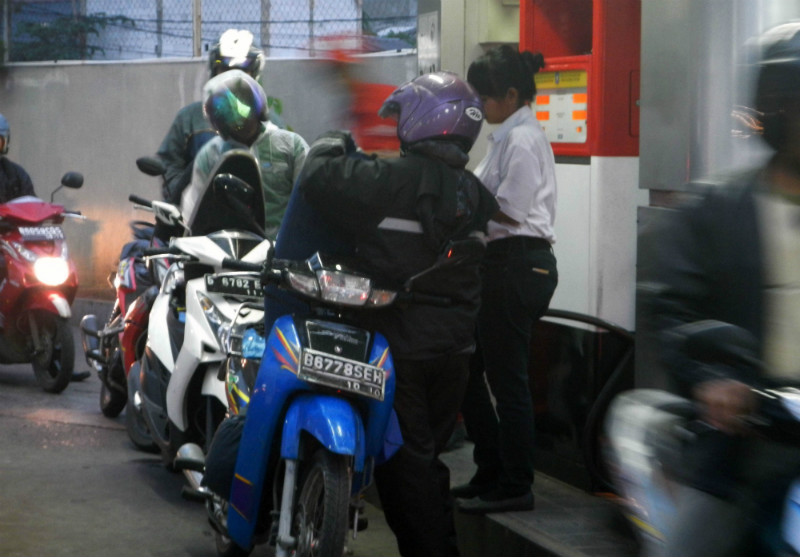

Motorists formed long lines at gas stations hoping to get the last drops of subsidized fuel before the midnight price hike deadline. Photo: AFP
President Joko Widodo finally announced the long discussed increase in the price of subsidised fuel yesterday, taking a risky and unpopular first step towards fixing the tattered finances of Southeast Asia’s top economy.
Jokowi announced the price of petrol and diesel would go up more than 30 per cent starting at midnight, a deep cut to government subsidies that will be welcomed by economists but risks denting the president’s popularity.
“From time to time, a nation faces difficult choices – nevertheless, we must take a decision,” Jokowi, said in a televised address to the nation.
Government fuel subsidies are a thorny issue in Indonesia. Economists have long been calling for the payouts, which gobble up a huge chunk of the state budget, to be reduced but large sections of the public are staunchly against any increase.
Previous cuts – including a large one last year – have sparked violent protests and before Monday’s announcement, stone-throwing youths briefly clashed with security forces in one traditional protest hotspot.
However most parts of the county were calm before the announcement, which had been expected for weeks, and TV news channels focused their attention on queues of cars and motorcyclists waiting to fill up on cheap fuel before midnight.
Analysts hailed the move by Jokowi, as it fulfilled a campaign pledge to cut the payouts in order to divert money to reforms, such as overhauling infrastructure and helping the country’s poorest.
It is seen as an urgently needed boost to an economy that is expanding at its slowest pace for five years, with growth slipping to 5.01 per cent on-year in the third quarter.
“The move is encouraging since it suggests that Jokowi is serious about economic reform in Indonesia, and is even prepared to take steps that may prove unpopular in the short-run,” said Gareth Leather, Asia economist from Capital Economics.
BUDGET WASTED ON FUEL SUBSIDIES
The price of petrol is rising 2,000 rupiah to 8,500 rupiah a litre, an increase of just over 30 per cent, while diesel will go up 2,000 rupiah to 7,500 rupiah a litre, a 35 per cent increase, Jokowi said late Monday.
“The state needs a budget for infrastructure, education, and health. The budget has not been available as it has been wasted on fuel subsidies,” he said.
Jokowi also said there would be “social protection” for the poorest, a reference to a government scheme aimed at providing cash handouts to cushion the impact of the fuel price increase.
The cut in subsidies was smaller than some had been expected after recent steep falls in global oil prices granted the government some breathing space as it’s fuel import bill shrank.
Before the announcement, several hundred protesters demonstrated in Makassar, hurling stones at security forces, and there was a small protest in Surabaya, according to AFP reporters.
However, the demonstrations were small compared to the mass protests that have accompanied past fuel price hikes. While some of the anger has come from the growing army of car and motorbike owners in Indonesia, much is among the wider public as a fuel price increase dramatically pushes up inflation in the short term.
Politicians are nervous about dismantling the decades-old fuel subsidy programme in part because, as you might remember, it was an attempt by Suharto to reduce the payouts that triggered the riots that helped end his three-decade dictatorship.
Story: Agence France-Presse