
After Telegram’s CEO Pavel Durov came to Indonesia earlier this week to personally guarantee that his messaging app would do more to work with the government to block terrorist-related content, the IT Ministry decided to repeal its block on the service in Indonesia. The government had previously threatened to block other major social media networks for failing to do enough to block so-called “negative content,” but after today’s meeting with representatives of two of the world’s biggest IT companies to discuss better ways blocks could be implemented, that seems unlikely.
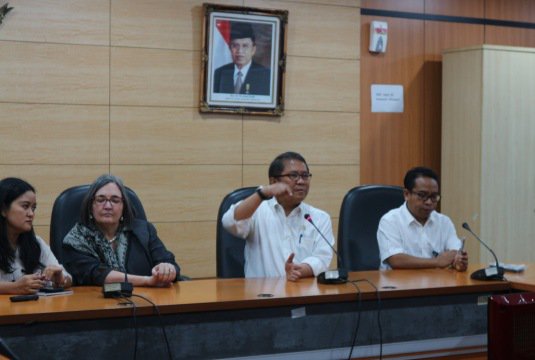
The Minister of Communications and Information Technology (Menkominfo), Rudiantara, met with Google Asia Pacific director of public policy and government affairs Ann Lavin, Google Indonesia head of public policy and government relations Shinto Nugroho, and Twitter director of public policy in Asia Pacific Kathleen Reen. The meetings with the reps from the two companies took place at separate times, but all attended a press conference with Rudiantara after.
Menkominfo menyampaikan: Google Asia Pacific telah berusaha meningkatkn level utk menangani konten2 negatif yg ada di YouTube, Google dll pic.twitter.com/sFU1h6UBxM
— Kementerian Komunikasi dan Digital (@kemkomdigi) August 4, 2017
According to Rudiantara, both parties agreed to the use of a “trusted flagger” system as a way to more quickly report and eradicate negative, radical, and terrorist content on their platforms.
“We discussed how to improve the service level in handling negative content on Google’s proprietary platforms, one of them being YouTube. In the past, the process still used e-mail reports, but since the end of July this year we have started using the trusted flagger system,” Rudiantara said as quoted by Kompas.
Youtube already has a trusted flagger system that gives members of the public who have flagged problematic content with a demonstrably high degree of accuracy more powerful tools and has their reports acted on more quickly.
Interestingly, Rudiantara discussed giving trusted civil society organizations, such as the Wahid Institute, the Anti-Defamation Society of Indonesia (Mafindo), and ICT Watch trusted flagger status so that they could monitor content. He said the government would create a joint panel with these organizations so that the system could not be abused.
In addition to working with trusted flaggers, Menkominfo said the government is working with Google and Twitter to simplify direct reports via dedicated channels, such as e-mail. He said this method could be used for content that was deemed to be in violation of Indonesian laws, but did not violate the standard rules of the community of each platform.
“For example, the definition of pornography in the US and Indonesia is different. There, it may be that only child porn is prohibited. So it could be reported through a special path, not a trusted flagger,” Menkominfo’s director of general information applications, Semuel Abrijani Pangarepan said.
“But for radicalist or terrorist content it’s different, it will be immediately taken down because it is not in accordance with global standards,” he added.










