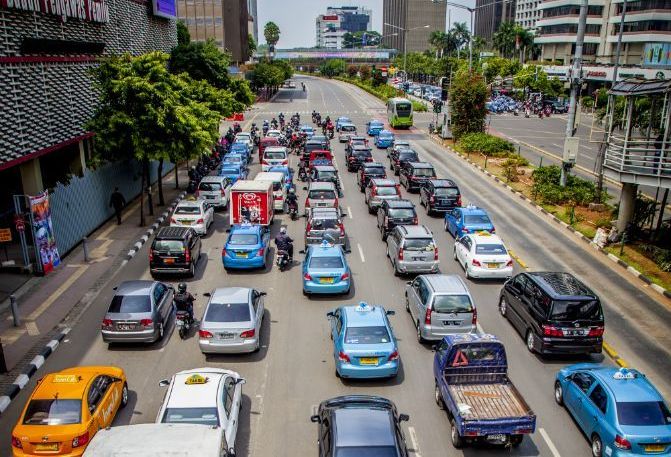

Love it or hate it, the expanded odd-even traffic zones in Jakarta will likely be here to stay beyond their intended use for the Asian Games.
Yesterday, the Jakarta Traffic Police said that, pending approval from Governor Anies Baswedan, the odd-even expansion will be enforced after the regional sporting event, which concludes on September 2.
“It will continue. But we will propose that the times [the rule is enforced] be changed,” Jakarta Traffic Police Law Enforcement Head Budiyanto told CNN Indonesia.
Today, Anies hinted at the strong possibility of making the odd-even expansion permanent, but that some aspects of it will have to be changed depending on feedback from the public and experts.
“What that modification will be, we’ll announce it later,” Anies said today, as quoted by CNN Indonesia.
The odd-even rule — which only allows vehicles with odd-numbered plates to use certain major roads during rush hours on odd calendar dates and vice-versa — was expanded to include more major roads in the capital in a bid to reduce congestion during the Asian Games.
This map below, from the Jakarta Transportation Agency, details exactly which roads are now covered by the odd-even rule. The light blue lines represent the roads where the odd-even rule was previously enforced, while the red lines represent the new additions and the blue dotted lines represent suggested alternate routes (be warned: they have reportedly been more jammed than usual).
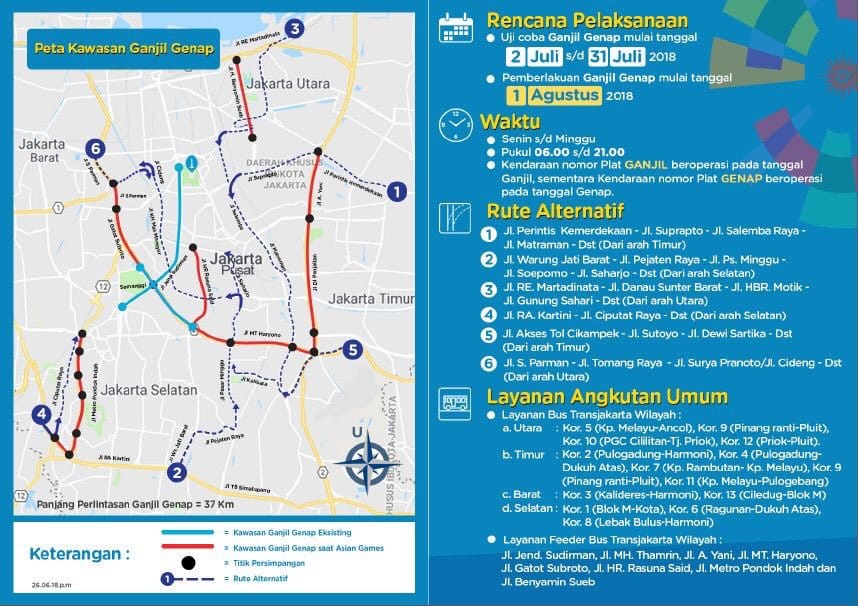
The biggest expansion stretches all the way from Jalan S. Parman in West Jakarta, through Gatot Subroto, M.T. Haryono, D.I. Panjaitan, Jenderal Ahmad Yani up to Cempaka Putih in Central Jakarta, measuring close to 22km.
The other three points of expansion are: South Jakarta’s Jalan Arteri Pondok Indah — Kebayoran Baru, Jalan H.R. Rasuna Said, and Central Jakarta’s Jalan Benyamin Sueb, Kemayoran.
In addition, under the expansion, the odd-even rule is now enforced for 15 hours every day, including weekends, from 6am to 9pm. This is much longer than the 7am-10am and 4pm-8pm rush hour windows prior to the expansion.
The government claims that the expansion increased traffic speed in the zones by 12% and improved air quality in the city due to an increase in citizens using public transportation.