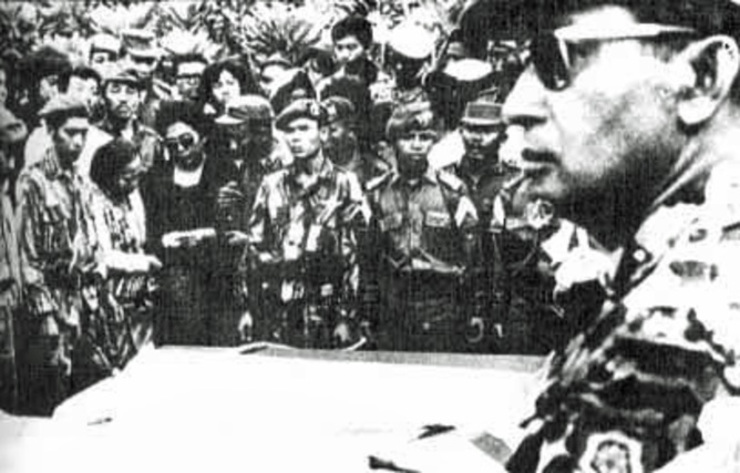

Earlier this week, the government seemed to make a major reversal on their policy position regarding the mass killings that took place in Indonesia from 1965-1966. During a national symposium on the subject from April 18-19, the government reiterated their stance that they would not apologize for the atrocities that historians generally estimate to have taken the lives of 500,000-1 million people under the pretext of a communist purge.
But on Monday, Coordinating Minister for Political, Legal and Security Affairs Luhut Pandjaitan said the government actually was ready to apologize if mass graves containing the victims of the killing could be identified. He said President Joko Widodo asked him to conduct an official search for mass graves and that any groups with relevant information should share it with the government.
Some organization, such as the Foundation for the Research into Victims of the 1965-66 Killings (YPKP), which has been doing research into the mass grave and has located several, have declared their readiness to share their findings with the government.
But the Commission for Missing Persons and Victims of Violence (Kontras), which has also conducted its own searches for the bodies of 1965 victims, has formally rejected the government’s request for their data on the mass graves. At least for now.
“The government has asked for the data, but we’re not able to give it. There must be legal safeguards. Then it should be explained to the public that it is being done on the legal basis of a presidential decree,” Kontras deputy coordinator Puri Kencana Putri told BBC Indonesia.
Puri said having a clear legal basis for acquiring the data and conducting the search was crucial to making sure the information was not buried or misused.
“If the mass graves are excavated without a legal basis, [the process] could potentially be undermined by those who do not like the truth-seeking efforts,” Puri said, adding that Kontras already had data on 16 mass grave locations throughout Indonesia.
With the government apparently undergoing a major change of heart regarding the mass killings, it may seem strange that Kontras is being obstinate (they also boycotted the 1965 symposium). But the organization has reason to question the government and particularly Minister Luhut’s motives. At the symposium Luhut strongly reiterated that the government would not apologize for the mass killings and remarked that the number of victims was far lower than the 500,000-1 million estimated by historians.
But perhaps an even greater concern for Kontras is the potential fallout of their research into mass graves being made public. The subject is still highly taboo and many people related to those killed in the purge still face discrimination. Without the firm legal protection of the government, the data on mass graves could potentially create civil conflict or cause evidence about the massacres to be buried once again.