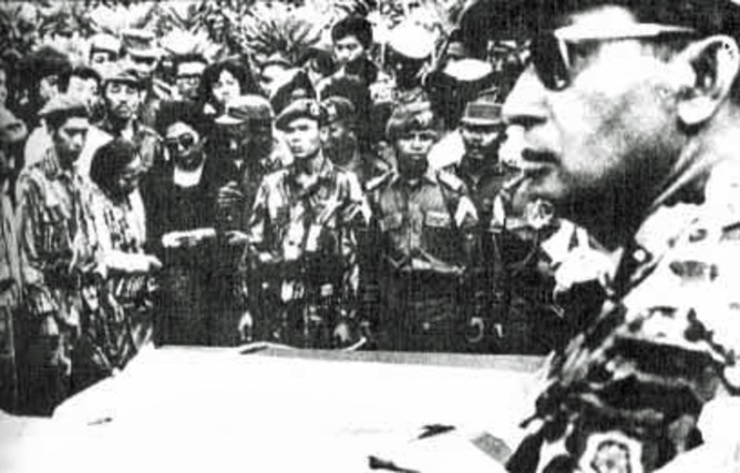

Suharto at the funeral of the six army generals on October 2, 1965. Photo: Department of Information of Indonesia/Wikimedia Commons
Every Indonesian knows the September 30 Movement. Textbooks here still teach that on that night in 1965, a group of army generals under the sway of the Indonesian Communist Party (PKI) attempted a coup against President Sukarno, until Major General Suharto swooped in to save the day. A three-and-a-half-hour movie based on the subsequent Suharto regime’s official version of what happened remains the most-watched film in the country’s history – mainly because schoolchildren were long required to watch it at the end of every September.
Last week was the event’s 50th anniversary, and while the government still holds to their official line, it has become more accepted that Suharto’s version leaves a lot to be desired. The problem is, no one can say for sure what really happened.
A variety of theories exist – some say it was internal army affair that barely involved the PKI, while others posit Suharto planned the whole thing, with CIA support – but none of them stands up to close scrutiny. The event remains one of the great mysteries of modern history.
But one thing we know is that in the aftermath of September 30th, hundreds of thousands, maybe a million, of people were brutally slaughtered, and their killers have never faced justice.
So will we ever know the whole story behind what happened on September 30th? To get some insight, we talked to Bernd Schaefer, a senior scholar at the Woodrow Wilson International Center’s Cold War International History Project and a professor at George Washington University. He was one of the editors of “1965: Indonesia and the World“, a collection of essays that put the events of 1965 in an international context, examining different countries’ relationships with Indonesia at the time.
In Schaefer’s estimation, the truth about September 30th is probably out there, buried in classified documents held by parties including the Indonesian government and the Chinese government.
Schaefer spoke to us about what kind of information is being kept from the public and how the contents of those documents might one day come to light.
Declassification is a theme in nearly every essay included in “1965: Indonesia and the World”. One of those essays contains a line: ‘There are certain gaps that can only be filled by Indonesian documents that have yet to be declassified.’ What sort of documents are out there that might come to light?
It’s very hard to talk about something where you actually don’t know what’s in there. You hope for some revelations, and maybe in the end it turns out there’s nothing, or the records have been distorted or destroyed. And it’s very hard to tell after so many years, even if they were opened now, to what extent they are really reliable.
Though it’s exactly the objective of those who held them back to convey this very impression.
In the ideal case, documents like this could fill in a lot of gaps in the entire relationship between Sukarno, the army and the PKI up to September 30. This would be particularly the files of the president and the presidential office. They could shed light on Sukarno’s role, or non-role; on the involvement of the army; and on the involvement of certain actors.
Like Suharto – what did he know about the entire thing? Was he actually planning that, did he want to become the top army guy, maybe by sacrificing the others? Why was he spared? And Sukarno – what did he know? Was he behind it? Did he want to get rid of certain people in the army, was he aware of what the PKI would be doing?
So the roles of Sukarno, the president, on one hand, and then Suharto, who became strongman – those are I think the questions which Indonesians are very interested to know about, and I think you could definitely, through the files, get some insights on that.
Otherwise, Foreign Ministry files would give you all the communications between the Indonesian embassies and the Foreign Ministry here and the president. That would give you lots of information about the international context. Which is, on the other hand, more or less well established.
You would get a lot more details, though, about CONEFO or the nuclear issue, which is a pretty recent path of inquiry; the Chinese Foreign Ministry had once declassified, though now reclassified, some material about Indonesian advances toward Chinese leaders to get the nuclear bomb between early August and late September of 1965.
“The Chinese Foreign Ministry had once declassified, though now reclassified, some material about Indonesian advances toward Chinese leaders to get the nuclear bomb between early August and late September of 1965.”
What about the role of China?
I think parts of the Chinese role could be gathered from the Indonesian Foreign Ministry files. These are the reports from the Indonesian embassy in Beijing back to Jakarta.
Obviously, the most light on the issue can be shed from Chinese records. Until two years ago, the Chinese Foreign Ministry had opened up selected files for the period between 1949 and 1965. In the case of Indonesia, they contained a lot of material on Sino-Indonesian relations, but nothing substantial on the actual background of September/October 1965 events in Indonesia.
Meanwhile, for reasons unrelated to Indonesia, the Chinese Foreign Ministry has completely closed its archives. Other, even more important Chinese records, like the communist party files, will probably never be opened. So Chinese materials contain keys to the following questions: what did the PKI leadership actually plan in 1965? And how did the Chinese leaders react to, or act upon, the information they got from Aidit and others?
By denying access to such information, China can maintain the existing narrative of ‘inconclusive evidence not allowing us to reach conclusions’ and further tilt it in this direction.
Are there indications that China might have encouraged the coup? D.N. Aidit, the PKI leader, went to China, right?
Right, in August 1965. Apparently he was discussing with the Chinese leaders all along about the strategy of the PKI. China was very interested in having the PKI come to a position of power. And the Indonesian army wanted to maintain its power and keep the PKI out.
The question back then was, how long is Sukarno going to live? In August 1965, Sukarno had a sort of health crisis and there were rumors he won’t live much longer. So the decision is imminent: one side is going to do something to push the other side out, and it’s who’s going to act first, who’s going to blink first.
Apparently the PKI was convinced the army was preparing a coup in order to eliminate the communist party. To preempt that, the PKI might have thought they had to stage their own act first. I think all those things were discussed with the Chinese leadership, with the PKI seeking their advice.
I don’t think it can ever be proved that the PKI did get direct advice from China. If they did, it was probably not just ‘stay back and be careful.’ Because what you can see from the other side – and we have plenty of documents from the Soviet and the Eastern European side –, the Soviets and the East Germans were only barely informed about that. Once in awhile, they also met with Aidit and other representatives of the PKI, but the PKI were not as open with them as they were with the Chinese communists, because they felt very close with the Chinese communists. For the Soviets and the East Germans and their friends, it was pretty clear the PKI were toeing the Chinese line.
You basically have a lot of documents on the Soviet and East German and other Eastern European sides, and one thing you could say positively is that if the PKI would not have been completely in the Chinese boat, but also been in closer contact with the other communist parties, it might have chosen a different strategy.
The PKI was still of course trying to find a path to power, and some sort of clash was inevitable. Even without any foreign interference this clash would have happened anyway. The question is who starts first, how is it conducted, and how is it going to turn out. And it might have turned out differently, if the PKI wouldn’t have completely followed the Chinese influence.
“Apparently the PKI was convinced the army was preparing a coup in order to eliminate the communist party. To preempt that, the PKI might have thought they had to stage their own act first. I think all those things were discussed with the Chinese leadership, with the PKI seeking their advice.”
So there may be some classified documents out there that could shed light on all this. How might they come to light? Here in Indonesia, would the government have to choose to release them? Or could citizens use freedom of information laws to force them out? Or would there have to be a leak?
Ideally, the government could set up a commission to investigate, mainly composed of Indonesian historians. It must not be a commission with a pre-ordained conclusion. And if Indonesians themselves were to do it, it would be a different story than if foreigners were to lobby. Foreigners will always be held at bay; people will say, ‘Why are you interfering in our affairs?’ If you have a commission, maybe appoint a few foreigners as advisers but have Indonesians run it and be responsible.
My wishful thinking is that a commission would first shed light on what happened in September/early October 1965, and then of course what happened afterward with regard to the awful mayhem of those organized massacres.
It seems like there’s a lot of competing interests in the government you’d have to reconcile for a commission to be able to work. For example, in 2012 the National Human Rights Commission (Komnas HAM) completed a landmark report about what actually happened with the massacres, and they made some recommendations about what should be done, but when the onus shifted to the Attorney General’s Office the whole thing just stopped.
But a historical commission would not necessarily present evidence which would then go to the attorney general in order to make decisions about prosecutions. It would basically be an attempt to establish the historical truth and sort of provide a basis for legal reconciliation by making available historical knowledge about what actually happened. This might be the smallest step, but at least it would be a step. It might be not as controversial as the Komnas HAM report, which was done with the idea that maybe it would lead to some prosecutions.
A historian’s report also should be not classified. The Komnas HAM report is considered a legal document, so it’s classified. The only thing they were able to publish is a 130-page summary, and the whole convolute was around 800 pages.
Some Indonesians have tried to get government documents through the Freedom of Information Commission, but it’s still pretty new.
An independent historical commission with authorized archival access established by the government has different leverage and would be a much better path than Freedom of Information inquiries. It has worked in many other post-conflict societies. In Germany it’s happening all the time, with all kinds of companies and government agencies looking at their brutal history up to 1945.