
By Htet Khaung Linn
Muslims around Yangon celebrated a low-key Eid festival on Friday amid simmering religious tensions in predominantly Buddhist Myanmar, just weeks before a general election.
Earlier in the week, Ma Ba Tha, an association of nationalist Buddhist monks, had sent letters to local authorities in Myanmar pressuring them to ban Muslims from carrying out the ritual slaughter of cows during the Eid ah-Adha festival.
The letters were sent to the government of Mandalay Region and also to the local authorities in the town of Meiktila in central Myanmar where dozens of Muslims were killed in a rampage by Buddhist mobs in March 2013.
In Yangon, the country’s commercial centre, and in other cities, the ritual slaughter went ahead under strict government controls, Muslim leaders said.
“Despite restrictions such as where and how the slaughter was conducted and how to transport the meat to avoid unnecessary problems, we were able to celebrate our religious festival peacefully,” Wunna Shwe, the head of Yangon’s Eid ah-Adha festival organising committee, told Myanmar Now.
The suburbs of Thanlyin, Dala and North Dagon were designated as slaughter zones in Yangon, said Al Haji Aye Lwin, the chief convenor of Islamic Center in the country’s most populated city.
“We are aware that there are people who disagree with our religion so we try to do it discreetly in order not to disturb them or give rise to criticism,” he said.
“We are able to share the meat with neighbours who we have known for a long time, but it’s now more difficult to donate it to places such as orphanages, which we used to do in previous years. Because it is such a sensitive time, we are worried that something would happen after we donated it,” he added.
Sectarian tensions are running high in Myanmar as it prepares for a landmark general election on Nov. 8. A rise in anti-Islamic rhetoric propagated by radical Buddhist movements has raised fears that religious nationalism will become a political rallying cry in campaigning.
On September 17, Myanmar Now published a special report that exposed how a campaign supported by Ma Ba Tha has forced dozens of Muslim-owned slaughterhouses and beef-processing facilities across the Ayeyarwady Region to shut down, with thousands of cows seized from their Muslim owners.
CELEBRATIONS RESTRAINED
Under the hot morning sun, some 3,000 Muslims gathered at a slaughterhouse in Ywar Thar Gyi , 8 miles from downtown Yangon, bringing cattle and goats with them. Noisy chatter competed with the braying of the animals and instructions from the organising committee over loud-speakers. There were also about 50 security officials present.
The chatter died down, however, when this correspondent approached, asking for an interview.
Almost everyone referred the questions to the organising committee, who were busy instructing those present not to walk around in blood-spattered clothing, to pack the meat carefully and to take care not to trouble anyone outside the premises.
One of the few who was willing to speak requested that his name was not used.
“I wanted to donate five cattle but I was only allowed three in the end,” said the Muslim businessman. “Before, we could donate as much as we wanted and we also did not have to come all this way to Ywar Thar Gyi.”
U Uttama, a senior Ma Ba Tha monk in Yangon’s Latha and Lanmataw townships, said the letters requesting the banning of ritual slaughter were sent mainly to authorities in areas where communal violence has occurred to prevent further conflict. In other places, they were sent for the benefit of animals, he said.
“It’s not about interfering with those from a different religion but there should be a limit (on how many animals can be slaughtered),” he told Myanmar Now. “Such slaughter is not a good thing whether the government looks at it from our religion’s perspective or a social perspective,” he added.
This article was originally published by Myanmar Now on 25/09/2015.
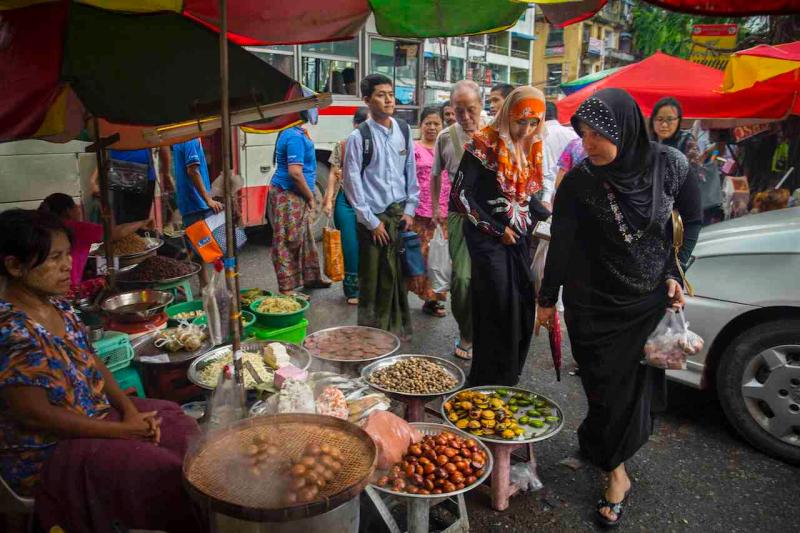
Muslim women in a market in downtown Yangon (PHOTO:- Hkun Lat/Myanmar Now)