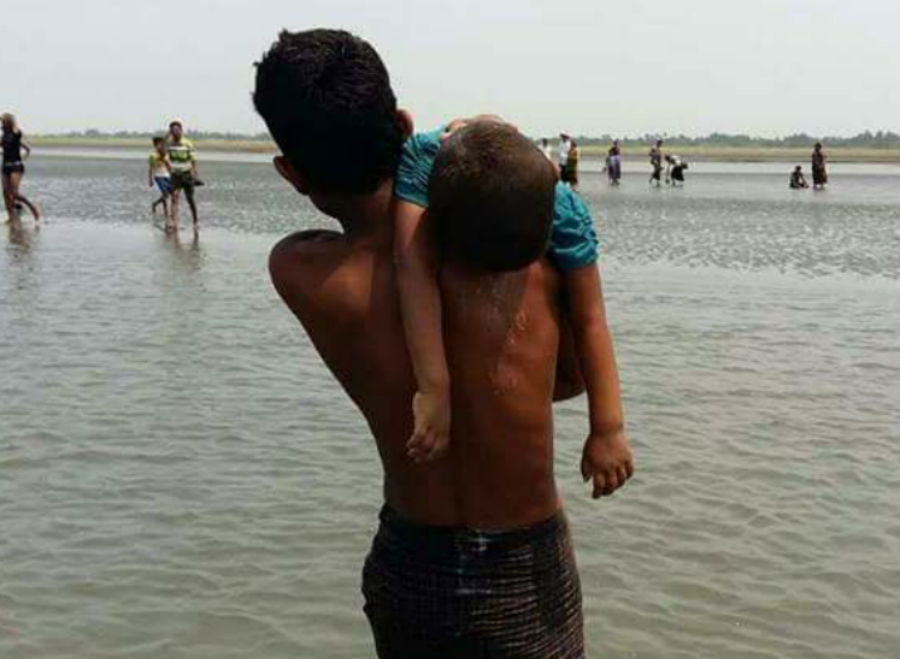

A witness to the deadly ferry sinking that killed at least 21 people including nine children in Rakhine state yesterday has recalled dragging bodies from the shore after the boat capsized in rough seas.
The boat was carrying dozens of Rohingya Muslims on an ‘authorized daytrip’ from an internal displacement camp in Pauktaw Township to a market in Sittwe, the state capital, when it was caught by strong waves near Thae Chaung, according to the United Nations.
Many remain unaccounted for.
“At that time, there was also a fishing boat beside their boat, and people were shouting to get help,” witness Khin Maung Shwe told Coconuts Yangon, “but no one could go and help because the waves were too strong at that moment.
“We couldn’t go and rescue them, even though we could see them. They were a few hundred yards away. We could only go and carry their bodies, when the waves washed their bodies onto the shore.”
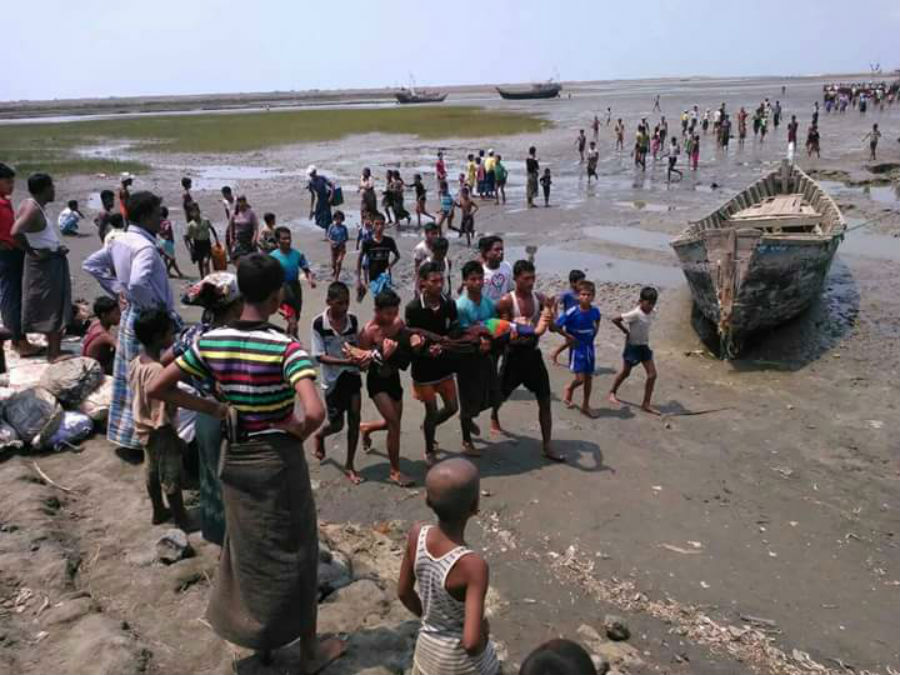
There were no ambulances or cars, so bystanders used tricycles to pedal survivors to the nearest medical facilities at the IDP camps at Thet Kae Pyin village. Five people died on the way, said Khin Maung Shwe.
“Actually, they died for no reason,” he said, “We had to carry patients from the shore to Thae Chaung village and then to the health care department at Thet Kae Pyin village. It took two or three hours to reach the health care department from the shore. We had to use tricycles and the weather was really hot at that moment.”
At least six survivors were recovering in the clinics yesterday.
In a statement, Janet Jackson, UN Resident and Humanitarian Coordinator in Myanmar, said: “The toll now estimated to be 21 dead, including 9 children, is expected to rise as there are still a number of people unaccounted for. At least 6 injured people received treatment at Sittwe General Hospital and Thet Kae Pyin health clinic. UN and NGO staff on the ground have provided support in the transport of injured people and have been providing extra medical capacity to the Thet Kae Pyin health clinic.
“This accident serves as a tragic reminder of the vulnerability that many communities and families face in this area of Rakhine where their only option is to use this mode of travel in order to access markets, livelihoods, and other basic services that are essential for a dignified life.”
More than 100,000 Rohingya Muslims have been confined to camps and villages in Rakhine state since 2012, when violence erupted between the group and their Buddhist neighbors.
They face severe restrictions on movement.
Thae Chaung market in Sittwe, to which the boat from Pauktaw, an isolated rural area, was traveling is one of the only places where Rohingya can still trade freely.