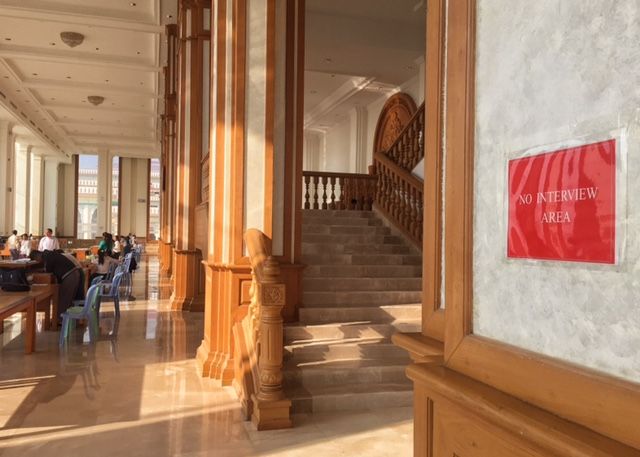

On February 5, Myanmar’s Union Parliament Office released a laundry list of new regulations for news people who want to report on the legislative happenings in Naypyitaw. The most visible were on display earlier this week in the form of special interview and non-interview areas. But the list is far more comprehensive.
There are 17 rules.
The list was published four days after the Lower House convened. During that session, the media mayhem was admittedly chaotic, but no more so than anywhere else in the world at a big news event.
As a public service (or a service to journalists), here is an edited – for clarity – translation of all the rules, which reportedly were introduced at the behest of National League for Democracy chairperson Aung San Suu Kyi. That means they may not change for a while, ya know, because the NLD just got into parliament after obliterating the competition in November.
The rules need a little explanation, so we put that in brackets next to each one.
- No more than 5 members per group [‘group’ meaning media organization].
- If you need more than 5 people, notification is required ahead of time [with the Union Parliament Office].
- Permitted media groups [those who have registered to cover parliament] have to enter from Gate No. 1. Members of the media need to have their permission checked and to see whether someone has unnecessary equipment [basically, go through security].
- Members of the media have to come inside the parliament via buses to respective buildings [this is after you take your cab or car to the gate]. The buses will pick up 15 minutes before the session starts and wait 20 minutes after the session ends [so don’t miss the bus].
- Taking photos or videos in restricted buildings without permission is prohibited. You must have separate security pass for the parliament council “l” building [there are so many buildings inside the compound, each labeled by a letter].
- Members of the media have to wear proper dress and security must not allow someone inside if he or she is not dressed properly [it does not explain what proper dress means, but safe to not dress like a backpacker].
- You must exchange the media ID for a parliament press pass at the gate before going in and exchange it again when leaving [this happens at the second security check just after going in, when you make the exchange and put your bags through a scanner then you are into the compound where the buses presumably pick you up].
- Only permitted media with separate application can be inside parliament when parliament is not in session [not sure how this works].
- Interview areas are assigned for interviewing union level officials or members of parliament. Only interview there [signs and cordoned-off spaces in parliament designate these spots].
- In the registration area for MPs, members of the media can take photos and video only from permitted areas [see above].
- All members of the media have to register at the media corner [this is not a corner but rather a hallway on the upper level of parliament, reached by going up a few flights of stairs].
- An agenda will be put on notice boards in the media corner about restricted offices and areas.
- Journalists can cover and rest in the media corner as it is already set up to get images and audio there [well, via a television monitor].
- Representatives from the Ministry of Information, the Myanmar Press Council and the Foreign Correspondents Club of Myanmar have already been assigned and the names should have been sent to the parliament office [why this is a rule escapes us].
- Smoking and chewing betel nut are only allowed in smoking areas [alright!].
- Journalists are not allowed to get inside the chamber of parliament or other restricted areas [by chamber they mean where the debating and the lawmaking is going on].
- When writing news about discussions in parliament, do so with media ethics in order not to damage the image of parliament and the country [they saved the best for last].