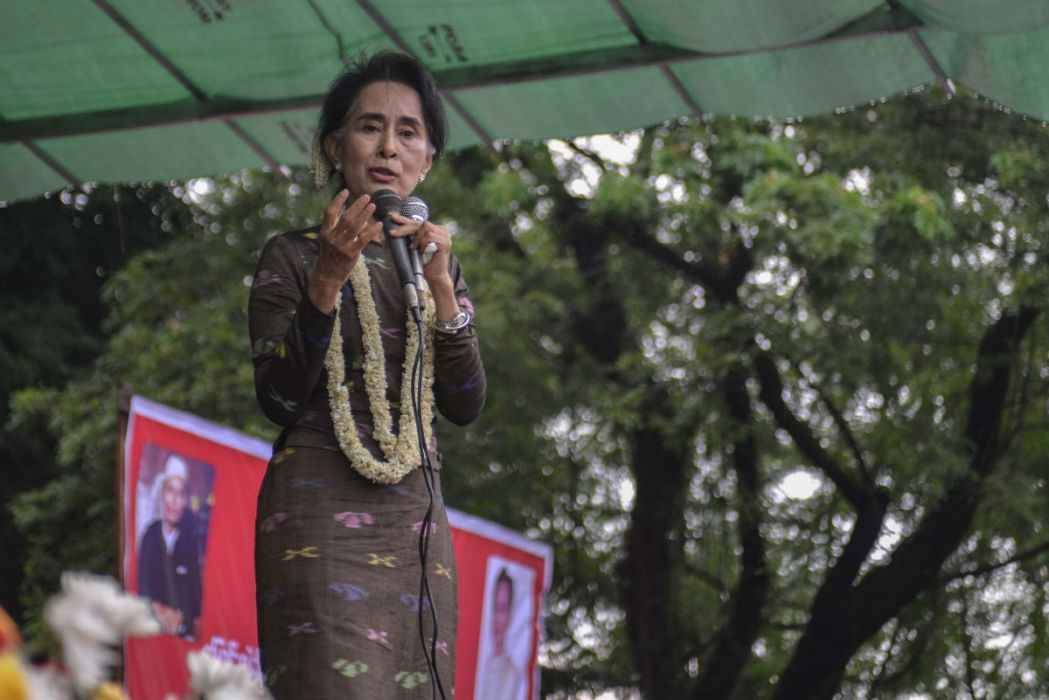

As intrigue builds over Aung San Suu Kyi’s bid or non-bid for the presidency, it’s a good time to look at the constitution that is legally standing in her way. Most coverage of this hurdle focuses on Article 59(f) of the 2008 military-drafted document. That article is normally described as barring someone with a foreign spouse or children from the presidency. But it is far more stringent (more on that later). And besides, there are six other part in Article 59 other than Article 59(f). Namely, a, b, c, d, e and g.
Let’s take a look at all of them, shall we? With each one, we will determine whether Suu Kyi qualifies. Isn’t this fun?
Okay, so the part we are talking about is Chapter III of the Constitution of the Republic of the Union of Myanmar. This chapter is called “Head of State,” which lays out rules for “The President and the Vice-Presidents.”
Before we even get into the list, we run into the first wrinkle. Parliament votes for three presidential candidates, one floated by each house of parliament, and one offered up by the military, whose unelected MPs control 25 percent of the total seats. The two losers of that vote become the two vice-presidents. It is often said that Suu Kyi can’t be president. But since the rules we are about to explain apply to the next post down, she can’t be vice-president either.
Now that that is all cleared up, let’s get on with the qualifications.
Article 59(a) says you have to be “loyal to the Union and its citizens.”
Safe to say Suu Kyi qualifies for this one.
Article 59(b) says you have to be a citizen of Myanmar “who was born of both parents who were born in the territory under the jurisdiction of the Union.” This one also says your parents have to be “Myanmar nationals.”
Check! As far as anyone knows Suu Kyi’s parents were born here and were citizens.
Article 59(c) says you have to be at least 45 years old and be “an elected person.”
Done and done. Elected to what it does not say, but Suu Kyi is definitely “an elected person.” In November she defended her seat in the Lower House. Age is also not a problem, as she is 70 years old.
Article 59(d) says you have to be “well-acquainted with the affairs of the Union,” specifically “political, administrative, economic and military.”
Hmmm. Political, administrative and economic, sure. She has been a lawmaker since the 2012 by-election, meaning she knows how the system works. But military? Her father, Aung San, is Myanmar’s most famous general, but he was killed in 1947, when Suu Kyi was two years old.
Not that long after the 1988 uprising, the military put her under house arrest, where she would stay, on and off, for a combined 15 years, getting out in 2010. If an organization puts you away for that long, you are probably going to be “well-acquainted” with them, even if you have never served in the organization. With that and the family connection, the argument can be made. Let’s check this off the list.
Article 59(e) says you have to have lived “continuously” in Myanmar for at least 20 years up to the time of your election to the presidency. There’s something lost in translation here. Does “continuously” mean that you literally have to have been in Myanmar for 20 years non-stop until the very day you take the job? Or does it mean that you have to have logged 20 years of residency sometime before you take the job?
We think it is the latter. Suu Kyi has been in the country since the late 1980s, when she returned from England to take care of her ailing mother and got involved in the 88 uprising. In 2012, after 24 years, she traveled abroad for the first time. That means she makes the cut-off by four years. There is also a “proviso” that keeps the clock ticking abroad as long as the stay in the foreign country comes with the “permission” of the Union. That makes sense, otherwise you’d disqualify a lot of ambassadors and tons of other people who traveled or lived elsewhere.
Article 59(f) has finally arrived. This is a tough one. To check this box you must “not owe allegiance to a foreign power, not be subject of a foreign power or citizen of a foreign power.” This rule applies not only to the candidate, but to the candidate’s spouse, the candidate’s spouse’s children, the spouses of those children, and the candidate’s parents. “They shall not be persons entitled to enjoy the rights and privileges of a subject of a foreign government or citizen of a foreign country.”
Like we said, way more stringent. This is Suu Kyi’s big hurdle. Her late husband was British, their two sons are British. But speculation is mounting that some legal voodoo may be employed to temporarily suspend the article and remove the problem root and branch. Changing the constitution completely would require help from the military’s 25 percent, as it takes more than 75 percent of parliament to amend the constitution. In other words, it’s quite the pickle.
Article 59(g) says you have to possess the “prescribed qualifications” of the president as well as qualifications that make you eligible for a seat in parliament.
Suu Kyi has the parliament part covered, but if she does not meet 59(f), she does not meet the prescribed qualifications for president.
Conclusion: It’s hard to become president of Myanmar.