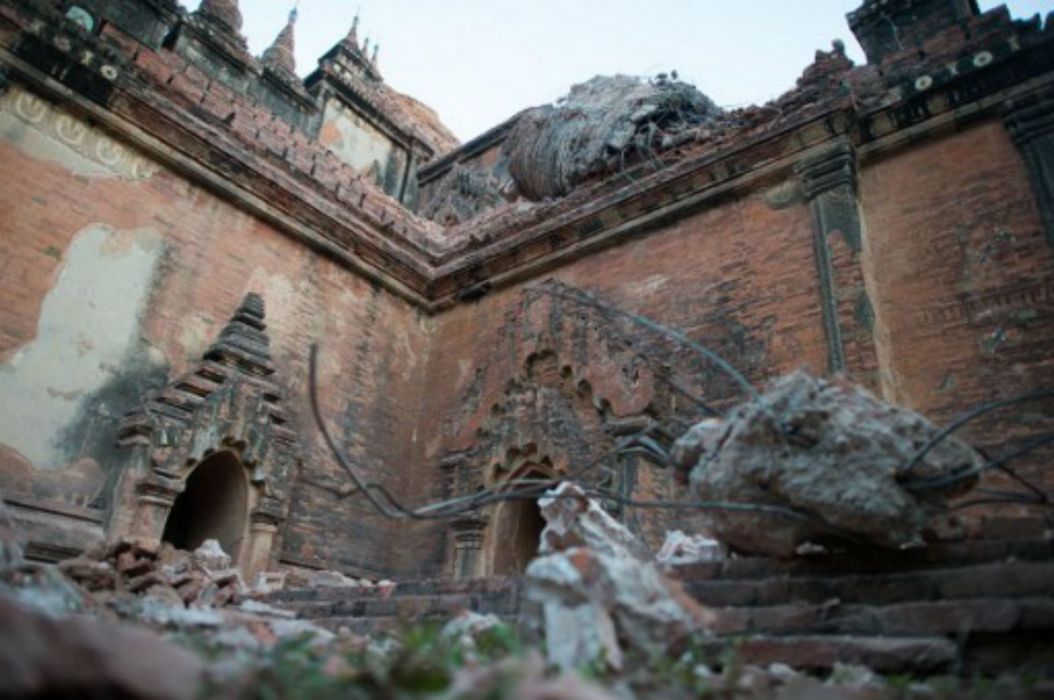

The powerful 6.8 magnitude earthquake that struck central Myanmar on Wednesday has killed at least three people and damaged nearly 200 pagodas in the famous ancient capital of Bagan, officials said.
Two girls, aged 7 and 15, were killed in Magway region where the quake struck, according to Myanmar’s Ministry of Information.
State-backed newspaper the Global New Light of Myanmar reported two deaths in Pakkoku after a factory collapsed, but but other reports said the factory only caused one death and one injury.
The quake, which the US Geological Survey said hit at a depth of 84 kilometres (52 miles), was also felt across neighbouring Thailand, India and Bangladesh, sending panicked residents rushing onto the streets.
Heavy damage was reported in Bagan, Myanmar’s most famous archaeological site and a major tourist destination 30 kilometres north of the quake’s epicentre.
Some 171 of the city’s more than 2,500 Buddhist monuments were damaged by the tremors, according to a statement posted by the Ministry of Religious and Cultural Affairs on Facebook.
“Some were seriously damaged,” Aung Kyaw, the local director of Bagan’s culture department, told AFP.
Photos showed clouds of dust billowing around some of the site’s larger temples, with bricks crumbling down their tiered facades.
A police officer from Bagan said a Spanish holidaymaker was slightly hurt when the quake knocked her from the temple where she was watching the sunset.
Scaling Bagan’s ancient structures to watch the sun set over the vast plain of pagodas is a daily ritual among tourists and local pilgrims.
The temples, built between the 10th and 14th centuries, are revered in the Buddhist-majority country and a top draw for its growing tourism industry.
Myanmar, which has opened its doors to a rising tide of visitors since emerging from junta rule in 2011, is eager to see the ancient capital designated a UNESCO world heritage site.
Soe Win, a local politician from Chauk, the riverside town closest to the epicentre, said the tremors were the worst he had experienced in years.
“More than eight pagodas in town collapsed,” the 50-year-old told AFP, referring to Chauk. “Two buildings collapsed as well, while some others were cracked. People in town are still scared.”
Damage was also reported in the capital Naypyidaw some 200 kilometres away, with MP Thiri Yadanar posting photos on Facebook of cracked glass windows inside a parliament building.
The earthquake caused high-rise buildings in Myanmar’s largest city Yangon to sway, as well as those in the Thai capital Bangkok and the Indian city of Kolkata.
“Services of the underground railway have been suspended fearing aftershocks of the quake,” Kolkata Metro Railway spokesman Indrani Banerjee told AFP.
The quake was also felt throughout south and southwestern Bangladesh close to the border with Myanmar, with residents running outside.
At least 20 people were injured as workers tried to flee a building in the Savar industrial district outside Dhaka, ATN Bangla television reported.
“All of us ran to the streets leaving the houses and shops unsecured as the quake seemed very dangerous,” Nazmus Sakib, from the southern city of Chittagong near the Myanmar border, wrote on his Facebook wall.
Earthquakes are relatively common in Myanmar, although the country has not suffered a major one since 2012.
That powerful tremor, also of 6.8 magnitude, struck the centre of the country, killing 26 people and injuring hundreds.
Main text / AFP