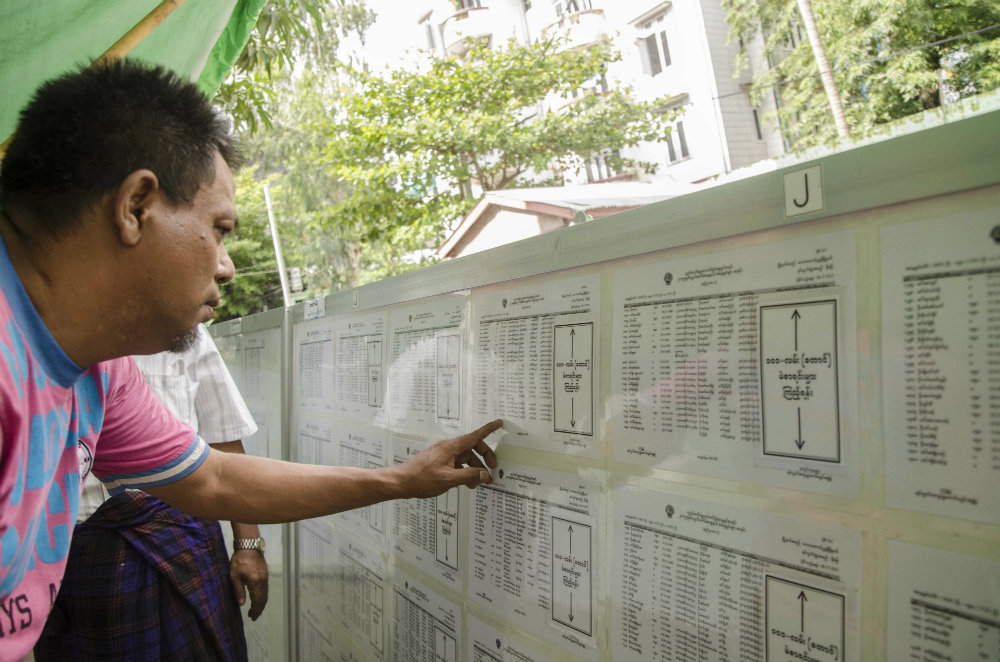

The big vote has been scheduled for Sunday, November 8, 2015, and will be the first nationwide polls in 25 years to be openly contested by all political parties after decades of military rule.
President Thein Sein’s ruling Union Solidarity and Development Party (USDP), which is linked to the army, will compete with Aung San Suu Kyi’s widely popular National League for Democracy for the majority vote.
Dozens of parties from ethnic minority states will compete for a share of the votes in their areas, while a large number of smaller parties will also run for seats in the Bamar-majority regions.
KEY FACTS
Myanmar has a population of around 51.5 million people, according to the 2014 census. Those over the age of 18 who are eligible to vote account for about 33 million.
The former military government ratified the constitution in 2008; it held general elections in 2010 that were considered rigged in favor of the USDP. The 2012 by-elections were openly contested and the NLD won 43 of the 44 seats it contested.
Electoral sub-commission offices must issue voter eligibility cards no later than one week before the polls and voters much present their national registration card to receive the card.
Voters will be able to cast their ballot on November 8 from 6am to 4pm.
There are a total of 6,065 candidates in the upcoming elections, almost double the figure of 3,069 candidates in the 2010 elections.
The electorate will vote in 325 representatives to the Lower House (five constituencies under control of ethnic armed groups will not hold elections due to security concerns), 168 representatives to the Upper House, and 673 representatives to state and regional parliaments for a five-year term. A remaining quarter of seats in both houses of parliament, and on state and regional level, are reserved for unelected military officers, in accordance with the constitution.
The election results will be determined through the first-past-the-post system, in which the candidate receiving the majority of the votes takes the seat to represent the whole constituency.
Post-elections, in a bicameral parliamentary session, newly elected lawmakers vote for a president. They can vote from three candidates; one nominated by the Lower House, one by the Upper House and one by the military. The losing candidates become vice-presidents.
A party needs to secure more than 50 percent of parliament seats in both houses, or more than two-thirds of the contested constituencies, to gain a sufficient majority to be able to vote in a new president. Myanmar’s president then forms the new government and appoints the states and regions’ powerful chief ministers.
The current legislature’s term expires on January 30, 2016 when it hands over powers to new lawmakers. In early February, the parliament convenes to vote for a new president. On March 29, the current government’s term expires and a new government takes over.
COMPETING POLITICAL PARTIES*:
A total of 93 political parties will compete in the elections, the ones fielding the biggest number of candidates are:
National League for Democracy [Aung San Suu Kyi’s party] – 1,130 candidates
Union Solidarity and Development Party [ruling party] – 1,130 candidates
National Unity Party – 757 candidates
National Development Party – 353 candidates
Myanmar Farmers Development Party – 286 candidates
National Democratic Force – 274 candidates
Shan Nationalities Democratic Party – 206 candidates
Shan National League for Democracy Party – 158 candidates
Karen People’s Party – 117 candidates
Arakan National Party – 77 candidates
Independent candidates – 309
Sources: Union Election Commission, International Crisis Group
* The figures are the latest at the time of writing on October 21
This story was first published by Myanmar Now on October 23, 2015
Photo / Aung Naing Soe / Coconuts Yangon