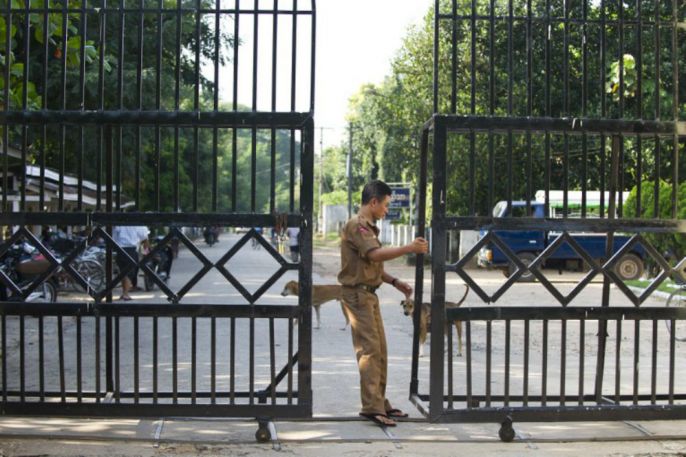

In Myanmar language, the name ‘Htin Kyaw’ means ‘the famous one’. There are a few of them in this country, including the man who is about to become president. But as he is sworn into office next week, another, less famous, Htin Kyaw will be stuck in a cell in the country’s notorious Insein Prison.
His crime? Distributing anti-government pamphlets in 2014, for which he was given a 13-year and 10-month sentence. Htin Kyaw was charged in every single township he walked through, adding years onto the sentence. Last month, his wife was also imprisoned, along with their 11-month-old baby boy, after speaking to journalists about his plight. “I am worried,” said his lawyer, Kyi Thar Phone Myint. “The boy is not very healthy. He has been weak since he was born.”
But information about the trio is hard to come by because, not only is Htin Kyaw’s entire family in prison, but so are most of his friends and members of his organization, the Movement for Democratic Current Force (MDCF), which has been deprived of its loudest voice. Htin Kyaw’s a peaceful man, his lawyer said, but when it comes to campaigning: “He’s like a lion – he jumps up and roars.”
When President Thein Sein came into office after the transition to semi-civilian government in 2011, he promised that all the country’s junta-era political prisoners would be released. And, at first, hundreds were. But the cycle of politically motivated arrests in Myanmar has not stopped, or even slowed down, a new report published by Amnesty International shows. Actually, it has sped up. Even as many have been freed, dozens have been jailed.
At least 90 prisoners of conscience remain behind bars in Myanmar. Hundreds more are awaiting trial or sentencing. Some were imprisoned for simply participating in peaceful protest. Some, like Htin Kyaw were leaders of organizations that campaigned for democracy. Aung San Suu Kyi’s NLD – a vast number of whose members are former political prisoners – will soon lead the government and has promised to free them.
“The best case scenario would be the government comes into power and issues a blanket amnesty straight away,” said Laura Haigh, the lead author on Amnesty International’s new report. “Basically the priority is to get these people who are behind bars out of prison because they’ve been deprived of their liberty for too long.”
According to this vision, the party would use their parliamentary majority to repeal or amend some of the legislation that has allowed for the imprisonment of activists. This ranges from archaic penal code sections to the Peaceful Assembly Act, enacted in 2012, which requires organizers provide intricate details of planned marches to the authorities and has been used to punish students and journalists.
In the meantime, the NLD could issue a moratorium preventing police and prosecutors from arresting people under these laws, Haigh said.
Key institutions remain under military control
While an amnesty is still possible in the last days of the outgoing Thein Sein government, and probable in the early days of the NLD administration, the revolving door of political prisoners could prove slow to shut.
The new administration faces the prospect of grappling with a military that has surrendered some, but not all, of its power.
Crucially, the police remain under the control of the military-led Home Affairs ministry, one of three to be overseen by a general. “Aspects of Myanmar’s institutions will remain under the ultimate control of the military so we do think the NLD are going to face huge challenges,” said Haigh.
Issues likely to bring them into conflict range from massive army-linked land grabs to ongoing civil conflict.
“Civil war produces arbitrary detention, rape, internally displaced people and other violations,” said Bo Gyi, who was jailed himself during the junta years and who now heads the Assistance Association for Political Prisoners. “I believe the government will try to handle the issue of political prisoners but they don’t have much power to handle them.”
‘The executive wields undue influence over the judiciary’
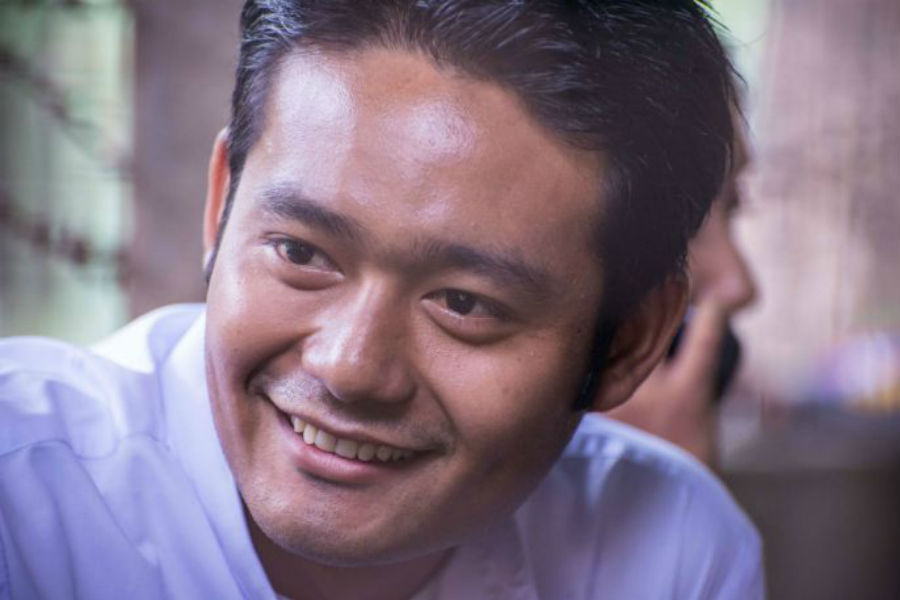
Maung Saungkha, 24, is on trial at Shwepyithar court in Yangon. Photo: Aung Naing Soe / Coconuts Yangon
As in many aspiring democracies, the judiciary in Myanmar is more independent in theory than in practice. Lawyers told Amnesty International that politically-motivated sentences were often simply handed down “from above”.
“The judiciary in Myanmar currently struggles to adjudicate such politically sensitive cases with impartiality and competence,” said Vani Sathisan, international legal advisor to the International Commission of Jurists, in an email. “The executive wields undue influence over the judiciary. Corruption is prevalent and interferes with fair administration of justice, including access to effective remedies for human rights abuses.”
The NLD has promised to implement legal reform and will soon have the chance to appoint an Attorney General, with the incumbent set to retire.
“One of the most critical factors will be who Aung San Suu Kyi chooses to be Attorney General,” said Mark Farmaner, head of Burma Campaign UK, in an email. “A proactive Attorney General can intervene to stop any prosecutions going ahead.”
But the ties between police, prosecutors and judges will likely be slow to unpick. “The police… are connected to the court and working together,” as lawyer Kyi Thar Phone Myint put it. “Personally, most of them are very close to each other.”
Last week, another one of his clients, the poet Maung Saunghka, was assaulted outside the courtroom after guards allegedly let a fellow inmate out of his cell. The other prisoner is accused of using his handcuffs to choke Maung Saunghka, who was arrested last year over a verse in which he claimed to have ‘the president’s portrait’ tattooed on his penis.
Minutes before the attack, which left him with minor injuries, he had recited a new verse about his hopes for the NLD government. As of Friday afternoon, he was getting a checkup at Yangon General Hospital.