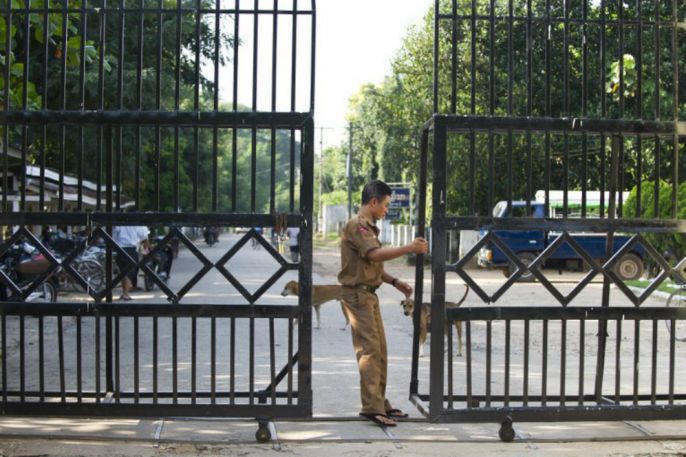

Tens of thousands of prisoners in Myanmar are enduring often inhumane conditions as a result of a justice system in dire need of reform, according to a new report.
The study by the nonprofit Assistance Association for Political Prisoners (AAPP) published this week identifies overcrowding, unsanitary conditions and malnutrition as a major problem in jails across the country, and advocates extensive reforms to the sector including the establishment of a Ministry of Justice.
Despite improvements since the former semi-civilian government took power in 2011, “conditions in prison and labor camps continue to be harsh due to inadequate access to medical care and basic need including food, shelter and hygiene”, the report reads.
Findings include jails operating at more than double capacity, sewage flowing into drinking water and inmates “living on the brink of starvation” due to inadequate food rations.
Myanmar has an estimated prison population of 60,000, 16 per cent of who are women and about 2 per cent juveniles. Some of these are confined to hard labor camps, where more than 1,000 inmates died between 2004 and 2014, according to the government’s own figures.
“We had to start hard labor by carrying heavy logs for firewood while fettered,” the report quotes an unmated former inmate as saying. “We had to carry these heavy logs from the bottom of the ravines to the hilltops, including Sundays, without holidays.
“When carrying logs, the man in back must keep pace with the front man, otherwise the security guards would beat him up. When someone fell to the ground from exhaustion after a long workday, a security guard would come and kick him in the chest. We had such ill-treatment and persecution in this labor camp.
“We had our meals rationed, the notorious so-called ‘Briyani’ (Danbauk) meal. It was a mixture of small stones, un-husked paddy and even some mice faeces. The work was so hard but we were poorly fed. Within two to three weeks, the prisoners became pale and lost weight due to malnutrition. Some fell ill and others got bruises and abscesses due to our fetters. Some got boils. I myself got a boil three or four times. A monk from Myitkyina died of the harsh prison environment on the last full moon day of Waso.”
Other former prisoners interviewed described horrifying solitary confinement practices – including use of the notorious ‘dog cell’. “Once in the dog cell, [prisoners] are forced to crawl on all fours, beg for food, and are not allowed to talk,” one recalled. “The cells are 8 feet by 8 feet with no mats, no windows, and one pot for use as a toilet. The cells are also effectively soundproof.”
In Sittwe prison, meanwhile, it was reported that water wells and sewage holes were located so close together that, during the heavy rain, sewage flows into the drinking supply, leading to cholera outbreaks and deaths.
The organization recommends extensive reforms including adapting laws governing pre-trial detention, division of different types of prisoners and access to healthcare as well as the creation of an independent Ministry of Justice. While the executive is technically independent from the judiciary under the constitution, in practice the government wields a great deal of influence, according to human rights experts.
“Separation of the departments responsible for police and prison administration is important for limiting the potential for abuse of power and corruption,” the report reads. “This in turn helps to limit arbitrary incarcerations, lifting the strain on the prison sector, changing prison objective from retribution to rehabilitation, and promoting respect for the rule of law.”
The report’s authors acknowledged the difficulties of carrying out such reforms. Despite the transfer of power to former opposition leader Aung San Suu Kyi after the victory of her National League for Democracy at the polls last November, the military retains control over significant levels of power. It still heads the Ministry of Home Affairs, under whose jurisdiction the prison system falls.
“In particular, transferring control of the prison sector from the Ministry of Home Affairs to a Ministry of Justice will be difficult,” the report reads. “Without the full support of the government and military it is likely that prison reform practices will be met with red tape and bureaucratic stoppages leading to an inefficient reform project.”