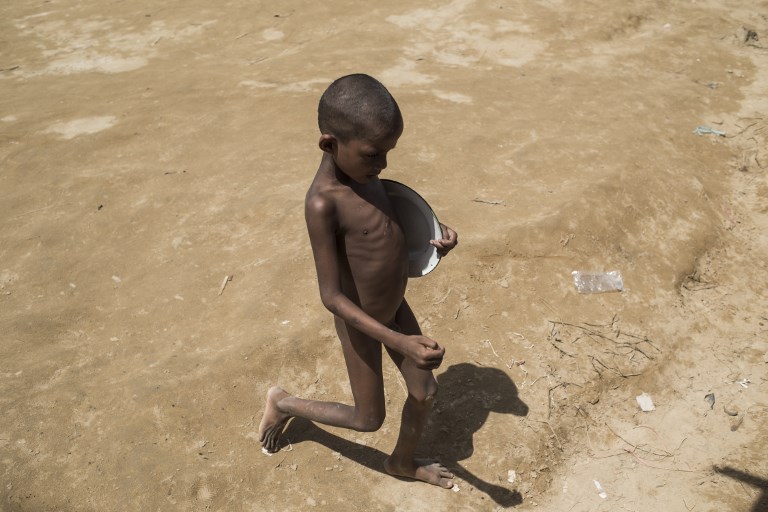
The Myanmar military and government have created widespread starvation that is forcing Rohingya Muslims out of the country. Restrictions on aid and movement, in addition to the threat of physical violence, are pushing a new wave of tens of thousands of Rohingya refugees to seek a more bearable existence in squalid refugee camps across the border in Bangladesh.
“They (security forces) have restricted our movements. Many are starving, as we could not even go to a shop or market to buy food,” a 30-year-old Rohingya man named Sayed Hossain told AFP after the boat that brought him from Myanmar to Bangladesh sank last night. His mother, his pregnant wife, and his two children are still missing.
“Today’s drowning and tragic loss of life is yet more evidence of the desperate situation still prevailing in Rakhine State,” said James Gomez, Amnesty International’s director of Southeast Asia and the Pacific. “While the Myanmar military has engaged in a campaign of violence, there is mounting evidence that Rohingya women, men, and children are now also fleeing the very real threat of starvation.”
The food shortage within Rohingya communities in Rakhine State is not new. Restrictions on movement have been imposed on them for years, preventing Rohingya from reaching farms, jobs, and markets. A World Food Programme report published in July said more than a quarter of the population of Maungdaw, which was overwhelmingly Rohingya at the time, was suffering from hunger.
The same report said 80,500 children from the area would need treatment for acute malnutrition over the next year.
However, according to a statement released by the Burmese Rohingya Organisation UK (BROUK) over the weekend, since renewed conflict erupted in Rakhine State in August, the food crisis has worsened to the point where it is now impossible for Rohingya to stay in Myanmar. Furthermore, the dangers of food insecurity have exacerbated by military operations, the burning of villages, and the blocking of humanitarian aid.
In interviews with Rohingya who are still in Rakhine State, BROUK learned that Rakhine Buddhist mobs accompanied by soldiers have torched markets in Maungdaw and Buthidaung, where many shops were Rohingya-run, as recently as last week. Rohingya who have remained have also been subjected to extortion, cattle theft, and forced labor by security forces as well as by Buddhist neighbors.
“Rohingya are now being starved out of Burma, and unless real pressure is put on the government and military to lift aid and movement restrictions, most of the Rohingya left in Burma will be forced out within weeks,” said Tun Khin, the president of BROUK. “Starvation is the new tool to commit genocide of Rohingya.”
Humanitarian aid organizations have been unable to fill the gap left by the conflict as the Myanmar military and government maintain strict restrictions on access to the conflict area. Aung San Suu Kyi’s government has also accused the World Food Programme of aiding “terrorists.”
A group of 20 diplomats who visited northern Rakhine State on a government-guided tour on October 2 described the humanitarian situation there as “dire” and urged the government to resume “life-saving services without discrimination.”
The government has not complied.
Amnesty International’s James Gomez said today: “The Myanmar authorities are actively blocking aid groups from reaching affected areas in northern Rakhine State, where people are on the brink of survival. These restrictions show a callous disregard for human life and must end immediately.”