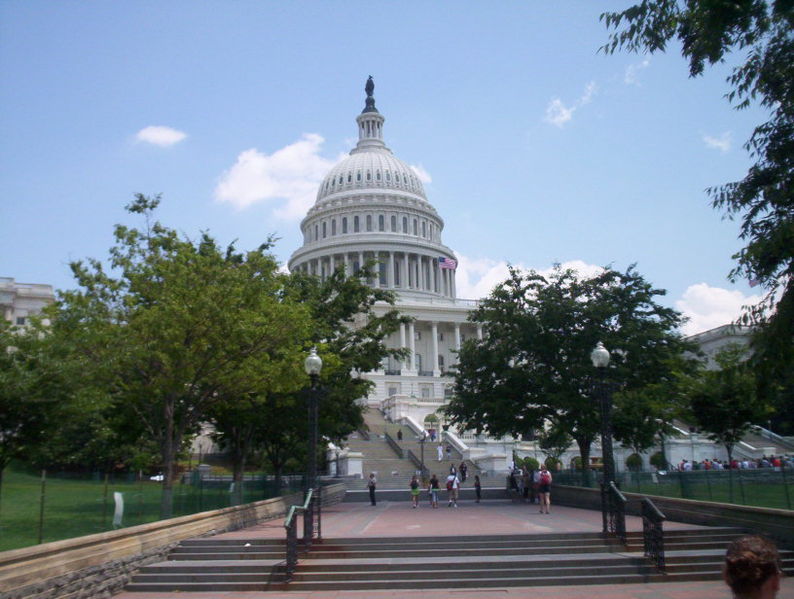

The United States Capitol building. WIKICOMMONS/THEAGENCY
Myanmar’s leaders have agreed to pay lobbyists in the United States $840,000 a year to promote their interests in Washington D.C.
And according to the contract, they’ll be promoting those interests in style.
The Podesta Group, a lobbying firm with ties to US presidential aspirant Hillary Clinton, began working March 31 on a contract basis, the duration for which lasts 12 months. Under the “scope of the work,” Podesta will “provide government relations and public relations services to strengthen the ties between Republic of the Union of Myanmar and United States institutions,” among other “services.”
In return, the firm gets $210,000 every three months plus expenses. That means “business-class travel” and “deluxe” accommodations, according to a disclosure.
The Podesta Group, co-founded by John Podesta who is now campaign chairman for Clinton’s 2016 presidential run, is one the most powerful lobbying organizations in the US.
On its website, it is described as “always original, never ordinary, we know how to chart a winning course for our clients. Whether across the country or around the globe, we change outcomes.”
Governments looking to polish their less than stellar images by hiring lobbyists in the US is nothing new. Indeed, Myanmar is no stranger to the game, having worked with organizations in the early 2000s, 1990s and 1950s – but this is the first time the government has been party to such a deal since the military junta severed relations with DCI Associates in 2003, according to The Hill.
Podesta declined to comment to The Hill on the deal. The Myanmar embassy in Washington did not immediately respond to a request for comment.
The timing of the arrangement is interesting, to say the least. It comes at a crucial juncture for relations between the two countries, which were frosty until Myanmar’s transition to a nominally civilian government in 2011. Myanmar is also holding elections later this year, a poll that will be watched closely by observers critical of the reform process.
The Obama administration rewarded the country by lifting most of the sanctions imposed on it, but Congress has taken a more skeptical stance towards the reform process, according to Mark Farmaner, director of Burma Campaign UK.
Late last year, US lawmakers proposed legislation that would block military cooperation with Myanmar until the country improved its human rights record and made progress in ending ethnic conflicts.
“With a possible nationwide ceasefire and elections happening this year, the Myanmar government clearly wants to use these events to try to persuade Congress that the reform process in Burma genuinely is a transition to democracy,” Farmaner said in an email. “The Myanmar government is saying it needs international aid to modernize its departments, but at the same time has almost a million dollars to spend on spin doctors in the USA.”
Though The Hill said the amount in the contract was “a relatively minor sum” in comparison with similar deals, Phil Robertson, deputy Asia director for Human Rights Watch, said Myanmar could be spending its money more wisely.
“The sad part is that instead of using government budgets to improve the lives of ordinary Burmese people and their families struggling to make ends meet, the government prioritizes hiring expensive foreign spin doctors in faraway lands to make them look good. This is a great example of everything that is going wrong with this so-called ‘reform’ government in Myanmar. “
As for the travel “expenses,” he was more blunt.
“Hey, what do you expect? Fat cat Washington lobbyists expect to travel in style and have an unobstructed view of Shwedagon pagoda from the air conditioned comfort of 5 star hotel rooms when they ‘advise’ the government.”