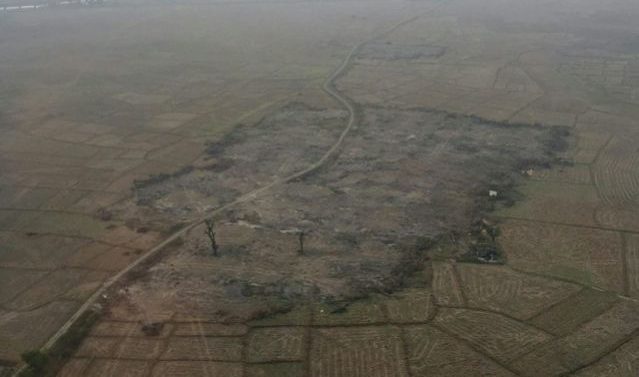

Myanmar is building security installations on top of razed Rohingya villages, Amnesty International said Monday, casting doubt on the country’s plans to repatriate hundreds of thousands of refugees.
Nearly 700,000 Rohingya Muslims have fled northern Rakhine State to Bangladesh since Myanmar launched a brutal crackdown on insurgents six months ago that the US and UN have called ethnic cleansing.
Myanmar rejects that accusation, saying it was responding to attacks by the Arakan Rohingya Salvation Army in late August.
But critics accuse the military of using the insurgent attacks to launch disproportionate, scorched-earth “clearance operations” as a pretext to push out the loathed minority.
The new Amnesty report, “Remaking Rakhine State,” uses satellite imagery and interviews to point to a rapid increase in military infrastructure and other construction since the start of the year that researchers say amounts to a “land grab.”
“The new evidence and the rebuilding that Amnesty has documented in our latest research shows that the Myanmar authorities are building over the top of the very places the Rohingya need to return to,” Tirana Hassan, Amnesty’s crisis response director, told AFP ahead of the report’s release on Monday.
“In some instances, there has been the destruction of existing homes.”
Though admitting the images only paint a partial picture, the rights group says structures for security forces, helipads and even roads have been built in and around torched Rohingya properties.
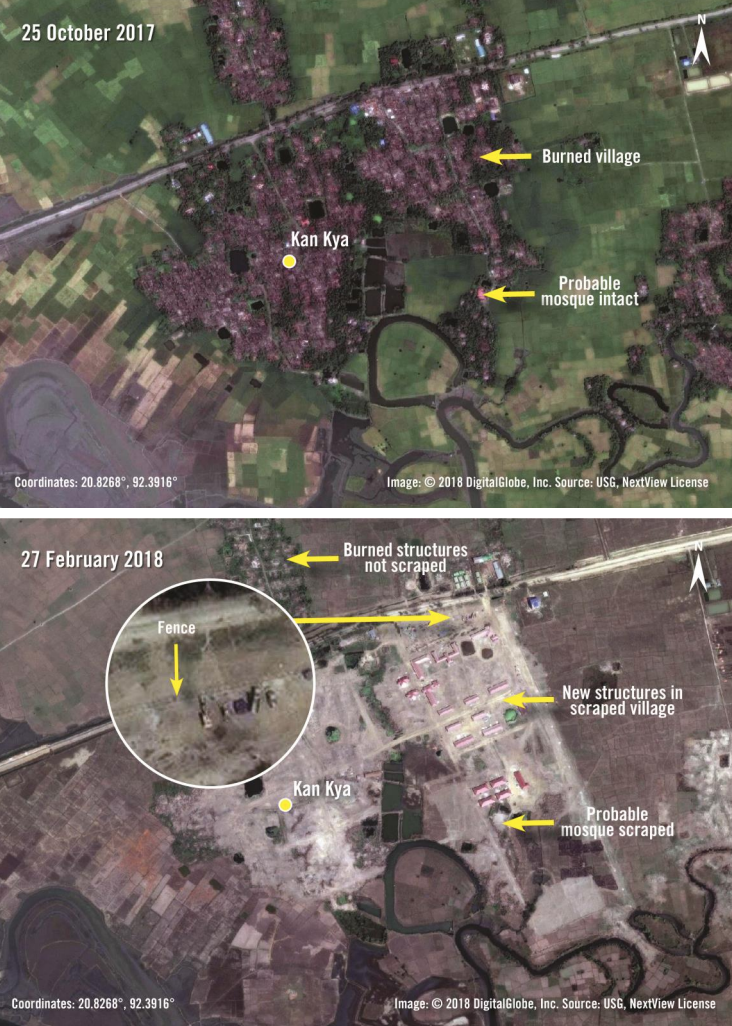
Satellite imagery of one village called Kan Kya on the outskirts of Rakhine’s Maungdaw town taken two months after the August attacks shows a settlement scarred by fire.
But by early March buildings could be seen on the revamped land. Amnesty believes they are part of a new base for security forces.
Similar building activity was also detected in Inn Din village, where Myanmar has admitted that its security forces took part in the killings of 10 Rohingya residents in September.
Rakhine State has been largely sealed off from rights groups, the media and UN investigators.
Myanmar and Bangladesh were supposed to start repatriating Rohingya refugees in late January but many are reluctant to return to a place without guarantees of basic rights and safety.
The report also highlights concerns that abandoned Rohingya land will be set aside for ethnic Rakhine Buddhists and other non-Muslim groups in the area, and that alterations to the landscape will erase evidence of alleged atrocities by the military.
Myanmar officials could not immediately be reached for comment.
Myanmar has denied claims it is covering up evidence, saying it is improving the standard of living in one of the poorest states in the country.