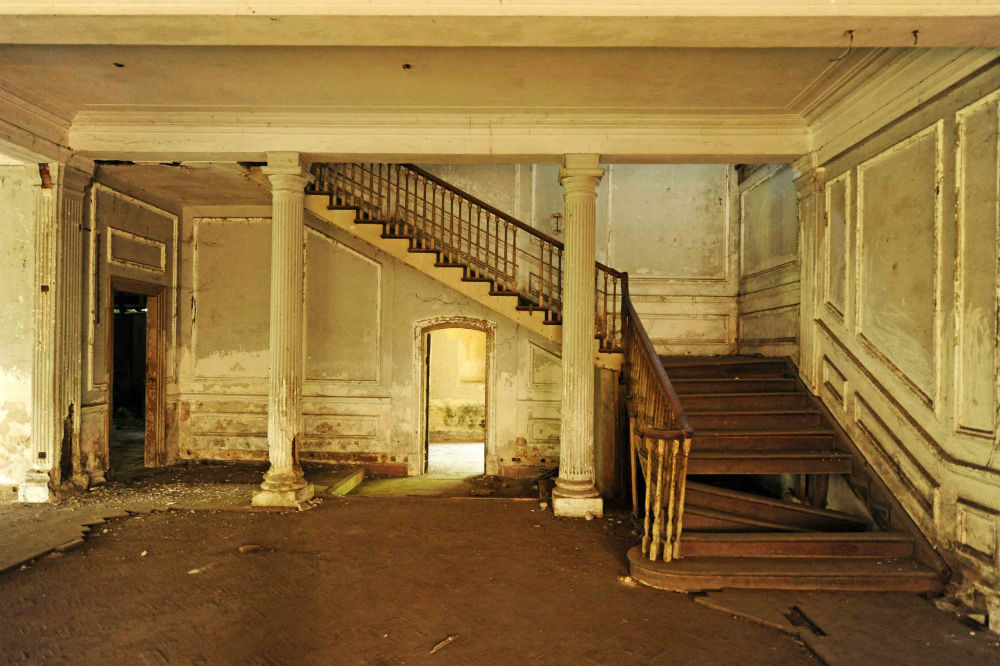

Walking through Yangon, with its moldering British mansions, decades-old shop houses and historic religious sites, is a glimpse into a majestic past. Once one of the world’s busiest trading ports, the city has the densest concentration of colonial-era buildings of any in Southeast Asia.
Amid rapid development, hundreds have been destroyed and more are at risk. In 2012, American journalist and photographer Phil Heijmans set out to catalogue those still standing. It wasn’t an easy task. Many of the most interesting sites are decrepit or strictly off-limits to the general public.
His upcoming photo-book, Relics of Rangoon, is a definitive study of more than 200 of the most striking buildings, from a racecourse that was the starting point for a bloody student rebellion to a storied pagoda hiding rare Buddha relics.
Here, in photos, audio and text, he walks us through 10 of the more overlooked gems, telling their stories along with his own tales of grappling with dilapidated staircases and a sometimes intransigent bureaucracy.
Should you want to see some of the buildings in person, Heijmans also offers advice on visiting in the audio sections, which you can find after the relevant text entry for each site. The audio clips are a few minutes long, so take your time and feel free to dip into one or two now and return later.
To kick things off, you can start by listening to Heijmans explaining the project and how it came about. After that, we’ll get into the history. Enjoy.
1) Botataung Pagoda
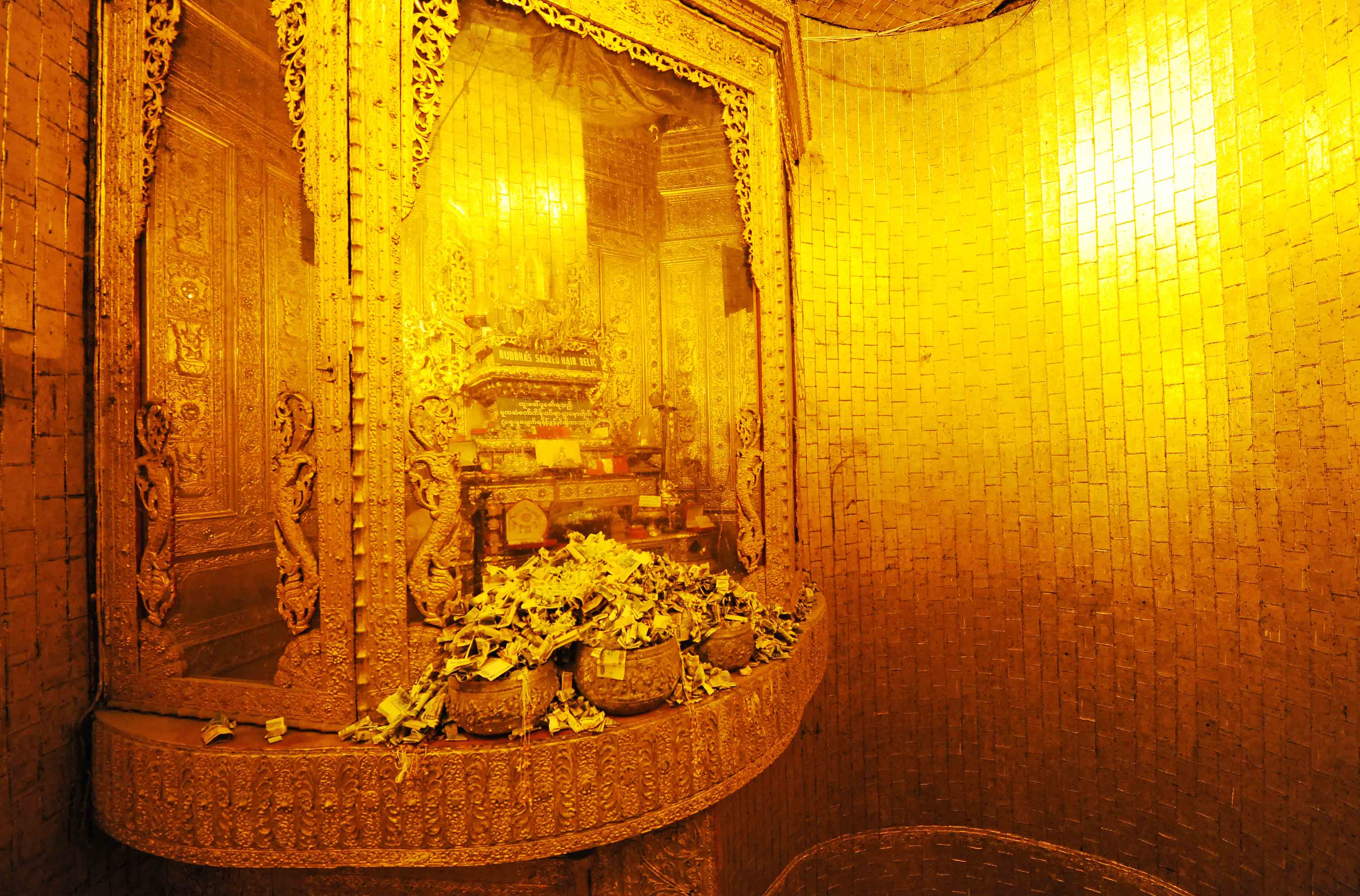
Created some 2,500 years ago around the same time as Shwedagon Pagoda, Botataung Pagoda (or literally, 1,000 Military Officers Pagoda) is one of Rangoon’s most celebrated and storied payas.
According to local tradition, it was on a hillock at this site along the Yangon River that one thousand military officers of the king were summoned as guards of honor to welcome the landing of Buddha relics brought over from India. The Buddhist king Sihadipa would give one of his ministers a sacred hair from Buddha’s head and two other relics from his body. The minister, renowned for his piety and good nature, consulted a famous religious leader, who advised him to enshrine the relics at Botataung Mount.
Despite being relatively unharmed for hundreds of years, the pagoda was completely leveled by the British Royal Air Force on November 8, 1943 while they were attempting to bomb the nearby Rangoon wharves.
The rebuilding of the pagoda would later begin on the same day Burma gained its independence from the British, on January 4, 1948, and the 20’ by 20’ relic chamber was excavated intact. The new pagoda was then built of the same design, standing at 40.13 meters high and 29 meters by 29 at the base, gilded from top to bottom.
The uniqueness of the Botataung Pagoda’s past is surpassed only by its own physicality. Its artifact strewn hallowed interior walkways resemble something of a mirror-maze path, completely covered in gold – at the heart of which, behind a large piece of glass, lies the Buddha relics for all to see.
Its façade meanwhile bares many ornate layers including traditional terraces at the base. Those are then stacked by other layers resembling thin bands, a decorative bell-shape, an inverted bowl, then simple mouldings, inverted lotus petals, ywe (or a crystal ball like structure), open lotus petals, a lotus banana bud and finally, hti (or an umbrella).
Address: Botataung Wharf, Botataung Township
2) Aung Shwebontha Dhamma Beikman Monastery
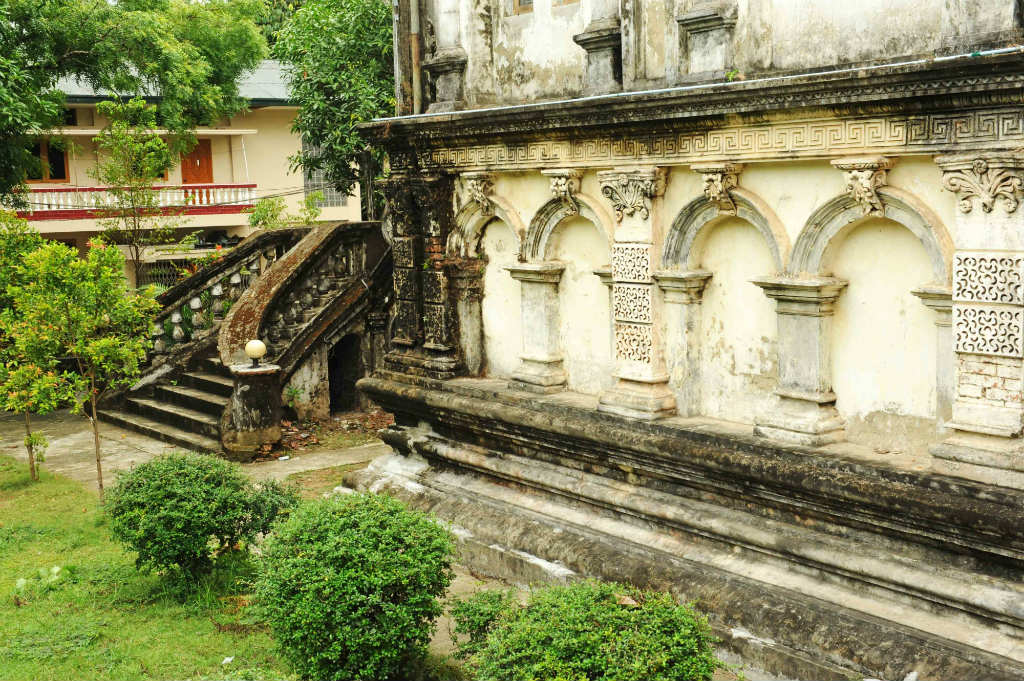
The beautiful Aung Shwebontha Dhamma Beikman Monastery in Mayangone Township is a peaceful and more or less modern grouping of housing facilities with a plush new hall located at its rear. What stands at the entrance, however, is its centerpiece, the Ninth Mile Shan Monastery Library, a delightful example of classic revival architecture built in 1908 and wonderfully kept.
A former meditation hall, the library’s façade bares ornate Corinthian columns ranging from about 1.4 to 3 meters high, a series of decorative arches wrapping around the whole of the lower floor and three sprawling, multi-entrance staircases.
The building would be renovated on May 25, 1988 and again in 1995, a year before being giving heritage status by the city. The exterior of the structure, standing at about eight meters tall, and seven by eight meters wide has suffered some minor weather damage, but remains virtually untouched despite a major renovation to the interior, transforming the once grand hall into one of Yangon’s few modern libraries.
The complex was originally built by the ethnic Shan community who first acquired the land in 1841 and established a community there. During the Japanese occupation, the monastery was used to by Japanese soldiers as a mess hall and housing, though some buildings within were completely destroyed during the Allied bombing campaign.
According to the original map of the compound, the monastery sits on 9.08 acres.
Address: No 4, Ward No.5, Pyay Road, Mayangone Township
3) Home for the Aged Poor
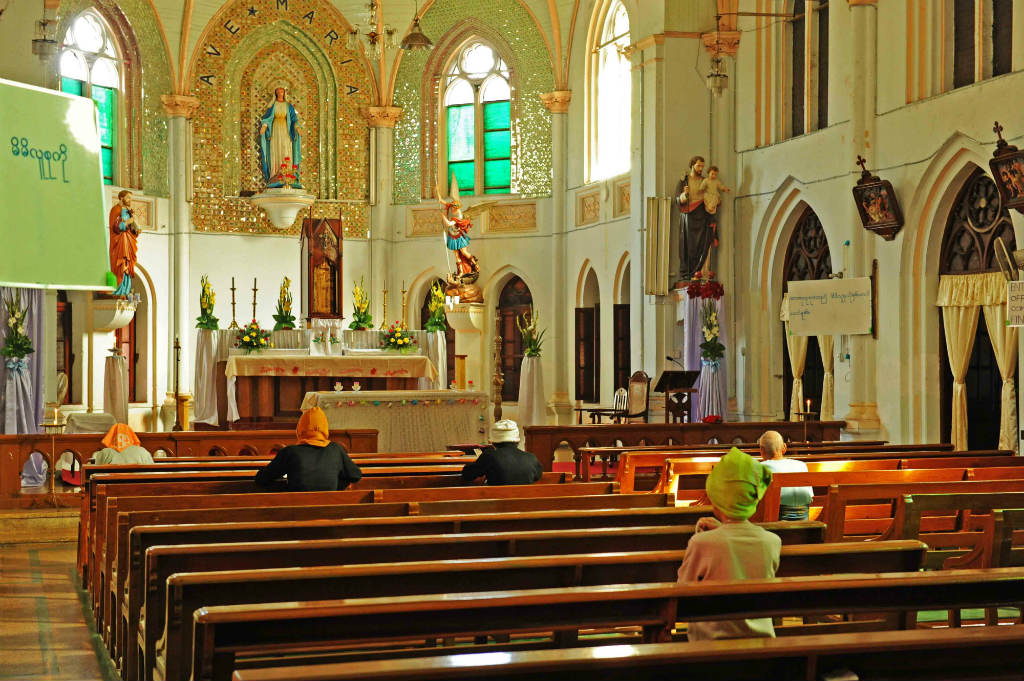
With the Catholic mission engrained throughout Burma in the late 19th century, the community led by French born Vicar Bishop Paul Bigandet sought out to do charitable works for the elderly in Rangoon. The result was the opening of a small cottage by two of his followers, teachers by the names of Gertrude di Oliveiro and Helen Carr, who dedicated the facility to helping those elderly with nowhere else to turn.
It was not until years later when Bigandet’s successor, Bishop Alexandre Cardot, wished to see the program expanded, and he appealed his case to the Little Sisters of the Poor while on tour in France. The sisters, from Roman Catholic religious institution for women founded in France in 1839, are required to take vows of poverty, chastity, obedience and hospitality. They were receptive to the idea and on November 21, 1898, arrived in Burma to start the Home for the Aged Poor.
The home took on more residents and the need for a larger facility became quickly apparent, so they sold the cottage and in 1901, with the help of donors, purchased the land where the current home stands. Construction of the complex would be done piecemeal and the premises were expanded to its current state by 1923.
In 1966, the sisters passed responsibility of the home over to the pontifical congregation of the Sisters of Reparation and the Franciscan Missionaries of Mary. They continue to supervise the home to this day.
Located a stone’s throw from Kandawgyi Lake in Mingalar Taung Nyunt, the sprawling two story Home for the Aged complex has its own infirmary, split-gender dormitories, dining halls, spacious balconies and at its heart, a sizable chapel with its own interior balcony.
As of January 2016, the home had 22 sisters overseeing 130 residents of various religious faiths from all over Burma.
Address: 539 Theinbyu Road, Mingalar Taung Nyunt Township
4) Guanyin Si Chinese Buddhist Sasana Center
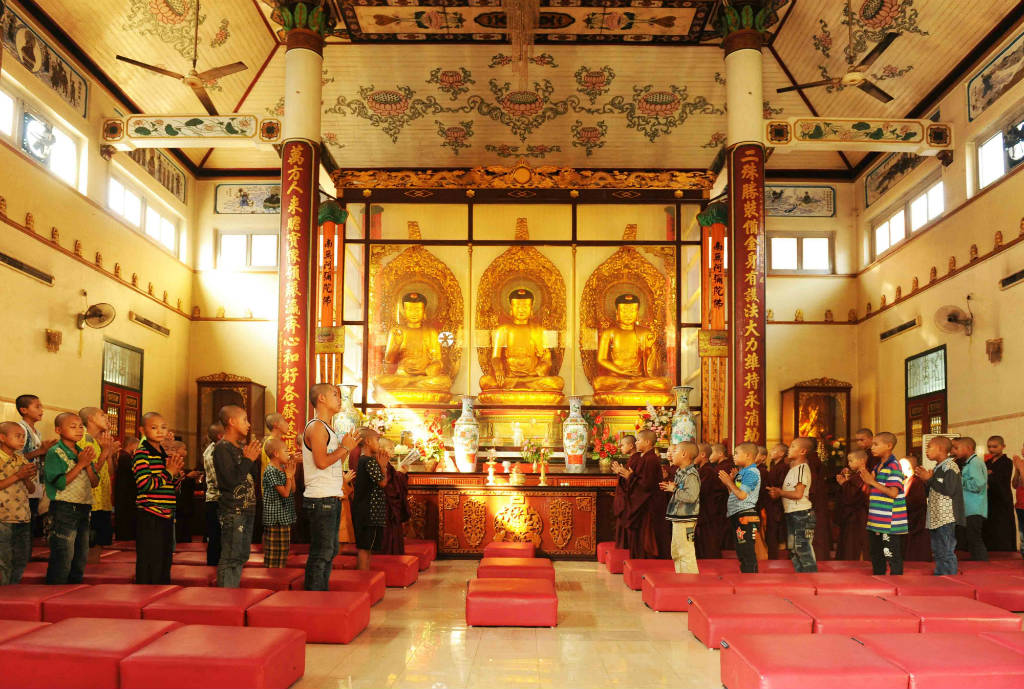
Dedicated to Guanyin, the East Asian God of mercy, this gorgeous Chinese Buddhist compound on a large peaceful plot of land off of Old Yedashe Road contains a series of tightly fit classrooms and prayer rooms, at the center of which is a spacious brick-made main hall unlike any other in Rangoon.
The centerpiece single-story structure with a tall wooden ceiling is painted with intricate floral patterns and symmetrical design work that is fitted beneath a tiered roof and with a large traditional Chinese portico at the front.
Throughout the Guanyin Si Chinese Buddhist Sasana Center, which functions as a school for young monks, are a number of classrooms all adorned with Chinese calligraphy, some of which appear to have fallen out of use. Still, one can make out calligraphy lining the doorway of one of the front structures as a Buddhist poem written in the Qing Dynasty by a poet called Zhu Daoze.
Address: 58 Arzami Road, Bahan Township
5) Insein Administrative Office
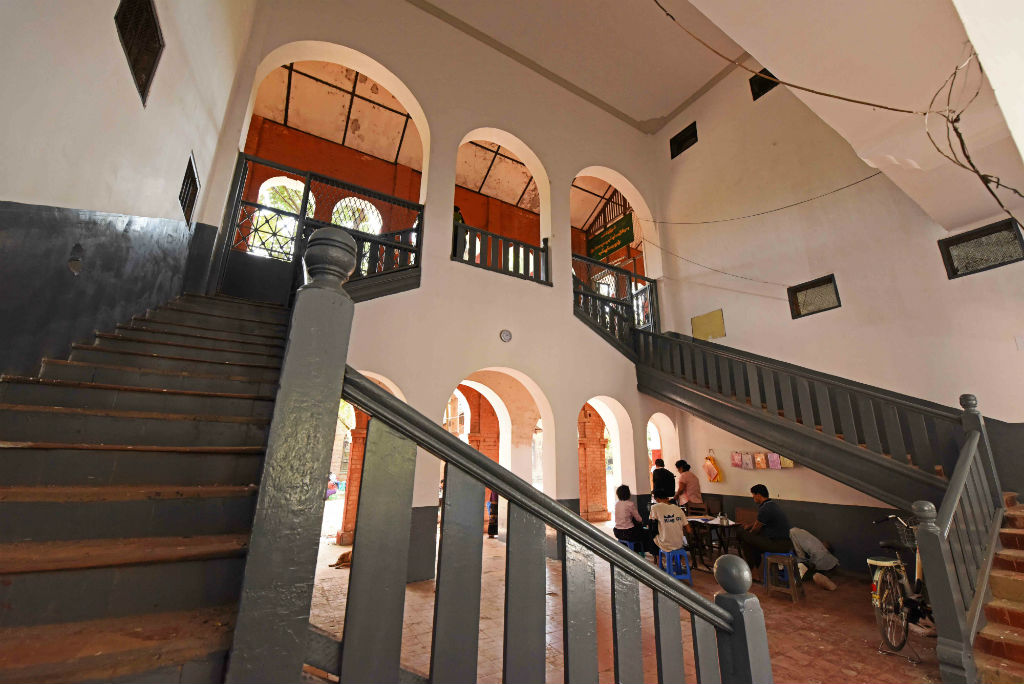
Insein Township’s District Administrative Offices on Mingyi Road are housed in a well-cared for complex spanning two levels with dozens upon dozens of units that are today used for several of the government’s local-level administrative bodies from small courts to association headquarters.
The building, also referred to as the Su Paung Yon Office complex, contains long stretches of corridor with repetitive open-air arches all along the ground floor level. Perhaps the building’s most impressive feature is the main entrance hall along the north wing – a large open space with two wooden staircases at either side.
Unfortunately, the plaques that once gave a glimpse into the history of the compound have long been removed, though it is said the building was created for a similar purpose it serves today, as administrative offices and for local magistrates.
Tiles used in the construction of the building are inscribed as being made by the Commonwealth Trust Ltd, and the late Basel Mission, patent 1865.
Address: Mingyi Road, Insein Township
6) Kalayama Temple
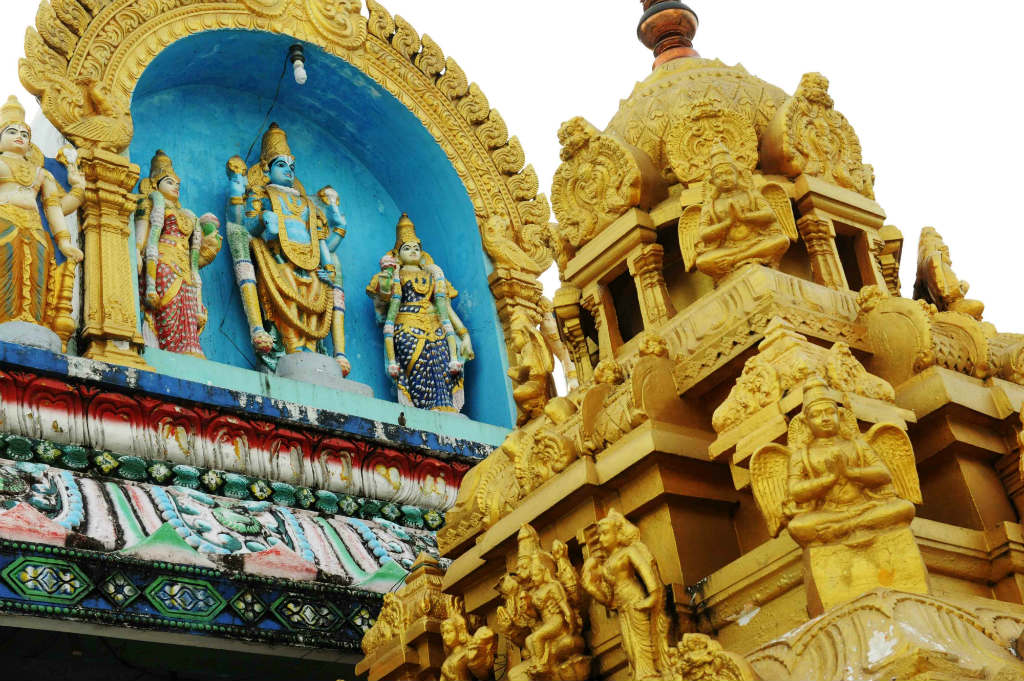
Dedicated to the Hindu lord of death, Kalayama Temple in Yankin Township is one of the largest southern Indian places of worship in all of Rangoon with a compound stretching 67.1 meters by 33.53.
Construction began in 1904 thanks to a major donor by the name of M. Venkataswami Naicker, with the temple opening for the first time in 1907. It came at a cost of about 100,000 kyats, according to the temple’s trustee, U Aung Win.
In Hindu mythology, Yama is the lord of death, first recorded in the Vedas. Yama belongs to an early stratum of Indo-Iranian theology. In the Vedic tradition, Yama was considered to be the first mortal who died and ascended to the celestial abodes. It was in virtue of this precedence he became the ruler of the departed.
The complex contains a very large traditional gopuram over the front entrance and column-strewn covered walkways along most of the perimeter around its various shrines. At its center is the main prayer hall covered in sculptures of deities and paintings depicting scenes from lore, with a fantastic portico supported by 16 ornate pillars at the front.
Kalayama Temple, also sometimes referred to as Zekwet Pagoda, has remained well cared for over the course of its history with renovations occurring in 1921, 1957, 1964 and a major one in 2010 that costs some 400 million kyats.
Address: 66 Dhammayon Road, Yankin Township
7) Masedi Khan Sunni Jamah Mosque
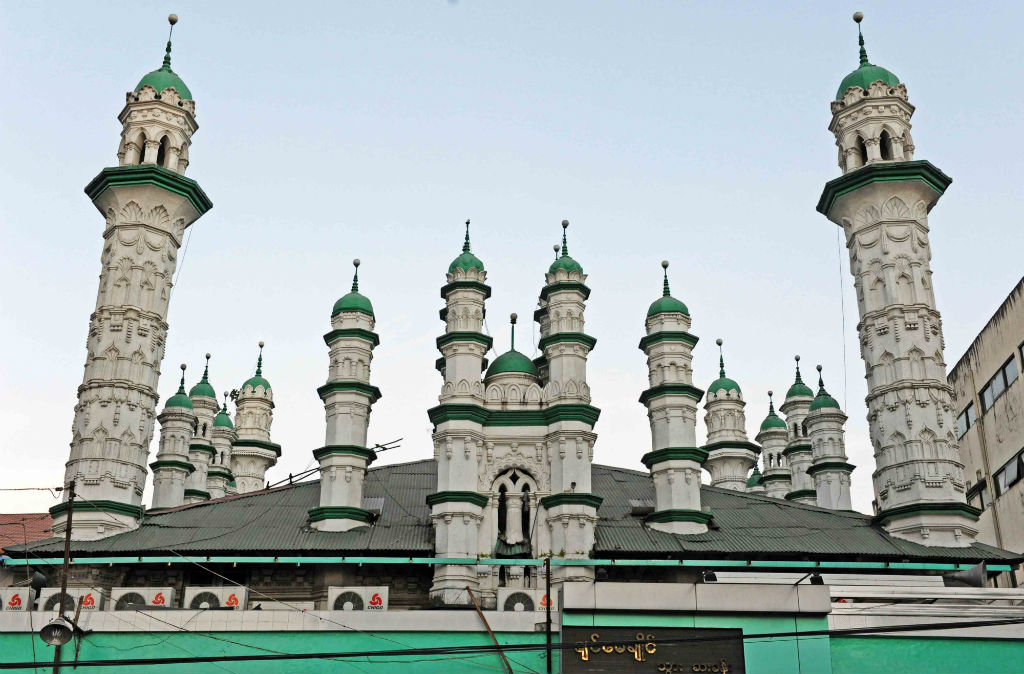
The Masedi Khan Jamah Mosque stands alone in Tamwe Township as one of the stunning buildings in the area, featuring more than twenty intricate minarets and similarly designed domed towers protruding from an otherwise very modest zinc roof and a façade hidden behind a strip of typical shops.
Built in 1908, the structure required about seven years to construct, according to U Aung Soe, the imam of the mosque. It is also named after the man who built it, Masedi Khan, a prominent businessman hailing from India.
The mosque has endured despite being damaged in not one but two earthquakes: one in 1930 that completely destroyed a minaret that has now been replaced, and another about a decade ago that damaged the roof as well as some decorative columns on the facade. They, along with the roof, have since been replaced. Much of the original design work and stained glass windows inside that were imported from India, meanwhile, still remain intact.
Some 50 years ago, the mosque also opened a madrasa called the Islamic Basic Education School, which today offers courses from grades one to five and to about 300 students in all.
Where the mosque serves a critical need for the community, its history and architecture seem to only tell part of the story.
According to texts from early 20th century, segments of the Muslim community in Tamwe were associated with gang-related crime by the colonial government in what B.R. Pearn himself refers to as “terrorism,” as officials complained the violence, which carried on for decades, was spiraling out of control.
In one instance, Pearn sites a police commissioner report from 1909 where the commissioner identifies rival factions loyal to men identified as “Meshidi” and “Mamsa” as gangsters who incited riots and even committed murder.
On December 21, 1923, The Straits Times reported that Khan himself had to be taken into protective custody by the police after sustaining severe injuries when his men engaged in an altercation with those of “one Sultan” and they were ambushed by a barrage of glass soda bottles being hurled from the rooves of houses.
The story referred to Khan as “one of the best known characters in Burma.”
Address: 356 Kyaikkasan Road, Tamwe Township
8) Kyaikkasan Grounds
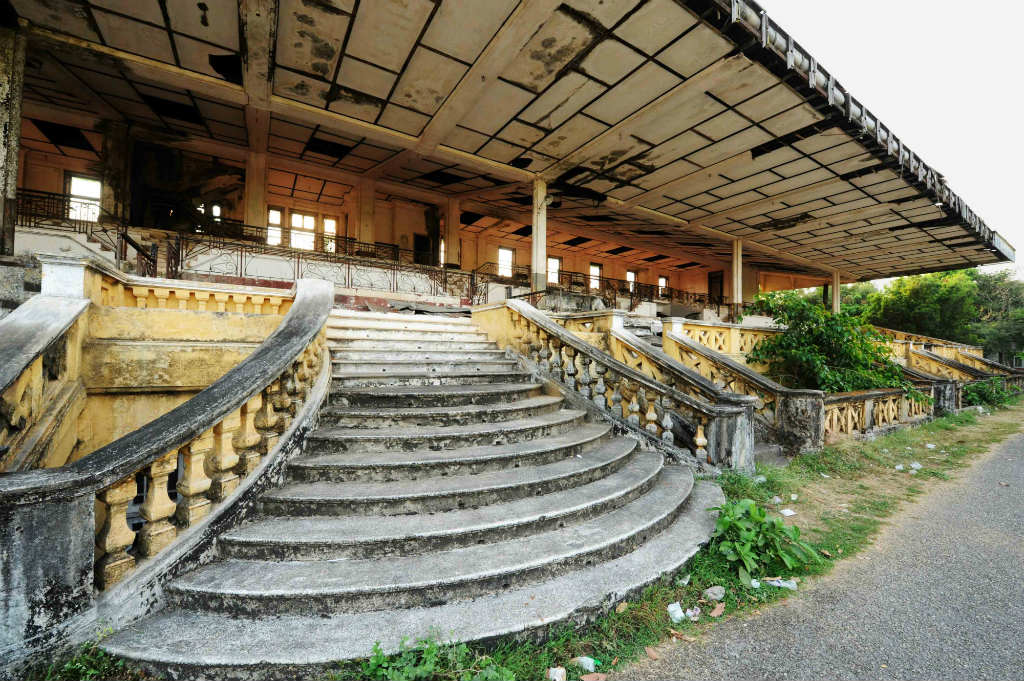
Founded about 150 years ago, the run down Kyaikkasan Grounds came to prominence after it became the home to the colonial Rangoon Turf Club in 1926.
A couple of stands that remain are two-tiered and would have been large enough to seat hundreds of patrons apiece. The concourses that lie beneath either structure, meanwhile, are also massive with high ceilings reaching the stands, plenty of room for light commerce and numerous ticketing stations.
Unfortunately, little is known about the early history of the grounds, other than that it was used primarily as a horse track for the elite class. The grounds were occupied by the Rangoon Turf Club into the 1950s and were used for military rallies and celebrating national holidays following the military coup in 1962.
The event the grounds are most well-known for, however, occurred on December 5, 1974, when an estimated 50,000 people led by students converged there to pay their respects to the repatriated body of deceased United Nations Secretary-General U Thant.
At the time, Burmese dictator General Ne Win had refused to acknowledge the work of U Thant, who was known internationally as a tireless peacemaker, and would not sponsor a state-funeral. Instead, the United Nations Development Program had to organize a small pick-up truck to carry him from the airport to the grounds, while students wanting to attend the funeral were denied transportation by the government.
Choosing instead to march to the grounds, students and monks would take control of the coffin as it was to be carried off to a lesser cemetery, placed it atop a truck decorated with flowers and placed it in Yangon University’s Convocation Hall. Six days later, thousands of soldiers would storm the campus and reclaim the body, but not before killing more than a dozen students.
Prior to moving to its current location, the prestigious Rangoon Turf Club and its stables were owned by Chinese-Burmese tycoon and merchant Lim Chin Tsong before his death in 1923. The club was first founded in 1887.
Today, the concourse of the stands on the grounds are occupied by squatters and are very unstable, with elements of the buildings collapsed. Not included on the Yangon City Development Committee’s list of 189 protected heritage structures, it has been reported that the structure may be demolished to make room for modern retail space.
Address: South Race Course Road, Tamwe Township
9) Kyun Taw Monastery Ordination Hall
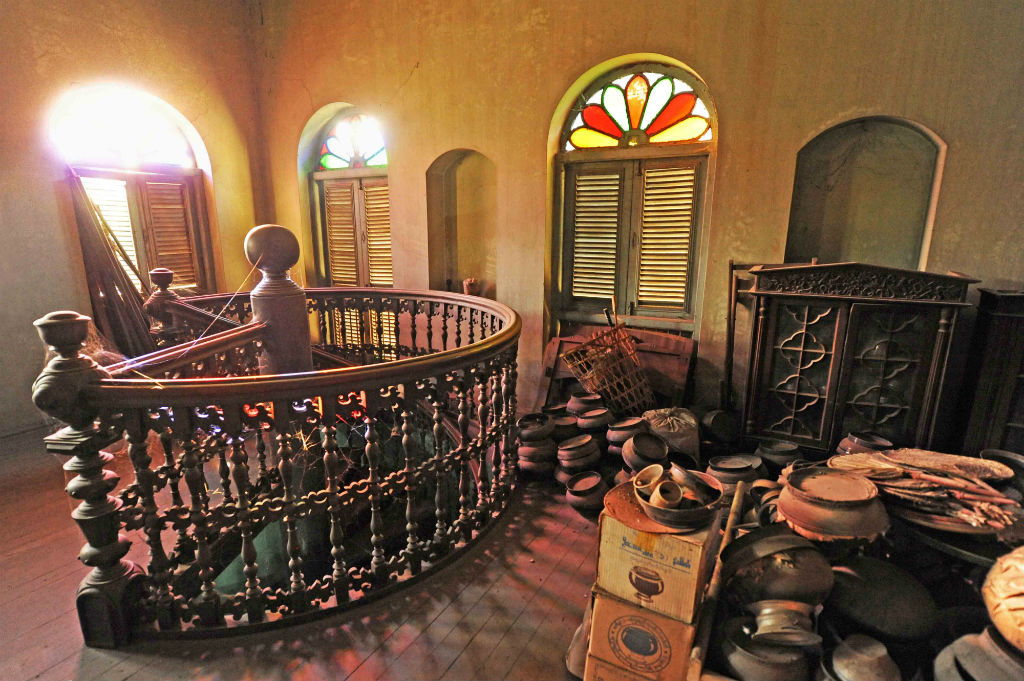
Located on a street named after the monastery and on the corner of Bargayar Road, Kyun Taw Monastery Complex is perched atop a small hill and is quite spacious, containing a number of different structures in different styles, from red-brick to timber and even those predominantly made from concrete, each erected in different eras of the monastery’s long, important history.
At the center of the complex, however, is one building that stands out above the rest, a two-story, gold colored ordination hall that is unique as a religious structure in Rangoon for its use of Victorian architecture.
First built in the Myanmar year of 1252, or about 1890, the ordination hall contains some truly appealing elements such as intricate floral stucco work above each of the repetitive arched windows, which are divided by engaged columns. The golden quality of the building is complimented by the small, yet crucial stained-glass windows that line the second floor.
Conceptualized by local architects, the exterior of the building was actually modeled after a residence of Queen Victoria, while the interior resembles that of a typical prayer hall, though this one contains a balcony that winds around three quarters of the main hall. The iron winding staircase that leads to the balcony were made by a major Glasgow-based trading firm called Cowie Bros & Co.
Standing at about 18 meters high by 18 meters long, the building was renovated in 1986 and again in 2012 at the expense of a wealthy donor who poured some 4 million kyats into the project, according to an inscription inside the building and testimony of monks living on the site.
Address: Corner of Kyun Taw Monastery and Bagayar Roads, Kyeemyindaing
10) Sarpay Beikman or Sorrento Villa
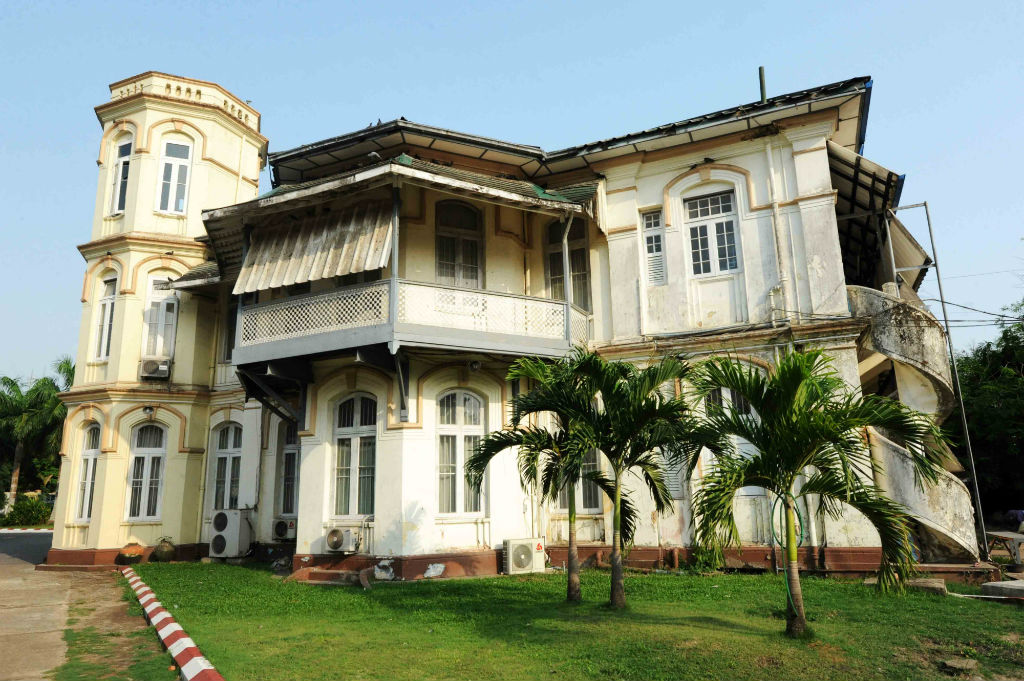
Built in 1909 as the Sorrento Villa, this plush two-story building at 361 Pyay Road is famously known as the location where a two-year national post-war development project by the name the “Sorrento Villa Plan” was drawn up in 1947.
During the ongoing high-level conferences staged at the villa, deputy chairman of the governor’s executive council, Aung San, on June 6, 1947 took to the roof atop the portico at the front entrance to introduce the two-year plan in front of thousands of supporters. He would give just one more speech before being assassinated about a month later.
On August 26 of the same year, the interim government led by Prime Minister Thakin Nu founded the Burma Translation Society (BTS) in this building with the goal of creating a library of locally produced texts. This included an encyclopedia, a project that was undertaken in 1948, and it would eventually be responsible for a number of magazine and academic texts. The first president of the society was Prime Minister U Nu.
In 1955, construction was completed on a new four-story BTS headquarters on the corner of Merchant Road and 37th Street, and the editorial and administrative staff relocated there the following year.
In 1963, BTS was absorbed by the Ministry of Information and renamed Sarpay Beikman, or Palace of Literature, and its publishing arm was named Sarpay Beikman Press.
Today, the building is owned by the Ministry of Communications and Information Technology and serves as posh facility for telecommunications provider Myanma Posts and Telecommunications.
Address: 361 Pyay Road, Sanchaung Township
Interested in hearing or learing more? You can buy the book at indiegogo at a discount or go see Heijmans give a talk on May 4 at Pansuriya in Yangon.