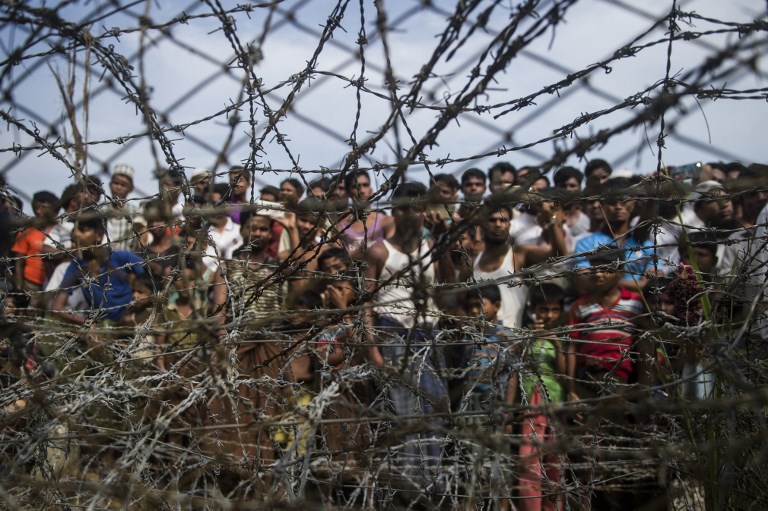

The circumstances behind the release of seven soldiers convicted for their roles in the 2017 Inn Dinn massacre — less than a year into their 10-year prison terms — became a bit clearer today, and while the man behind the decision will surprise no one, it’s still provoking outrage.
Myanmar military commander-in-chief General Min Aung Hlaing, recently banned from Twitter, personally made the call to reduce the men’s sentences, as they didn’t have “any intention to kill,” military spokesperson Brigadier General Zaw Min Tun told online news outlet the Irrawaddy on Wednesday.
Min Tun added that Min Aung Hlaing’s decision followed the delivery of a petition by an anonymous group of citizens calling for the men’s release.
The revelation drew swift condemnation from Sean Bain, legal adviser for the International Commission of Jurists (ICJ).
“The military’s apparent tolerance for serious crimes enables and perhaps even encourages the repetition of violations by soldiers. Last year, Rohingya civilians were targeted. This year, it appears that Rakhine civilians are being targeted, in violation of national and international law,” he told Coconuts Yangon today.
While the soldiers have already been released from prison, Bain says there are still existing legal options to hold them to account, but only if Myanmar’s civilian government exercises their constitutional right to do so.
“As a matter of law, the president could order these soldiers be re-tried in Myanmar’s criminal courts, under Section 130 of the 1959 Defence Services Act. Unlike military courts, a criminal court adjudicated by civilian judges should also consider redress, including reparations for the families of victims,” he said.
“Ordering a re-trial would demonstrate a genuine commitment to accountability for gross human rights violations, which has so far been lacking from the elected civilian government.”
But critics of the government say there is little reason to believe that Myanmar has the interest or the will to undo the general’s decision, hinting that an ongoing investigation at the International Criminal Court may be the only avenue left for justice.
“This is yet another example — if one were needed — of why Myanmar cannot and should not be trusted to ensure accountability for atrocity crimes. The notion that the military is in anyway committed to justice is both dangerous and delusional,” Laura Haigh, Myanmar researcher for Amnesty International, told Coconuts Yangon.
That sentiment was seconded by Human Rights Watch deputy Asia director Phil Robertson, who called for a global arms embargo on the Tatmadaw, Myanamar’s military.
“The Tatmadaw has a well deserved reputation for horrendous human rights violations which is equaled only by their record in covering up those atrocities and making sure soldiers are not held accountable,” he said.
“This culture of impunity shown by this outrageous and shameful pardon for these 7 murderers in Myanmar military uniforms explains why a global arms embargo should be proclaimed on the Tatmadaw, and its top commanders universally sanctioned and ultimately sent to the International Criminal Court.”
The seven soldiers were sentenced to 10 years at hard labor in April 2018 for the murder of 10 Rohingya men and boys after an internal military investigation led to a rare admission of wrongdoing.
Myanmar’s military-drafted 2008 constitution shields the Tatmadaw from any civilian oversight, and confers special powers to the top military general, in this case Min Aung Hlaing, giving him the “final and conclusive” decision on all matters of military justice.