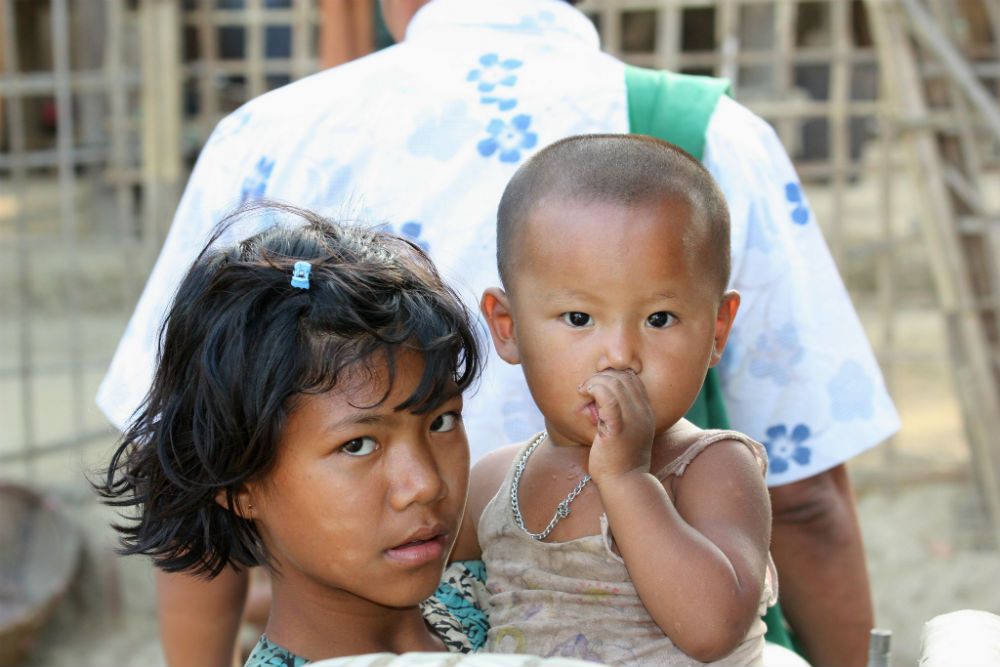

The Asia Pacific Conference on Reproductive and Sexual Health and Rights begins today in Naypyitaw.
To mark the occasion, state-run newspaper the Global New Light of Myanmar this morning published a fretting editorial about falling fertility rates, imploring young women to marry early and have lots of children so the country can develop economically.
The advice, of course, flies in the face of United Nations ideas about sexual and reproductive rights – that the empowerment of adolescent girls will help build the economy.
The two opposing views were brought into stark contrast in local media this morning.
“It is undeniable that marriage is an important social and economic construct in most societies,” writes Khin Maung Aye in the New Light. “Marriage is not just the union of two persons; it also involves the union of two families or kinship groups. In this regard, one’s first marriage is the most important for today’s youth because it is the starting point of the transition from adolescent to adulthood.”
But the age of first marriage is increasing, he notes. “This new marriage pattern creates ripples in society, particularly affecting fertility rates. Delayed marriages play a vital role in the decline in birthrates, with the consequence that the reproductive lifespan of a woman is reduced. This, in turn, affects family sizes and population growth rates.”
Conversely, in an editorial published by the Myanmar Times this morning, Yoriko Yasukawa, regional director for The United Nations Population Fund, and Janet E Jackson, its representative for Myanmar, argue that the falling fertility rates mean the country “appears poised to reap a demographic dividend – the economic growth that can occur when a population shifts from one with many dependents and comparatively few working-age people to one of many working-age people with fewer dependents.”
They give this explanation of why adolescent girls are the key:
“Visualise two scenarios. In one, an adolescent girl has little or no access to comprehensive sexuality education, or sexual and reproductive health and rights. She’s forced to leave school due to unintended pregnancy or to help her family earn a living. She’s not free to decide when to marry, how many children to have or when to have them. She may suffer illness, injury and death from childbirth. She doesn’t have decent employment opportunities, and can’t adequately provide for her children. Eventually, years down the road, she’s confronted with an insecure old age….
In the other scenario, this adolescent girl accesses vital information and services in an environment that allows her to make optimal choices. She graduates from school. She marries whom she wants, when she wants. She chooses how many children to have and remains healthy through childbearing. She’s protected from gender-based violence and displacement. She has the opportunity for gainful and satisfying employment. She achieves her true potential and worth – as a girl, a woman, a citizen, a human being.”
Just FYI, here are some other countries where the median age of a woman’s first marriage is in her teens:
Bangladesh, Mali, Niger, Yemen, Sudan.
And here are some countries where she marries later, in her mid to late twenties:
Japan, the United States, France.