
By Phyo Thiha Cho and Htet Khaung Linn
Hundreds of political prisoners remain behind bars and more than 400 people are facing trial on political charges despite a presidential pardon last Friday by the outgoing government of President Thein Sein, human rights groups said.
Of the 102 prisoners released in the amnesty, 52 were imprisoned for political reasons. Philip Blackwood, a New Zealander who was serving a two-year jail term for insulting Buddhism, was among those released.
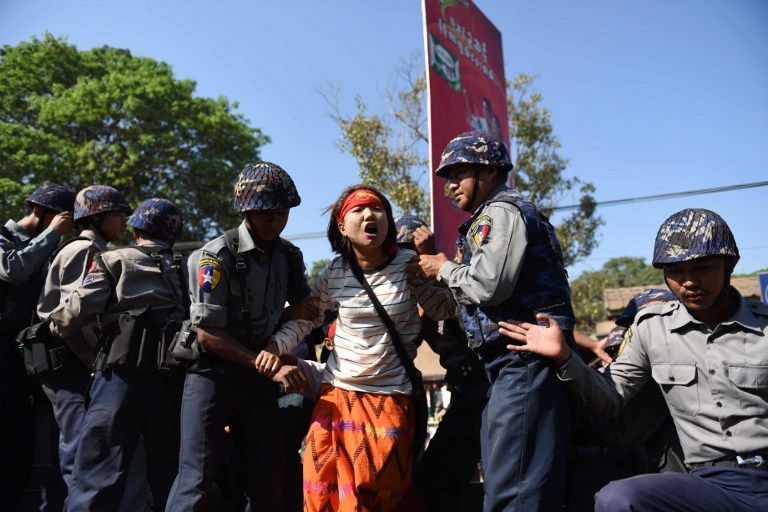
Yet new political prisoners have been arrested and jailed in the same week, and many outspoken government critics and dozens of students detained in March last year for protesting against a controversial education bill are still incarcerated. Many are suffering health problems.
Bo Kyi, co-founder of the Assistance Association for Political Prisoners in Burma (AAPP) and himself a former political prisoner, questioned the government’s decision not to release all political prisoners and detainees.
“Why doesn’t the government release all of them unconditionally? If they do that, it would improve its image and help the country’s national reconciliation,” he told Myanmar Now.
Myanmar’s outgoing administration has been praised by the international community for holding free and fair general elections in November that handed a landslide victory to the opposition National League for Democracy (NLD).
Yet critics say the continued detention of political and human rights activists raises questions about the country’s democratisation process and the authorities’ willingness to embrace further reforms.
MORE JAILED
On the same day the presidential amnesty was declared, Kachin peace activist Patrick Khum Jaa Lee was sentenced to six months in jail by a Yangon court on charges of defaming the powerful military chief Senior General Min Aung Hlaing on his Facebook.
His wife May Sabe Phyu is head of the women’s rights group Gender Equality Network. She called the verdict unfair, saying there was no evidence her husband had shared the defamatory Facebook post.
Also arrested and put into jail last week was Nyi Nyi Lwin, better known as U Gambira, a leader of 2007 Saffron Revolution. The authorities charged the former monk with immigration offences.
“These actions, and the relatively small release of political prisoners demonstrate that the government continues to harbor resentment and animosity toward those that oppose them,” AAPP noted in a statement.
Well-known dissidents who are still behind bars include Htin Lin Oo, a former NLD official sentenced to two years in jail last year on charges of religious defamation. He raised the ire of nationalist Buddhist monks when he criticised them.
His wife, Saw Sandar, said she was not surprised when she learned her spouse was not among those released on Friday.
“It is the current government who jailed my husband on trumped-up charges. They will not release him because he dares speak the truth,” she said in a telephone interview with Myanmar Now.
“My husband must be glad to know that he is not released since he doesn’t want to owe any sort of gratitude to this government.”
Five journalists, sentenced to 10 years in jail in 2014 under the State Secrets Act for reporting on an alleged chemical weapons factory, were also not among those released, their family members told Myanmar Now.
“We have been looking forward to the government’s amnesty. But this is now very disappointing,” said Lwin Lwin Mar, wife of Lu Maw Naing, one of the jailed journalists.
HUNDREDS AWAITING TRIAL
Currently, more than 400 individuals are awaiting trials in detention on political charges, according to rights groups.
Fifty-three are students and activists who were arrested in a violent crackdown in the town of Letpadan in Bago Region while they were calling for changes in the National Education Bill.
They face charges that carry up to nine years and six months imprisonment, according to Fortify Rights, a human rights group.
While awaiting trial, these students and activists are suffering medical problems after being denied access to adequate food and medical care in prisons, said a report published on Monday by Fortify Rights and the Yangon-based All Burma Federation of Student Unions.
“There is no question that a lot of the medical deterioration [of the detainees] is from lack of care. The students of Letpadan need and must receive effective treatment,” Dr. Thet Min, a medical practitioner, was quoted in the 16-page report.
“The authorities must address and improve sanitation and living conditions [in detention] to ensure patients don’t contract any other diseases,” he added.
Aung Nay Pai, one of the students activists in Yangon, said the government is adding more charges to the detained students to create the perception in the public that the students are law breakers.
“The oppression against the students continues even in this transitional period,” he said in a phone interview.
Ye Aung, a former political prisoner and a member of a committee on political prisoners, said that the continued detention of many political prisoners show that the government has not changed its attitude towards political dissidents.
“It’s frustrating,” he told Myanmar Now.
This article was originally published by Myanmar Now on 22/1/2016.










