
The Guardian has announced, somewhat reluctantly, that it will stop using Burma and Rangoon to refer to Myanmar and Yangon.
In a typically self-flagellating editorial published Tuesday, the British newspaper said the decision was made partly because the new names have become universal but also “because colonial names should be part of the past, along with the empires that gave rise to them.”
The newspaper was one of the last holdouts – alongside the Washington Post and Atlantic – to stick with Burma, originally used by British but later associated with the pro-democracy movement.
Earlier this month, Wikipedia moved its Burma entry to Myanmar. See the discussion about that here.
The former military junta switched to Myanmar in 1989 in order to distance the country from its old British rulers.
But the change happened without the consent of citizens, meaning that, for a long time, going with the new-fangled Myanmar was a surefire way to align oneself with the dictatorial regime.
The slippery New York Times made the switch in 1989.
Foreign editor Joseph Lelyveld later admitted it was over-hasty. “Now Myanmar is associated with those dreadful people,” he wrote in the Boston Globe. “Basically, I was too fast off the mark.”
Since the transition to semi-civilian government in 2012, however, most political leaders and publications alike have agreed to play by the rules.
President Barack Obama did the switcheroo last year when he visited the country, saying: “I am optimistic about the possibilities for Myanmar.”
Confusingly, the U.S State Department still uses Burma.
Various indecisive people, like the Lonely Planet, go with variations of ‘Myanmar (Burma)’ and ‘Myanmar, formerly known as Burma’.
But the list of all-out Myanmar naysayers is shrinking.
The Washington Post ploughs on with Burma. (See recent articles: Burma’s grim reality; Burma’s half-hearted transition to democracy; Burma’s Rohingya exodus is a looming disaster.)
As does the Atlantic. (Although, let’s face it, they never really write about Burma, or Myanmar.)
And, of course, within the country there’s the Irrawaddy Magazine and the Democratic Voice of Burma.
But most of the other major publications – Reuters, the Associated Press, the Economist, CNN, Coconuts Yangon – have plumped for Myanmar.
The BBC switched back in 2013, as correspondent Jonah Fisher pointed out in a somewhat smug post on Twitter.
Most outlets made the switch with reluctance, however.
Whoever penned the unnamed Guardian editorial took pains to point out the myriad ways the democratic ‘transition’ remains incomplete and, in some ways, has reversed.
It begs the question: what happens if it all goes wrong in November? Do we go back to Burma?
One thing is for certain: it’ll be another few decades before anyone makes up their minds.
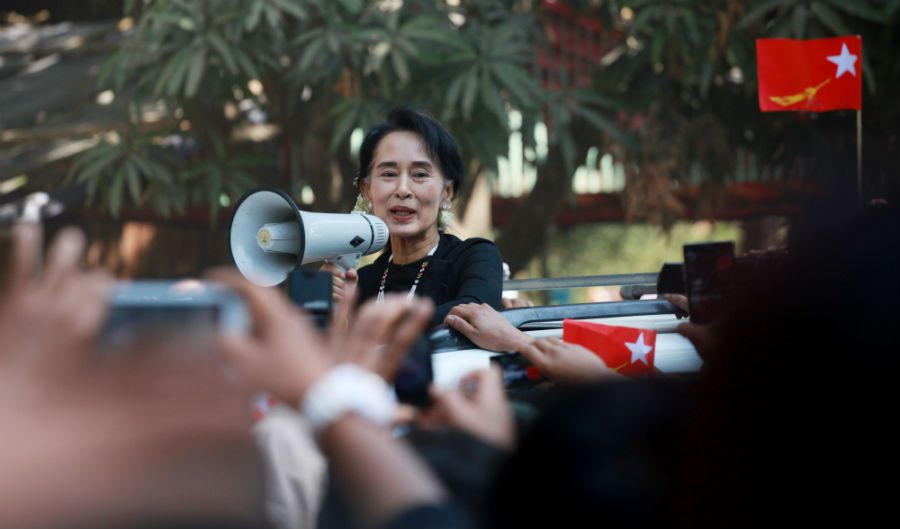
Photo / Coconuts Yangon