
Editor’s note: A few days ago we ran a story about famed Cambodia journo Nate Thayer (he of the Pol Pot scoop) publishing on his Facebook page a leaked 2011 letter from former Myanmar Times owner Ross Dunkley to President Thein Sein. In the letter, Dunkley asked for a new visa while also effusively praising the post-junta administration. Thayer slammed the letter but Dunkley was unable to respond at the time. He has provided us with his retort now on the condition that we run it in its entirety. Since this is the internet and we are not bound by column inches, we said sure. Warning, the letter is long and seems to be about more than just 2011. Obviously the views and descriptions here belong to Ross Dunkley alone. You can read Thayer’s own response to the response on his Facebook page.
Without further adieu, Ross, the stage is yours:
Nate is a well known if not controversial journalist whose name is usually associated with issues in Cambodia where he has some claim to notoriety. How he is suddenly a style master on Myanmar I don’t know, but anyway I have never personally met him and I am not quite sure what axe he has to grind with me.
Describing a letter I had or had not written as an offense to the concept of a free press, really, it’s a little bit rich isn’t it?
Nate has limited familiarity with the press in Myanmar and probably even less awareness about the machinations of Myanmar’s politics in the period immediately preceding democratic elections in 2010, the coming into being of a new constitution just prior to that, and then the new era which began with U Thein Sein’s ascendancy as President. I have never heard his name associated with Myanmar as an analyst, commentator or journalist. I doubt if he has even been here.
I don’t need to tell Nate though about the pressure that gets applied on those engaging in the media business at the pointy end of the stick, especially in countries not known for openness, tolerance or promotion of transparency but more for their heavy handedness. As the only foreign media proprietor operating in Myanmar from the year 2000 onwards for almost 15 years, I was the focus of intensity and even hostility by some people inside government which culminated in a terrible scenario whereby I was sent to Insein Prison for 47 days, smeared and muddied over feeble accusations I had done something to a disco girl that I had known for a few minutes. I was subjected to constant legal action for almost four years, from the criminal courts all the way through to the high court, and this included the period in 2011 that we are talking about here.
At one stage I was denied a visa for more than a year, literally trapped inside the country, unable to leave, yet nominally illegally resident inside Myanmar. Technically speaking I could have been deported. Later on and despite having a judge’s court order allowing me to travel I was barred from leaving the country at Mingalardon airport by the Immigration Ministry. I was deeply affronted and alarmed that such a thing could happen and I appealed to the high court to overturn it on the basis that the executive wing of government had no authority to override the decisions of the judiciary, fundamental of course to a democracy.
The high court case caused the temporary halting to the hearing of the criminal charges levelled against me and counter filed by me against Dr Khin Moe, wife of my then joint venture partner Dr Tin Tun Oo. You should be aware that she attempted to unilaterally and illegally take control of MCM by marching into the newsroom with five unknown people to me, taking photos and disrupting the daily routines at The Times. One of those five was her son-in-law, a person unknown to me who was acting aggressively towards me. I did what any normal person, a managing director, would have done in the situation and moved to eject him and the others from the offices of The Myanmar Times, something I believed I had the right to do.
How all of these things could be viewed as ‘corrupt shenanigans’ is beyond me.
In fact I was in a bitter and protracted struggle with my joint venture partner, a partner forced upon me after [co-founder] Sonny Swe was arrested and sent to prison with a 15 year sentence, the reasons for which I am still in bewilderment over. (Sonny later went on to serve 8.5 years).
I vowed from the first day of his imprisonment to wait and hold on for him at The Myanmar Times until he was released, no matter what, and that is what I was doing. Now, if you define that as the corrupt practices of a foreign businessman, ‘intent on cutting a deal with the most embarrassingly corrupt and inept dictatorships in Asia,’ then you are on a another planet to me. Either that or you must have had one or two drinks too many, too early in the day.
And as a matter of great seriousness, a foreign joint venture partner should not be held to ransom over his visa being renewed and it being used as a bargaining or negotiating chip. Surely no one’s visa should be withheld if they are undertaking legitimate business in this country. As the chief representative of the foreign side in a joint venture, I would have thought I had some basic right to be able to run a business without this sort of hindrance. Mr Nate Thayer, who portrays himself as some sort of latter day Clark Kent, should have conducted the scantest of research into what was happening at The Myanmar Times, and he would have discovered that almost all of my expatriate staff were unable to get their visas renewed as the squeeze tightened on The Times. I had no choice but to send them outside of the country but was fortunate as the publisher of The Phnom Penh Post to be able to send them to our Cambodia HQ where they were able to assist in editing the paper from there. If you call that cutting deals with the military then you are insane Mr Thayer.
So, Mr Thayer and Coconuts, you might well understand that in the most humble and polite way possible, and with the recommendation of my legal counsel, consultants and senior members of my management team, I had written a letter to U Thein Sein asking for fair treatment and as always I offered the services of the newspaper for the betterment of the country.
To describe any of my actions in these moments as outlandish and bizarre, and otherwise infer that I was acting irresponsibly, is sloppy journalism and mischievous, and it borders on slander.
It also goes to show that Coconuts has some way to go before it can claim to be publishing serious, credible journalism, although with a name like that perhaps it will be merely be confined to profiting from scuttlebutt. Mr Thayer, meanwhile, gained a reputation as an outstanding and incisive writer, a journalist that many came to respect and admire over the years. That he chose to stoop down low and muddy a colleague engaged in a not dissimilar fight to himself, with half baked accusations and obvious bias, is disappointing and saddening even, but surely a pointer that he has seen better days and ought to limit his shoot from the hip tendencies in favour of something a bit more honourable.
I will say this about The Myanmar Times to clarify speculation that continues to circulate: The Times is a pioneering newspaper which has long been a market leader in the press. It has always traded profitably and It has always had an aim to promote the benefits of Myanmar to an outside world which for so long had been fed information that distorted some of the good and even great things being done by Myanmar people. The newspapers, in both languages, have long had a commitment to training the editors of tomorrow, and to employing a set of workplace ethics which for so long made The Myanmar Times the benchmark in the sector. I am proud to have led a great team of people that is The Times for 15 years.
It is regrettable that Sonny Swe and myself were unable to re-engage as partners following his release from prison, because I believe we both came to the table with clear hearts and aspirational ideals and we were prepared to lead, and that made our partnership unique. You can’t just bring that back or recreate it. In the past couple of years a well known and important entrepreneur, U Thein Tun, bought out all the other partners in the business apart from myself. And whilst we remain on the best of terms in the end as a majority owner of the business he wanted to do things in a way which he considered to be appropriate, considering the juncture of the country at this time.
U Thein Tun is a canny and powerful businessman with relationships that go to the very top of government. As the chairman of the Myanmar Bankers Association he also wields a great deal of influence. In society he is well known as a man who has established a foundation to directly benefit those less fortunate than himself. He has poured much money into this endeavour. The MCM chairman can be likeable and charming and there are a great number of things I admire about him and I have the deepest respect for a self made man who has accomplished so much in life. To his credit he has largely resisted the temptation to interfere in the activities of the newsroom. Of course I wish him well and whilst it can sometimes be excruciating to be an observer of a business you were once in an intimate relationship with, I see that The Myanmar Times has its own path and will continue to be out there as a major league player and pacesetter in the sector.
You will see the company emerge as a media conglomerate and I really hope that U Thein Tun is able to steer this through to fruition even though he is at the end of a long and extraordinarily productive life. If given the opportunity I would seriously consider buying back into the company because I have the utter belief I know how to take it to the next level. As always and forever I would say ‘Long live The Times’.
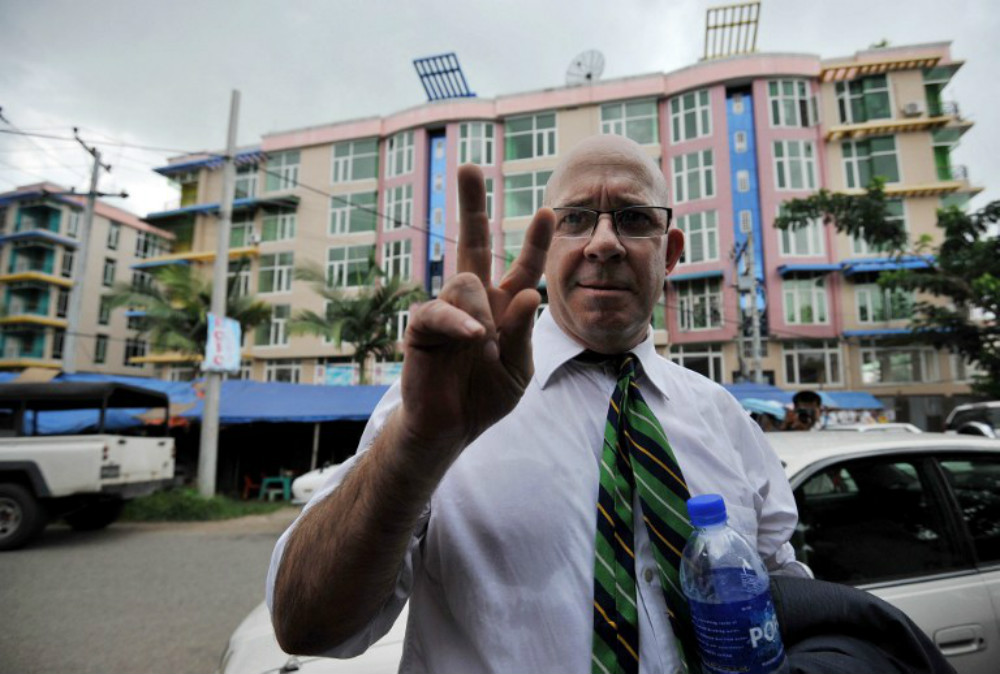
Photo of Dunkley outside a Yangon court in 2011 / AFP