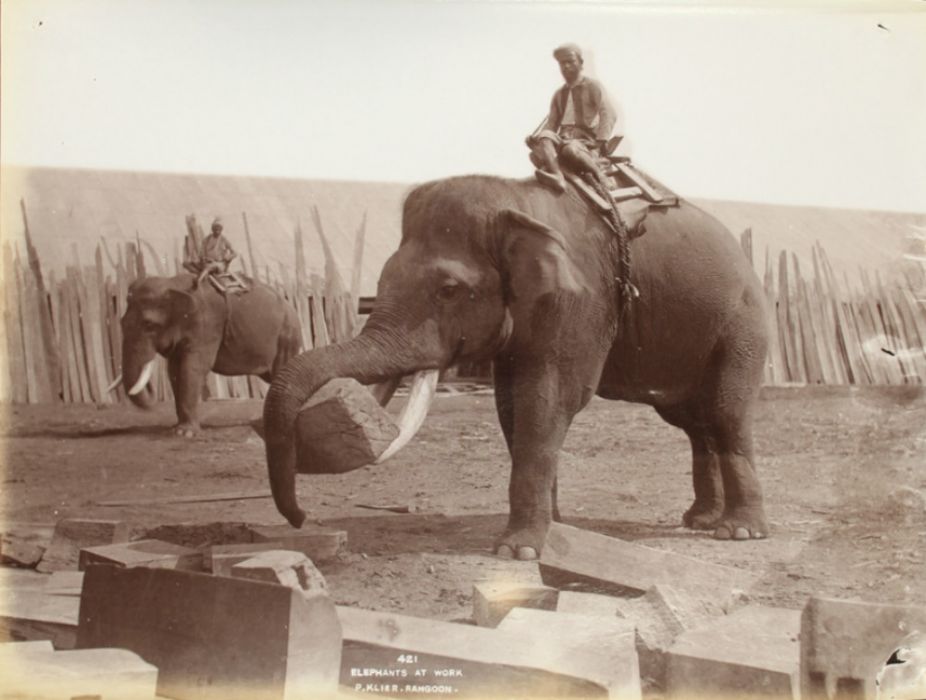

Myanmar’s system of putting elephants to work in logging capacities has ironically protected the species by giving them an economic function, says Vicki Constantine Croke, author of the bestseller “Elephant Company.”
Croke made the comments, which she admits sound “counterintuitive,” in an interview with the Harvard Gazette ahead of a talk at the university on Thursday called “The Half-Wild, Half-Captive Elephants of Burma.”
“In India, unemployed elephants are begging on the city streets with their mahouts [handlers]. Myanmar has the second-largest population of Asian elephants in the world, and the largest population of captive elephants in the world,” she said.
At length she explains how the system in Myanmar works:
“Each elephant who worked moving logs had his own uzi — elephant handler. They would work together for their whole lives. Elephant life spans are roughly the same as ours. These guys knew and really loved their elephants. The elephants would work in the morning for four to six hours, dragging and pushing [teak] logs that had been cut down, bringing them to dry creek beds to wait for the monsoons to bring them down. And in the afternoons, the uzis would bring their elephants to a river to be bathed, and the elephants, who wore teak bells around their neck, would be released in the forest. They’d mingle with wild elephants. Elephants only sleep a couple of hours a day, so the majority of their day was spent as wild elephants. They didn’t go far. They didn’t need to, and in the morning, the uzis would follow their tracks. They could tell their own elephants’ track, and listen for the bells — they made their bells so each was unique — and call them back for the morning work.”
Croke’s book, which came out last year, tells the story of James Howard Williams, also known as Elephant Bill. His use of the hulking animals to save refugees and transport supplies during World War II in Burma, as the country was then known, became world famous. He is credited with creating a more benign form of training using positive reinforcement as opposed to kheddaring, the practice of breaking young elephants using starvation and beatings.
“As it turns out, this whole system that they have in place saved their lives, as elephants vanished from some of the countries around Myanmar,” Croke said in the interview.
“I knew that what Williams did in Burma made life better for working elephants, but what I found out in researching the book is that the system that he helped refine basically saved the elephants of Myanmar. It’s amazing to me that what seems counterintuitive — having these beautiful wild creatures in chains for part of the day — turned out to be their salvation, even now.”
Read the full Q&A here.
Photo: Elephants at work in Rangoon in 1907. WIKICOMMONS/THE NATIONAL ARCHIVES UK