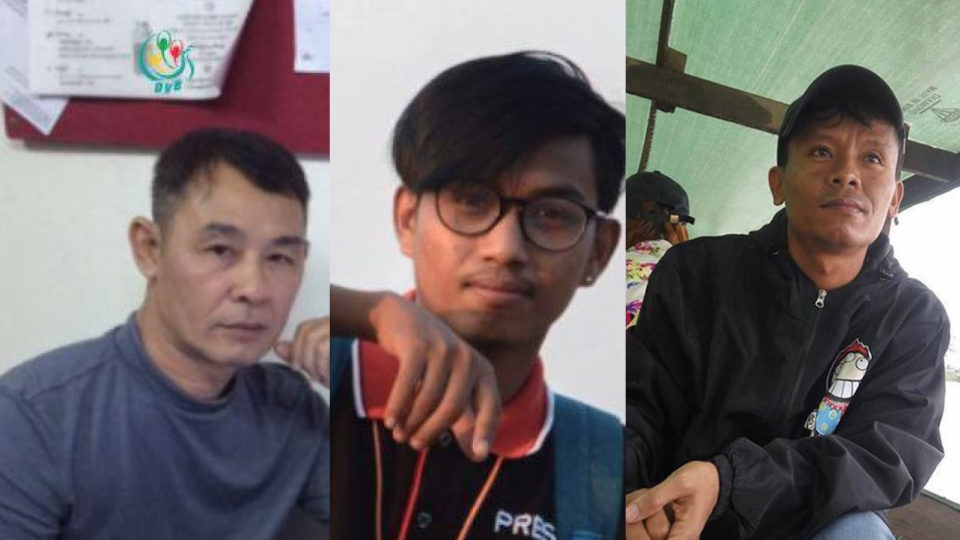

Three reporters who were detained after covering a drug-burning ceremony organized by an ethnic armed organization will be charged under the Unlawful Associations Act, a military source told Reuters yesterday.
DVB reporters Aye Nai and Pyae Phone Naing, along with Irrawaddy reporter Thein Zaw (aka Lawi Weng), were traveling away from the ceremony in northern Shan State when they were arrested by the Myanmar military.
Their current whereabouts remain unknown.
The Unlawful Associations Act was enacted by the British colonial government in 1908 and states that anyone who is convicted of being a member or consorting with an illegal organisation shall be punished with imprisonment of not less than two years but no more than three years, and shall also be liable to pay a fine.
The Ta’ang National Liberation Army, which organized the drug-burning ceremony, is not a signatory to the Nationwide Ceasefire Agreement and is considered an “unlawful association”.
President’s Office spokesperson Zaw Htay justified the reporters’ arrest to Reuters, saying: “Everyone should be treated according to the law.”
He also said the reporters and the four other unidentified men with whom they were arrested, are “being treated very well” and will be handed over to police within the next two days.
Despite its colonial origins, the Unlawful Associations Act has frequently been used by Myanmar authorities to detain and punish activists in ethnic and religious minority communities.
‘Rambo’ film star Ko Min Htay was charged under the antiquated law earlier this year for his dealings with the KIA in the 1990s, even though those dealings ended when the KIA signed a ceasefire with the Myanmar government in 1994.
Myanmar press organizations condemned the arrests, and Human rights watchdog Amnesty International has called for the reporters’ immediate release.
“These arrests are a crude attempt to intimidate journalists by a military that cannot seem to abide even the faintest criticism. Fearful of any scrutiny of its role in northern Myanmar, where they stand accused of war crimes, the army is doing its best to stop journalists and other observers from accessing these areas,” said James Gomez, Amnesty International’s director for Southeast Asia and the Pacific.
In a Facebook post, the US Embassy in Rangoon said: “Journalists need to be able to do their work, as a free press is essential to Myanmar’s success.”