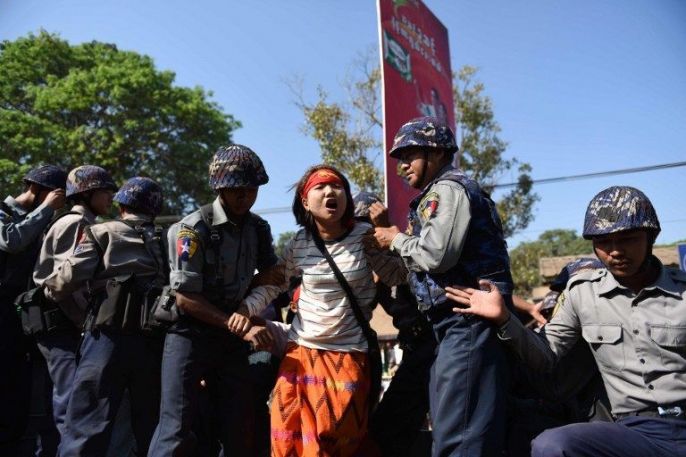

Amnesty International is urging Aung San Suu Kyi’s new government to dismantle the “repressive legal framework” that has allowed the outgoing military-backed regime to jail dozens of activists in the past two years.
A new report by the organization, featuring interviews with 71 human rights defenders, lawyers, journalists and prisoners, says a “climate of fear” has been maintained through an intensification of politically motivated arrests since 2014.
“Our research has revealed an alarming backslide in respect to freedom of expression in the past two years,” said Champa Patel, Amnesty’s Southeast Asia Director, speaking at a press conference in Yangon this morning.
The dozens of remaining political prisoners will pose a major challenge for the next administration, set to take office April 1. While the National League of Democracy, many of whose members were jailed under the former junta, plans to prioritize the issue, control of key ministries remain with the army.
While the outgoing military-backed government released hundreds of political prisoners following the transition to democracy in 2011, renewed harassment has brought the number back up to at least 90, according to Amnesty. “Almost any group that could be perceived as a potential threat has been targeted,” said Patel.
The authorities have continued to use colonial and military-era legislation to jail dissidents as well as applying newer laws and junta-style tactics including lengthy periods of detention and imprisonment and surveillance, the report says.
“These days, the authorities don’t physically target you, but there is general surveillance,” one human rights defender told the organization. “If we hold an event SB [Special Branch police] will come to ask what we are doing, take photos and collect information.”
Often, there is confusion over whether protesters have actually been charged. “Reporters informed me afterwards that I would be charged, but I didn’t hear anything about it myself from the police,” said one detainee.
And, sometimes, activists are charged months after the alleged crime. “I was surprised [by the charge] because it came six months after the protest,” said one jailed journalist. “We have done protests like this in the past, I didn’t understand, why now? Why this case?”
Amnesty has put pressure on representatives of the new government to repeal the vague and dated legislation that has allowed some of these cases to be brought to trial.
Laura Haigh, the lead author on the report, said: “We have a sincere hope that they will take swift action to end the cycle of arrest and imprisonment once and for all.”
But although the NLD now has a majority in parliament, the military retains a grip on influential levers of power, including the powerful Home Affairs Ministry, which controls the police.
“Aspects of Myanmar’s institutions will remain under the ultimate control of the military so we do think the NLD are going to face huge challenges,” Haigh added.