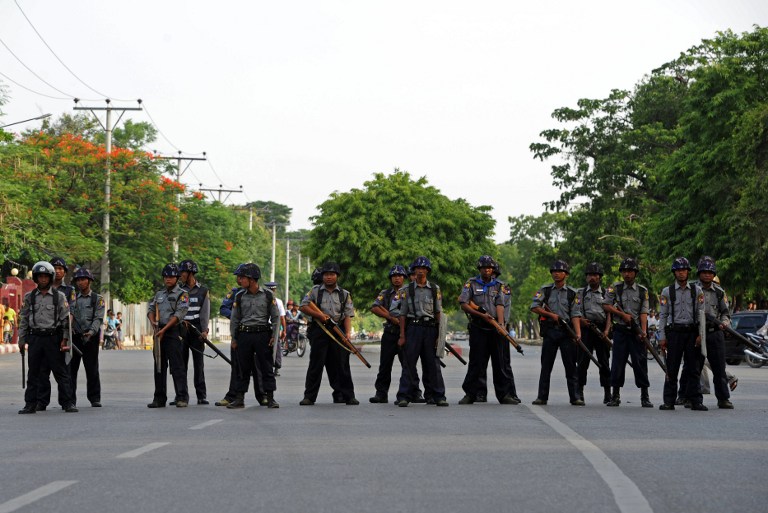

Myanmar police stand guard on a street in Mandalay on July 4, 2014. Thousands of people, some wielding sticks, flooded Myanmar’s second-largest city as tensions spiked during the funeral of a victim of Buddhist-Muslim clashes that have raised fears of spreading violence. AFP PHOTO/SOE THAN WIN
For four days last July in Myanmar’s cultural capital, Mandalay, angry mobs terrorised the city, killing two men (one Buddhist and one Muslim) and injuring at least a dozen. The violence was sparked by allegations, since proven false, that a Buddhist woman had been raped by Muslim men. Since then, more than a dozen people have been arrested and charged in connection with the violence, which fell into a pattern of clashes between religious communities that have left hundreds dead and created deep rifts in communities across the country. On Monday, US-based rights group Justice Trust released a report that placed the blame for the Mandalay riots, and other religion-infused violence, on ‘hidden hands’, or behind-the-scenes actors with ties to political and religious groupings.
It’s a thorough, persuasive report, which the government has remained quiet on so far. Here’s a digest of some of the most significant points. Quotes from Justice Trust interviewees are in italics.
1) The riots in Mandalay followed a distinct pattern of anti-Muslim violence in the country
Communal violence in Myanmar always happens the same way, the report’s authors note. First, a Muslim man is implicated in a crime, usually against a Buddhist woman. In the Mandalay case, it was rape. Social media is used by Buddhist national groups like the controversial 969 movement to whip up anti-Muslim sentiment tied to the alleged crime. Aggressive men, rumored to be outsiders, round up groups of rioters to target Muslims in the community. Little action is taken by authorities to stop the violence, and any legal action taken afterwards is insubstantial.
2) Violence ‘stage-managed’ by ‘trained and funded armed groups’
Multiple witnesses interviewed by Justice Trust over a period of six months reported identifying a clear group of instigators who had arrived from outside the city to whip up anti-Muslim sentiment. They were so far from being local that they got lost.
“I have never seen these rioters before and they clearly came from out of town because I overheard them asking each other for directions.” -Harry, a youth community worker from Mandalay
Unlike previous clashes which have arisen from what the report calls “genuine communal antagonism”, including riots in Rahkine State in 2012 that left more than 250 dead, Mandalay lacked a history of communal conflict, according to locals.
“I have lived in Mandalay for all my adult life and I can tell you that we do not have a problem between Buddhist and Muslim communities.” -U Khe Mar Nanda, senior abbott at Maha Wi Thoat Ta Monastery in Mandalay
Senior monks at two monasteries said that rioters visited, trying unsuccessfully to recruit monks to join the violence.
“I told them they needed to leave as they were disrupting our peace and frightening the children.” -U Dama, senior abbott at Moe Khaung Monastery
3) Agitators were supported by a faction of the government with strong ties to the former military regime
According to the report, an “overwhelming consensus” of people placed responsibility for the riots on military hardliners – specifically those loyal to former President Than Shwe. The authors argue that, while Than Shwe and other top generals retired before the 2010 elections, “it goes without saying that they continue to exercise influence over active military and political bosses, all of whom served faithfully their entire careers under these junta leaders.”
4) The violence, and other religiously-motivated clashes in the country, is part of an effort to undermine the democratic transition
Civil society and political activists interviewed noted the timing of the Mandalay riots, just as the opposition party was unfolding a campaign for constitutional reform and days ahead of a signature gathering event in Mandalay. The event was cancelled and the campaign damaged.
“If you’re busy thinking about the so-called Muslim threat in Myanmar, you probably won’t be worried about the widespread land grabs taking place, resource extractions by multi-national corporations, the upcoming 2015 elections, and much-needed reforms to the constitution” -U Thein Win Aung, an analyst from Mandalay
“The most dangerous effect of the riots is that I’ve already heard on a few occasions people discussing whether a return to military rule would be best to maintain order in Myanmar” -U Thein Than Oo, lawyer from Mandalay, member of Justice Trust steering committee
5) Even the President alluded to the “hidden hands” claim
The authors of the report note that President Thein Sein, in a speech broadcast on TV last July, referred to the riots in Mandalay as “the intentional and deliberate acts of a group or organization.”