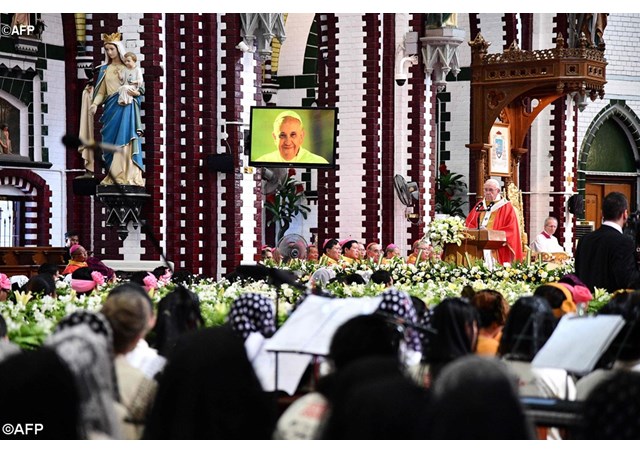

Last night, Vatican spokesman Greg Burke held a press conference where he explained why Pope Francis decided not to mention the Rohingya by name during his historic visit to Myanmar, even after speaking publicly in support of his “Rohingya brothers and sisters” in the past.
Burke previously worked as a journalist for Fox News before he was hired by the Vatican in 2012. He has been called a “marketing mastermind” and is credited with getting Pope Francis onto Twitter and creating his lovable public persona.
Here are five reasons Burke gave for the pope’s decision not to mention the rape, arson, and murder that have driven 620,000 Rohingya refugees out of Myanmar over the last three months:
He respects the locals
Catholic leaders in Myanmar had been urging the pope for months not to mention the Rohingya by name, fearing an anti-Catholic backlash by Myanmar nationalists, who insist that “Rohingya” is not a legitimate ethnic identity and that those who claim it are illegal “Bengali” immigrants.
Burke said last night: “I think it was pretty clear from the local concerns that the pope was going to take the advice [from local bishops] very seriously in public.”
His presence is enough
The pope doesn’t even need to mention the Rohingya because his support for them is implicit.
Burke said: “The fact of the matter that the pope is here and draws attention to the country itself is an incredibly positive thing.”
He does the right thing in private
Burke said the pope’s decision not to mention the Rohingya in public “doesn’t take away from anything the pope has said in the past, or from anything he says in private.”
He said the pope’s goal was “building bridges” with “brothers, which often take place behind closed doors.”
He doesn’t work miracles
Burke insisted that even though the pope is “not afraid of minefields,” he can’t just “parachute in” to areas to solve crises.
“I find it really hard to think that the moral authority of the pope has somehow diminished. People are not expected to solve impossible problems,” he said.
He’s not infallible
The First Vatican Council in 1870 declared that a pope is considered infallible on all issues of faith or morality. According to Burke, though, crimes against humanity do not fall under those categories.
He told reporters: “Everyone’s entitled to their own opinion here. Nobody ever said Vatican diplomacy’s infallible.”