By Htet Khaung Linn and Aung Nyein Chan
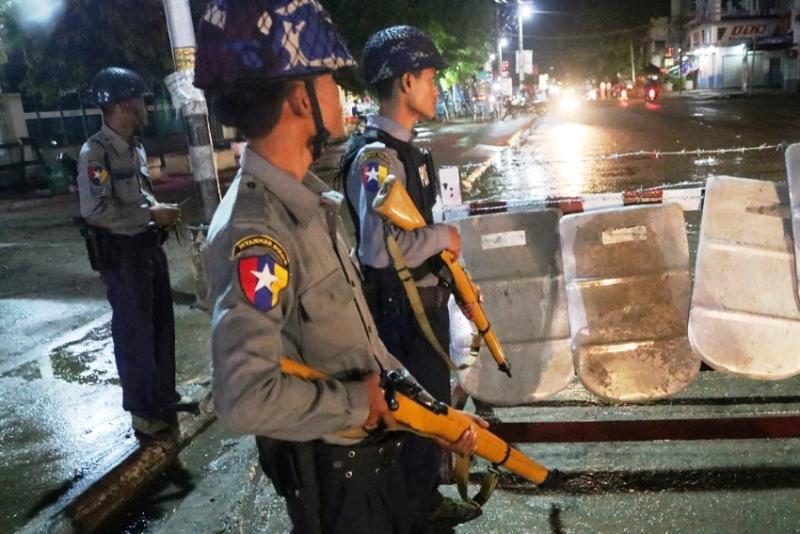
On the evening of September 10 in Magwe Region’s Taungdwingyi Township, a group of masked men set out to destroy Muslim-owned businesses and property.
The men were angry over attacks on police and army posts by the Arakan Rohingya Salvation Army on August 25 in Rakhine State.
More than 400,000 of the stateless Muslim minority have fled to Bangladesh after the army launched a brutal crackdown in response.
But in a pattern that has repeated itself in recent years, the anger in Rakhine was spreading to other Muslim enclaves in the country with little connection to the state.
And now it had arrived in a central Myanmar town, at Soe Myint Lay’s mobile phone and hardware shop.
Trying to be inconspicuous, he hurried inside, turned off the lights, and listened to what the men were saying.
Over the growl of motorbike engines, they were talking about their next target. After roaming around they returned.
“When the mobs arrived in front of my shop for the second time, I went into my grandmother’s house behind my shop,” he said. “When they saw me on the upper floor, they pelted me with stones and slingshots.”
Eventually they broke down the shop’s door, caused costly damages inside and made off with whatever was left over.
In total five shops and three houses were damaged in the one-sided attacks, which lasted three hours, according to official reports.
A planned attack
Though no one was killed, the incident shows once again that what happens in Rakhine can easily ignite conflict elsewhere, no matter the preparation.
Before the violence, local interfaith groups and members of civil society held discussions, hoping to prevent clashes. They didn’t work.
Myanmar Now interviewed more than 20 witnesses of the September 10 attacks, and a picture emerges of a chaotic but planned assault that the police were initially unable to contain.
Some wore masks while others did not. Other than stones and slingshots, men were armed with makeshift batons and machetes. The average age was around 20 years old.
“The attacks could be thought of as planned out by a mastermind,” said Kyaw Swe, a dentist in Taungdwingyi.
“The mobs systematically avoided security police as they were choosing Muslim houses to target.”
He suggested the men in masks might be outside agitators, because when security forces arrived to control the situation, the masked attackers fled, leaving locals to shoulder the blame.
In the lead-up, Muslim residents suspected something was coming, and had taken shelter in safer places. Police tried to guard a mosque, but members of the mob torched a tuk-tuk in front of it. Those who did not escape made it out with injuries.
Soe Myint Lay showed photos of an 80-year-old woman who had been stabbed with scissors and a 45-year-old with cuts on her leg.
Myanmar Now visited the homes of these victims, but they were too afraid to verify the attacks, and relatives also refused to talk out of fear for their safety.
Authorities have arrested and filed charges against seven suspects, but their response to the chaos has come under scrutiny. Zaw Tun, the manager of the local mosque, said the authorities did little to stop the damage that occurred.
“Police just shouted at the mobs not to light the fire, without taking any serious action,” he said, referring to the tuk-tuk.
They did, however, move on the members of the group who had been throwing stones.
Aung Kyaw Kyaw, another witness, said the police weren’t equipped to deal with the attack, and were only able to guard sensitive areas. Many witnesses, both Buddhist and Muslim, didn’t go to the police out of fear of retribution.
“The mobs knew which houses on the road were Muslim houses,” said a Buddhist resident who requested anonymity for safety reasons. He also talked about a “conspiracy,” but said it was more of a locally-driven plan.
“We recognized the faces of those who involved in the attack,” he said.
A history of violence
Taungdwingyi is relatively peaceful, but its residents have suffered inter-communal violence before.
In 2012, a total of 10 Muslim pilgrims were killed while traveling to Rakhine State. Of the 10 victims, six were from Taungdwingyi.
The assault happened in the wake of accusations in Rakhine that a Buddhist woman had been raped by Muslim men. After the pilgrims were killed, violence between the communities flared up, and hundreds were killed. Afterwards, more than 140,000 mostly Muslim residents in Rakhine were sent to IDP camps.
Similar bouts of attacks occurred in Meikhtila in 2013 and Mandalay in 2014. A rise in anti-Muslim sentiment and hate speech has been evident in the aftermath of the ARSA attacks and military campaign. This month, a man was arrested in Yangon after getting drunk and walking down the street in Sanchaung Township threatening to kill Muslims.
In Taungdwingyi, the violence has left its mark in more than one way. Kyaw Swe, the dentist, said the town’s image had now been tarnished.
This story first appeared in Myanmar Now on September 21, 2017.