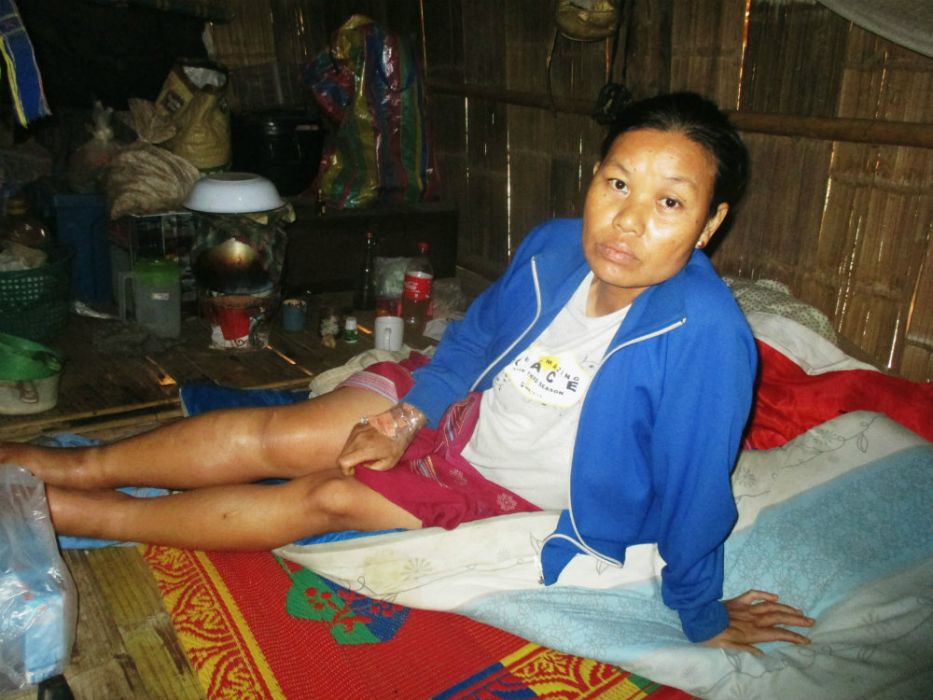

Mae Blae at her home in a refugee camp along the Thai-Myanmar border four months before passing away. Taken in December 2014. Eh Hser Wah / Myanmar Now
I vividly remember the day when my mother called to tell me Mae Blae, my neighbor, friend and weaving teacher, had passed away. It was March 11, 2015. There was cool evening breeze and I had just finished a typical day at school in Mae Sot.
I knew that this day would come but did not think it would be this soon. Shocked, I burst into tears. I had just visited her a month before. It broke my heart to see her lying down, weakened and thin, on a mattress in a small, dark room of her bamboo and thatched-roof house in Mae La refugee camp.
She was only 41, with that same sturdy face that used to elicit teasing from neighbors because her eyebrows, placed closely together on her forehead, made her look like she was constantly frowning. Mae Blae left behind two sons, aged eight and ten years old, and a husband.
She told me: “I want my children to have the opportunity to grow up as full human beings – to get an education and not have the kind of tough life me and my ancestors have had. For me, there is no worry anymore as I have already given all of myself to God. Soon, I will be gone,” she said sadly, gazing out of the window.
I felt helpless, unable to help her in any way in her final days.
Mae Blae’s untimely death, as for so many refugees in the nine camps dotted along the Thai-Myanmar border, came after a life of poverty, war and discrimination. She was denied the right to live in her hometown in Kayin State and had poor access to healthcare in her place of refuge.
Her story may not be unique, but it will stay in my mind forever. It has made me reflect deeply on the plight of displaced ethnic Kayin women. I am one of them.
I met Mae Blae when I moved to the camp in 2006. I was 10 years old. I went with my mother who was called to the camp by her relatives, who told her the camp could provide safety and stability, education for children and job opportunities.
Mae Blae was honest and kind, though people assumed she had a sulky character because of her dominant eyebrows. Despite our age difference – she was in her 30s when we met – she became my close friend and also my teacher. She was a skilled weaver, coming from the mountainous north of Kayin State where she learned the traditional craft when she was a child.
She grew up in a remote village and often told me stories about her survival and the hardships she faced growing up in this conflict-ridden part of southeast Myanmar, where Kayin rebels have fought a decades-long insurgency against the military. Mae Blae lacked formal education and had little knowledge of the outside world. She was simply a Kayin farmer and weaver trying to make a living in an area blighted by war and poverty.
After losing her beloved first husband during the fighting and all four of her children to malaria, she moved to the refugee camp in 2004. After a year, she was registered as a refugee by UNCHR, the UN refugee agency, and received a basic ration from the Border Consortium, which provides food and shelter in the nine camps.
After that, her life improved and she enjoyed security for the first time. In the camp, she met a Kayin man and they fell in love. Unfortunately, he became a drug addict and squandered what little money they had on opium and alcohol.
Yet I never heard her complain. She just tried to earn a living without relying on her husband. She would do both housework and outside jobs even when her two sons were still infants. She carried water and washed clothes even in the weeks after giving birth.
I used to visit her almost every day and learned to weave. She would confide in me, sharing her worries and fears. But when she fell seriously ill, I was not beside her. I was away from home studying.
Like many refugees who experience health problems, Mae Blae went to a nearby health clinic, was given some basic medicine to lessen her symptoms and carried on with her daily work. The medic told her that her uterus was moving downward and warned she should be careful not to carry heavy things, but she could not avoid that because camp life required many manual chores.
Her husband was oblivious to her condition and thought she was exaggerating the pain. She carried on until the pain intensified in mid-2014. In December, she was at last sent to the main hospital in the camp. By then, I was away at school and my mother told me the doctors had given up on her because they had found she was in the final stages of uterine cancer.
The doctors told her she could be treated if she could afford surgery that could cost tens of thousands of dollars. She was earning just a few dollars from selling woven clothes, of which she could make one garment every two days. She had no money and no one to support her treatment, so she was sent back to her hut to wait out her last days.
Mae Blae’s plight made me wonder how many other women suffer the same fate where there is war, poverty and lack of proper healthcare. Women’s vulnerability is compounded by our conservative culture that teaches them to keep quiet and accept their fate.
Life is extremely hard for those who are denied or do not know their rights. It hurts me to think of these women, invisible to the world and bearing their pain in silence. Will they ever find a way out? I don’t know. I can only hope.
As a woman who grew up a refugee camp, I feel an obligation to reveal the story of Mae Blae. As an aspiring journalist, I hope that sharing such stories will lead to discussions about the defenceless who suffer in our society, so they will no longer stay silent and people will offer them the help they deserve.
Text / Eh Hser Wah