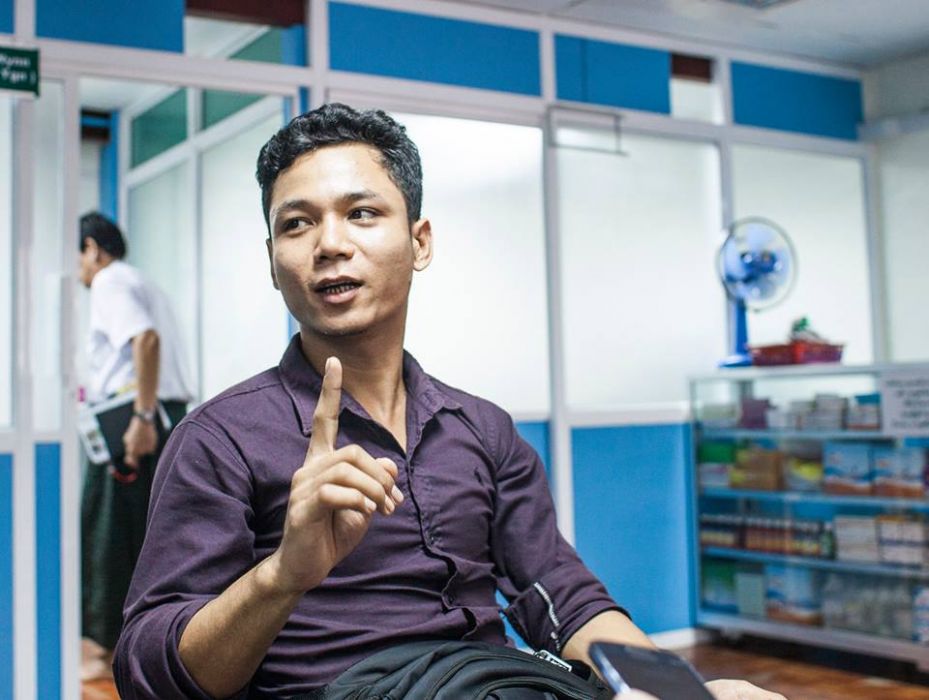

Myo Min Oo, 28, tells his story at the Myanmar Seaman’s Federation on April 22, 2015. PHOTO/COCONUTS MEDIA
On the morning of April 2, Myo Min Oo was asleep in his room on the lower deck of the Russian fishing trawler Dalny Vostok when he awoke to someone pounding on his door and shouting in Burmese.
Groggy and tired – it was around 5:30am – he was jolted awake when he heard the words.
“Wake up! Wake up! The ship is listing!”
There were 42 Burmese workers on the Dalny Vostok out of a crew of 132. Some 57 people, including 20 Burmese nationals, would die that day. As he sprang out of bed, however, Myo Min Oo had no idea how bad it was going to get.
“I put my clothes on,” the 28-year-old told Coconuts Yangon on Wednesday, through an interpreter at the Myanmar Seaman’s Federation, which is assisting the workers as they attempt to collect, via the government, back pay and compensation. “I went to the main deck.”
It was chaos. The sun had yet to rise and the area around them was thrown into darkness. Men were running around and shouting in foreign languages. There were Russians, Latvians, Ukrainians and men from Vanuata, a small island nation in the South Pacific. The ship was clearly sinking.
The men from Myanmar, who had packed fish in a small factory aboard the Dalny Vostok, stuck together. Before heading to the main deck, they ran to get immersion suits, which would keep them warm in the icy waters and help them float.
“One man didn’t get one,” Myo Min Oo said. “He died.”
As others went for the waters with lifeboats, Myo Min Oo and a small group rushed for the tip of the vessel, which was, for the moment, still above water. They clung to the railings and waited, “for about 30 minutes,” he said.
The Dalny Vostok was sinking in the Sea of Okhotsk in Russia’s Far East. Luckily, this is a heavily fished area. The captain of the ship had sent a distress signal and trawlers nearby were already moving towards the site. But they weren’t close enough.
After 30 minutes, “the ship started sinking faster,” he said. Myo Min Oo says he wasn’t afraid. He said Buddhist prayers. “I believed I would survive.”
Around him other Burmese men and foreign crew were in the water. Many of them would freeze to death even though the suits would keep their bodies floating in the water, which was how the rescuers were able to locate them so easily. Out of the 10 people sleeping in Myo Min Oo’s room, six died.
There was not much of a ship to hang onto anymore, so the men plunged into the stormy, freezing waters, with plans to swim to the boats. By now it was light. The ships were close enough to be seen but to swim to them was another matter.
“I was swimming in the sea for three hours,” he said. “I was almost about to give up, because I could not move any more.”
Their group had dwindled to a few Burmese men and a couple of Russians. The Burmese clutched each other in a group of three. Finally, a boat neared, and rope ladders were thrown overboard. As they neared the ladders, one man in their little circle could not exert any more energy. He slipped away and died in the waters.
Men started climbing the ladders to safety. Myo Min Oo grabbed on but he had no strength left to make the final push. All he could do was hold on. The rescuers noticed that he wasn’t climbing and began pulling him up themselves. He was laid out on the deck, completely motionless from the cold. But he had made it, as would 21 others.
Twenty workers from their country were not so lucky. The corpses of 16 Myanmar nationals were returned last week, while four men were never found. Myo Min Oo thinks they are still on the ship because they never made it out of their rooms.
The men on the rescue vessel were given hot water to warm up and covered with blankets. A doctor administered to them but they couldn’t eat; they had swallowed too much sea water.
Two days later, on April 4, the survivors were taken to remote Sakhalin Island where they stayed in a hotel and were issued new passports. On April 12, they flew home.
Myo Min Oo says he has fully recovered and will soon travel to Mandalay to see his family. He and other survivors are staying in a temple in Yangon.
What are his next plans? He is looking for a new job on a ship.