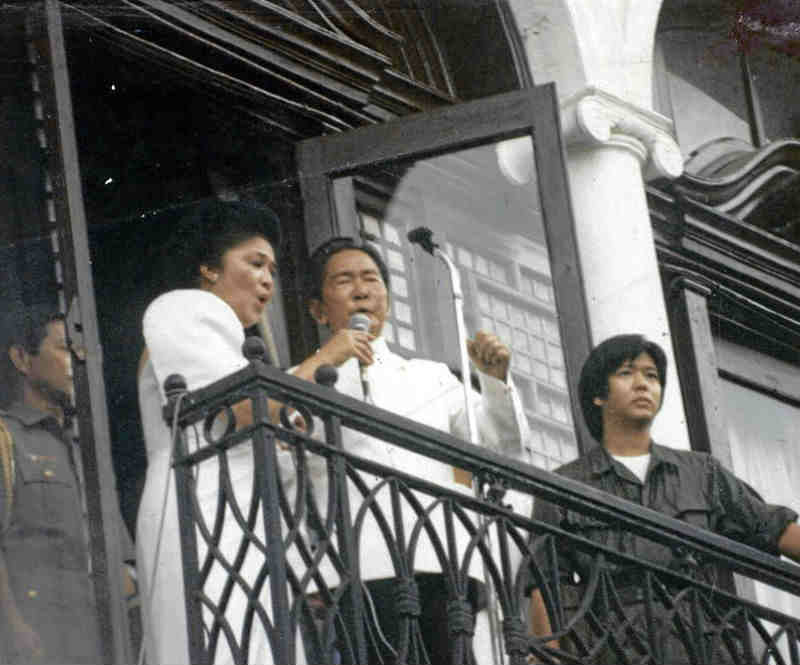

The Court of Appeals has stood pat on its earlier ruling junking the plea of human rights victims during the Marcos regime for the enforcement of a United States court decision awarding them $2 billion in compensation.
In a three-page resolution dated January 3, 2018 penned by Associate Justice Normandie Pizarro, the appellate court, through its Former 12th Division, denied the motion filed by the claimants and affirmed its July 7, 2017 ruling.
The case stemmed from a class suit filed before the United States District Court in Hawaii by ten individuals led by former Commission on Human Rights (CHR) chairperson Etta Rosales and film director Joel Lamangan on behalf of some 10,000 claimants. On February 3, 1995, the Hawaii court ordered the payment of compensation to claimants.
The petition was filed with the appellate court after the Makati City Regional Trial Court ruled that the enforcement of the claim over the estate of the late strongman Ferdinand Marcos could not prosper because of the Hawaii court’s lack of jurisdiction.
The lower court had also ruled that the US court’s decision violated the parties’ right to due process.
In its resolution, the appellate court upheld the Makati sala’s ruling and reiterated that the final judgment of the Hawaii court was null and void for lack of jurisdiction, that it violated both parties’ right to due process, and that it was “constitutionally infirm.”
“Consequently, the Final Judgment rendered therein [by the Hawaii court] is not binding,” the CA resolution read.
In the affirmed July 7, 2017 decision, the appellate court had pointed out that the Hawaii court’s final judgment failed to meet Philippine standards for a valid judgment.
It also stressed that “Rules of Comity should not be made to prevail over our Constitution and we cannot allow foreign impositions to trample upon our sovereignty.”
The CA added that the case was “erroneously filed” by claimants as a class suit and pointed out that claimants remained unidentified, depriving both sides due process.
It said the unnamed claimants had “no opportunity” to get “the full rehabilitative potential” of litigation and “[overlooked] the individual harms [they] purportedly suffered.”
The anonymity also gave “no opportunity for the Marcos Estate to confront each and every claimant.”
The upheld ruling had also stressed that the Hawaii court made a “constitutionally infirm” decision because it made a ruling on the basis of a different law, whereas claimants filed the case under the Alien Torts Statute, which grants jurisdiction to US courts over civil cases concerning violations of international laws filed by a foreigner.
“This invalidates the disposition considering that a decision that does not conform to the form and substance required by the Constitution and the law is void and deemed legally nonexistent,” the CA said.
Thousands of human rights victims during Marcos’ dictatorial rule continue to seek justice for abuse they endured during the regime, marked by extrajudicial killings, enforced disappearances, the incarceration of critics and activists, and the plunder of state coffers.
Sought for comment, Rosales said she was “very sad” and “disappointed” with the appellate court’s decision and said she and her co-petitioners are keen to elevate the case to the Supreme Court.
“Of course you can get a victory if members of the court take into account the human rights victims themselves, if they take into account the rule of law, if they take their mandate seriously,” Rosales told ANC.
“Members of the Supreme Court… have actually stood by us, our human rights. But then the others have not, that’s why Marcos was buried in Libingan ng mga Bayani. I’m only hoping that things will look better but we should not lose hope. We should just keep on charging and continue to educate people,” she said.