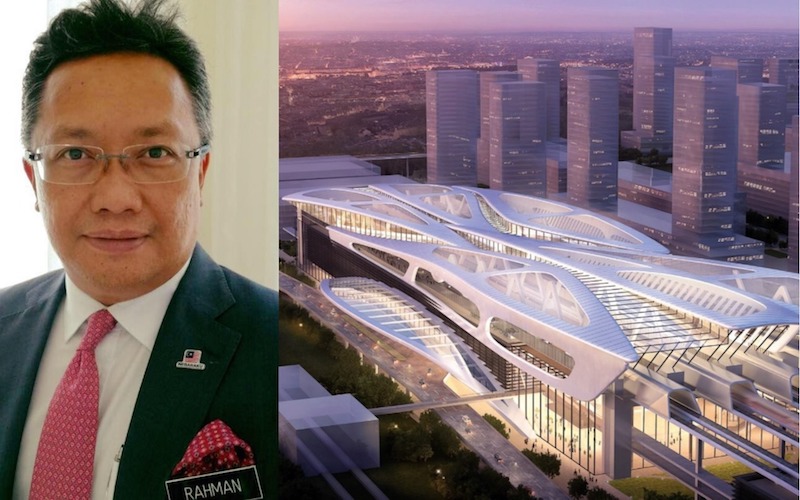

It’s not unexpected for Datuk Seri Abdul Rahman Dahlan to protest against the cancellation of the Singapore-Kuala Lumpur high-speed rail (HSR) project. After all, he was the minister in charge of the multibillion-Ringgit transportation project under the Malaysian government’s previous administration, before Tun Dr. Mahathir Mohamad returned as prime minister.
On Monday, the Malaysian leader announced that Malaysia will be scrapping the highly-anticipated project, calling it “unnecessary” and that it will not be beneficial at all for his country. So abrupt was this decision that Singapore has yet to receive any official notification from Malaysia, according to Singapore’s Ministry of Transport.
This turn of events will obviously leave Singapore in a lurch — over the past couple of years, the once-sleepy Jurong Lake District was revamped into a buzzing hotspot, with the government envisioning it to be Singapore’s second CBD once the HSR terminus in Jurong is completed in 2026.
Our deepest condolences to Jurong residents and West-side stans.
Not only will the cancellation of HSR become a troubling development for Singapore, Datuk Abdul Rahman believes that the new government in his country is making a huge, huge mistake, according to his post on Facebook.
As someone who was once in charge of the HSR project, clearly he would have in-depth knowledge of its economic impact and the consequences of not going through with the railway. As someone who is a figure in a defeated political party, perhaps his piece should be taken with a dab of salt. His detailed argument on why HSR is a missed opportunity can be found here, and check out some highlights from his post below.
On the HSR’s financial viability
“The HSR is a strategic project between the Governments of Malaysia and Singapore that aims to improve their economies and elevate the quality of life of both countries through seamless travel between the two capital cities, enhance business linkages, and connect the peoples of both countries closer together. With terminus stations in Kuala Lumpur’s Bandar Malaysia and Singapore’s Jurong East, the HSR link is expected to cut the travel time between the two cities to 90 minutes.
The Singapore-Kuala Lumpur air-route is the busiest international route in the world. There were 30,537 flights between both cities in 2017 putting Hong Kong-Taipei firmly into second place at 28,887 flights.
With such large yearly passenger numbers, there would have been a strong case for the financial viability for the project.”
On the economic potential
“The many stations in between, namely Putrajaya, Seremban, Melaka, Muar, Batu Pahat, and Iskandar Puteri which are relatively less developed than Kuala Lumpur or Singapore would stand to gain from development.
It is forecasted the result of HSR would be no less than the economic multipliers that happened to the Taiwan HSR between Taipei & Kaoshiung and the Tokaido Shinkansen between Tokyo & Osaka.
As such, it is too simplistic for the Prime Minister Tun Dr Mahathir to say that the project won’t be beneficial because it’s going to cost our country a huge sum of money and it will make no money at all from the operation as any potential returns from land value capture would pay for the railway project in the long run.
On the macro point-of-view, it is estimated that Malaysia will lose an estimated RM209 billion in gross national income (GNI) contribution and lose the potential to create 70,000 jobs if the Kuala Lumpur-Singapore High-Speed Rail is called off.
After the HSR is in operation, a study by the research body Institute of Developing Economies, Japan External Trade Organisation (IDE-JETRO) found that the HSR would have delivered a US$1 billion (RM4 billion) economic gain to Malaysia every year.”
On its far-reaching consequences
“With the cancellation of this mega-project, it would have far-reaching consequences for Malaysia than just the lowering of our GDP growth potential. It will also disappoint foreign investors who see the project as a catalyst for a more rapid pace of growth.
The government should not be short-sighted in making an important decision such as this. It is obviously clear that the spill-over benefits are so huge that it will be a wasted opportunity if we don’t proceed with the project now. Should this project be re-started in future years, the cost would only increase and the debt burden will increase manifold which is totally against PH government’s plan to reduce the national debt.”