
In April of last year, the Malaysian government passed an anti-fake news bill — similar to the one currently being considered by the Singaporean government — but after the surprise victory of Malaysian Prime Minister Mahathir Mohamad and his Pakatan Harapan alliance in May, the new government promised to repeal the law.
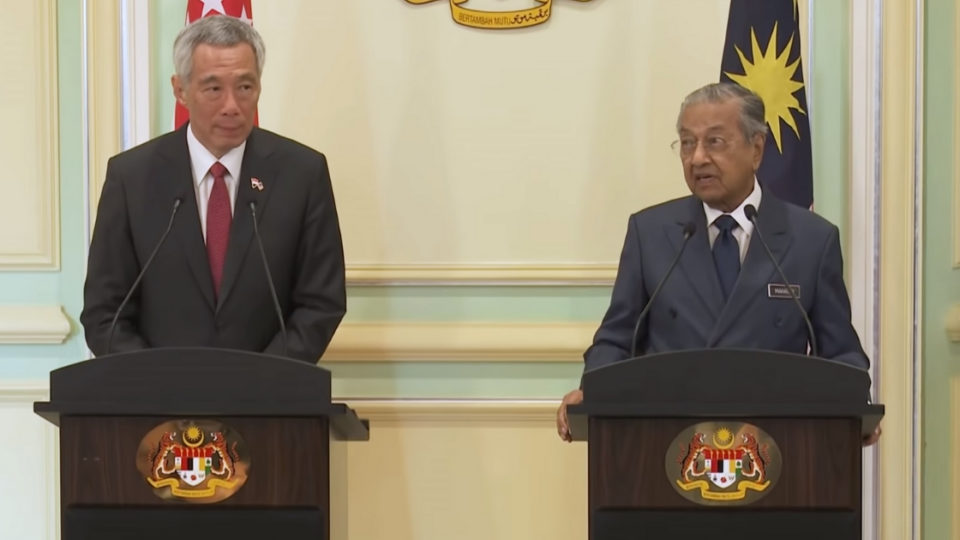
During a press conference yesterday, Mahathir explained his reasons for repealing his country’s anti-fake news law, just after Singaporean Prime Minister Lee Hsien Loong defended his country’s anti-fake news bill, in an exchange that revealed their differing views on the subject.

The leaders of the two neighboring countries were together for a two-day leader’s retreat in Putrajaya, Malaysia. At the press conference, one reporter from Malayiakini asked PM Lee about his response to critics of the Singapore’s anti-fake news, such as the NGO Reporters Without Borders, which recently issued a statement slamming Singapore’s bill as “completely inappropriate” and “Orwellian”.
Lee said he wasn’t surprised that Reporters Without Borders had criticized the Protection From Online Falsehoods and Manipulation Bill as the organization had often been critical of his government’s management of the media (the NGO also compiles the annual World Press Freedom Index in which Singapore most recently ranked 151 out of 180 countries).
The Singaporean PM also noted that his country was far from the only one enacting similar anti-fake news laws, mentioning France, Germany and Australia (which he noted had done something recently that was “similar and very draconian” — probably a reference to a newly-passed Australian law regulating social media in the wake of the New Zealand mosque shooting that was live-streamed on Facebook) as other examples.
Saying that the government had already spent over two years researching the issue as well as deliberating and debating the bill, Lee concluded “… what we have done has worked for Singapore, and it is our objective to continue to do things which will work for Singapore. And I think (the bill) will be a significant step forward in this regard.”
Lee’s response did not touch upon the primary concerns of activists critical of the bill, namely that it would give wide discretionary power for government ministers to decided what news is “fake” and what is true, which could lead to the suppression of legitimate criticism of the government.
But Mahathir did touch upon that subject in his follow-up to Lee’s answer in which he explained why his government was working to repeal the anti-fake news bill passed by his predecessor, former Prime Minister (and corruption suspect currently undergoing trial) Najib Razak.
Mahathir said that repealing the bill was “what the people want” and “we respect the people who voted us into power”.
The Malaysian PM then spoke to the possible chilling effects such laws can have, saying, “When we have a law that prevents people from airing their views, then we are afraid that the government itself may abuse the law, as has happened in the last government.”
Najib’s government had been notorious for suppressing critical coverage by the Malaysian media, particularly stories that related to his involvement in the massive IMDB corruption scandal.
While acknowledging that the task of tackling fake news would be hard, Mahathir said, “We do not want any government, this one and subsequent ones, to make use of the law in order to tell fake news, the government itself creating fake news in order to sustain themselves.”
“It will be difficult to handle. But we believe that we can accept the challenges and we can handle them,” concluded Mahathir.