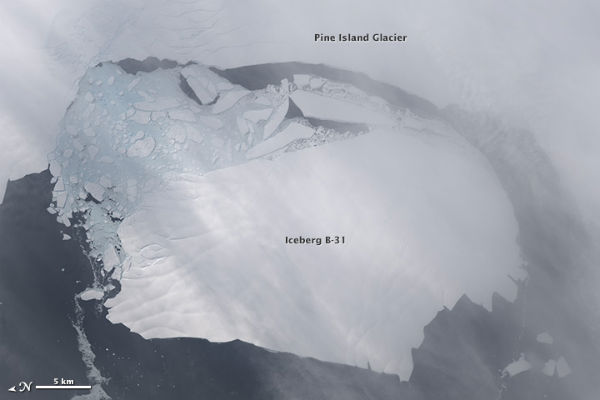

Iceberg B-31, named so by the US National Ice Center, has finally split completely from the Pine Island Glacier (PIG) in Antarctica and is now moving through the Southern Ocean.
Scientists first discovered the development of the iceberg when a long crack appeared across the 30km width of the PIG, the most rapidly shrinking glacier on Earth, in 2011.
[[{“type”:”media”,”view_mode”:”media_original”,”fid”:”29566″,”attributes”:{“alt”:””,”class”:”media-image”,”height”:”400″,”typeof”:”foaf:Image”,”width”:”600″}}]]
While huge, B-31 isn’t the world’s largest recorded iceberg, falling behind the 11,000 sq. km. B-15, which took over a decade to melt away into the ocean.
According to reports, scientists from Sheffield and Southampton have already received funding — an emergency $80,000 grant — to track and predict the movement of the 700 sq. km. chunk of ice.
Said principal investigator Grant Biggs, if this current iceberg follows the trajectory of previous ones, it will bring the Singapore-size floating island of ice into international shipping lanes.