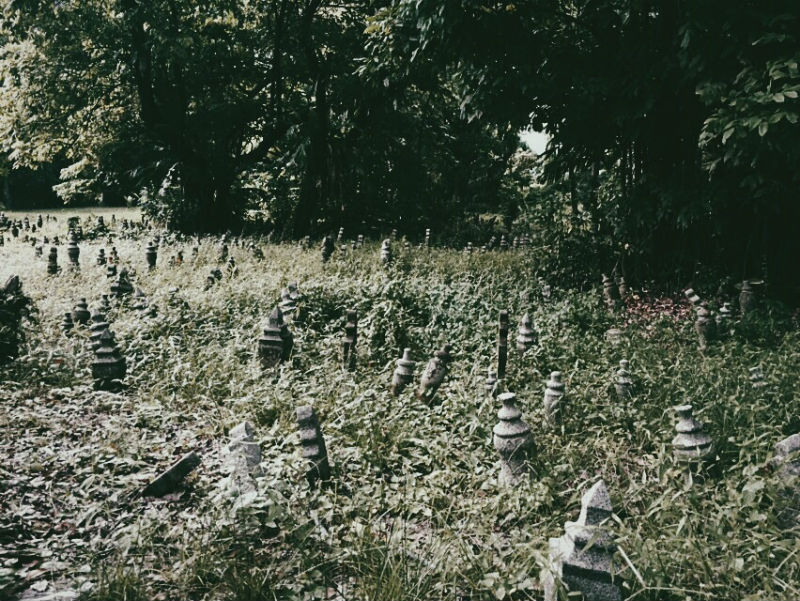

What happens when you die?
Aside from heaven, hell and other complex afterlife arrangements, when we die, someone arranges a funeral and then we commit to earth or fire. Or I guess, science.
In land-strapped Singapore, we keep our cemeteries and crematoriums at the end of the island, or tucked away in secret crevices in suburbs. There are some situated in the middle of bustling city life, but there’re very little of them and in small sizes, like the one on Jalan Kubor in the Bugis precinct and at Fort Canning Park (yes, right next to the locations of the annual Laneway and Retrolicious festivals).
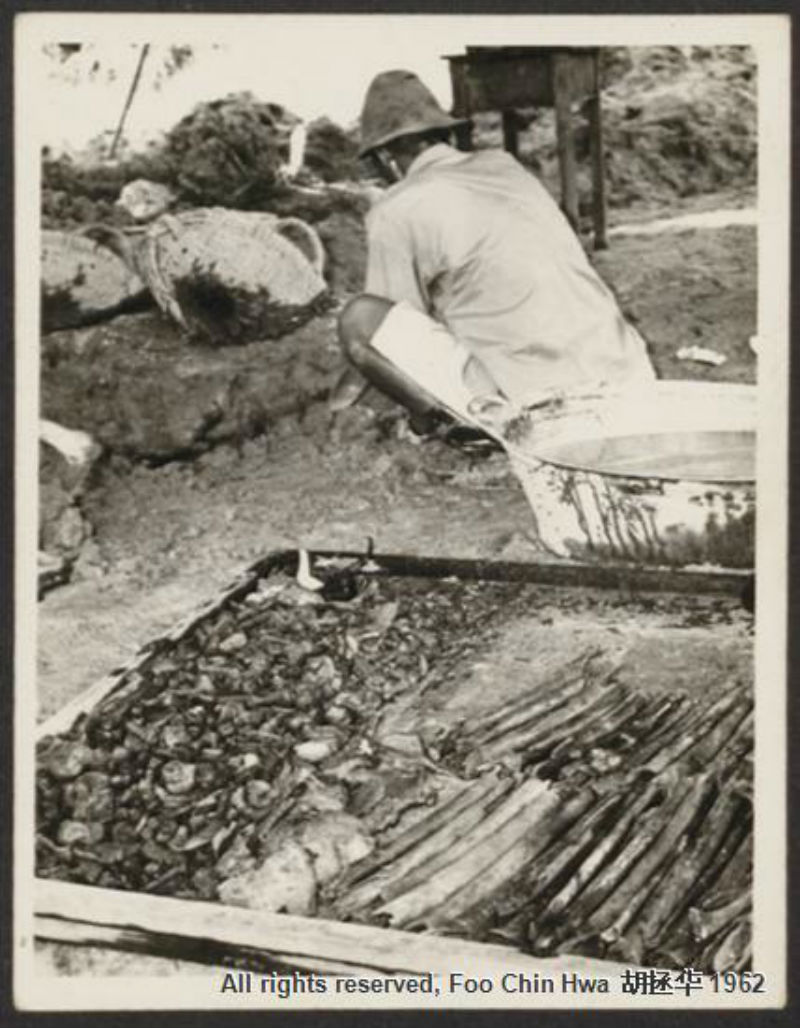 Photo: Grave-digging in the ’60s; Foo Chin Hwa
But a long time ago, Singapore’s cemeteries were scattered well over the island, some in more central areas than you’d expect. Chances are if you’re staying or working in Bishan, Novena or Tiong Bahru, you’re standing in a former gravesite.
Even Orchard Road had a cemetery, a Jewish one that functioned from 1841 to 1903.
But the dead and the living could only co-exist for so long.
It’s not that we were squeamish — hell one of our local literary classics is a series called the True Singapore Ghost Stories and in some cultures people actually want to live on former burial grounds (they call it feng shui) — we just needed the space. And badly.
The Jewish graveyard in Orchard was moved to Thomson, then to a mega cemetery in Choa Chu Kang.
 Photo: Exhumation of the Orchard cemetery; Ronni Pinsler
But one of the most significant cemetery upheavals in the city’s history is that of the lush and sprawling Bidadari estate. Once an Istana residence to one of Johor’s Sultan Abubakar’s wives, the space became Singapore’s third graveyard in 1904 — the final abode for many Hindus, Christians, Muslims and Singhalese — and only shut its gates in 1972. By this time, it had seen approximately 147,000 graves, which remained where they were until 1998, when Bidadari was earmarked in the Master Plan for public housing and development.
 Photo: The sprawling Bidadari Cemetery; National Library Board
By 2001, Housing and Development Board (HDB) had begun exhuming the graves. The process: a next of kin or family representative would be contacted for each and every grave and proceedings would assume. This was no easy task, as not only was the area vast, there had not been proper plot-planning for older graves and accounting for each grave was well, impossible.
The Master Plan also set precedent by setting a deadline… for the dead. With effect from November 1998, the burial period for all graves would be limited to 15 years. Once time is up, graves will be exhumed and for those whose religion permits cremation, the exhumed remains will be cremated and stored in columbaria niches. Where compulsory burial is required due to religious reasons, the remains will be re-buried in smaller individual plots.
“Of course it’s sad when you have to ‘see’ your deceased relative again, but everything’s carried out with respect and sensitivity,” said my friend, who witnessed her grandmother’s grave being exhumed at Bidadari in 2001, and relocated to Choa Chu Kang. “We’re so short on land, so exhumation is practical and thus, acceptable.”

Cemeteries aren’t the only ones disappearing in Singapore — individual graves have, too. Rose Effendi had gone to Bidadari to ‘claim’ her grandmother’s grave during the exhumation exercise, but couldn’t find it.
“We were told the grave had probably ‘sunk’ over the years.”
 Photo: Bidadari precinct; HDB
They say the life of the dead is placed in the memory of the living. Except in Singapore, the memory lives on in the landscape.
Top photo: One of Singapore’s existing city-centre cemeteries in Jalan Kubor; Ilyas Sholihyn
 Memory Lane is an original Coconuts Singapore series about the evolution of local culture. Got an idea about something we should pursue? Tweet us.
Read Also:
Memory Lane: Before Zouk, there was Golden Venus
#TrendSing: Launch into your inner space at Palm Avenue Float Club