
Can happiness be purchased? Did your donation to a non-profit organisation actually make a difference in someone’s life? How do you even measure that impact?
These are all questions that Singaporean filmmaker, Mak CK, wants audiences to think about after watching his new documentary: Buying Happiness. Never mind that it’ll only come out in 2019 — the film is more of a personal project, and it’s an ongoing one about the lives of a group of people very close to his heart. It’s been more than a decade in the making — well, sort of — but to understand that, you’ll have to rewind back to the beginning.
How it all started
After kicking his career into gear at MTV, Mak spent a couple years working for local production companies before moving on to documentaries. If you haven’t heard of his debut feature, The World’s Most Fashionable Prison, you oughta watch it for its fascinating tale of fashion designer Puey Quinones and the workshops he conducted at the largest maximum security prison in the Philippines. Or if weird and wonderful stories are more up your alley, you’ll wanna catch his 2014 release, Little People Big Dreams — it chronicles the lives of employees at the controversial theme park Dwarf Empire in China.
Both titles were wildly successful, and they were part of the reason why Mak realised this filmmaking path was something more than a passion — it was one he could pursue wholeheartedly. So he thought back to 2004, after he’d graduated and backpacked around the world.
“I was ready for the next big adventure after university,” he revealed. “I thought Africa was the ultimate frontier — it sounded so far and abstract. I wanted to get to know the community there.”

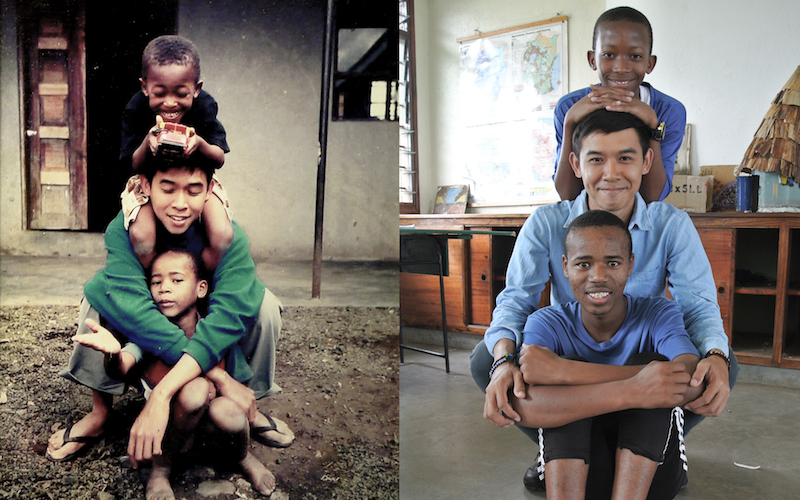
Mak searched for non-governmental organisations (NGOs) that needed volunteers and found an orphanage in Tanzania with about 30 children, but no running water or electricity. And he was sold. He turned out to be the first male volunteer the orphanage had ever seen, and the boys all looked up to him as an older brother figure. Solid relationships were formed — despite the language barriers — between the kids and their English teacher. Five months later, Mak left with vivid memories of his experience — ones that stayed with him through the years.
Revisiting the past over a decade later
Fast forward to 2015, when Mak returned to the orphanage in Tanzania. Everyone he knew, except one person, was gone. So he trekked across the country to track them down and managed to meet up with almost all his friends.
“When I left, I was always worried about keeping in touch, because it’s so romantic for me to go and ‘save’ their lives and teach them English and have that on my emotional CV,” he admitted. “But it’s hard to face up to the truth that maybe half of them didn’t benefit from the volunteerism, or maybe they would’ve been better off without my intervention, so to speak. All these questions came up, so going back I was surprised at how different their lives were.”
Turns out, while some of his friends were doing well, others had been to prison and were living on the streets. After hearing about their dire situations, he realised he couldn’t just make a film about their plight — he had to help them.
“If you ask a regular Singaporean for money to give to your African friends, it’s like, they’re dead behind the eyes,” he said. “It’s a cliché, a very ’80s or ’90s idea. But I thought, give me money and I’ll show you how your money can impact their lives every step of the way for a few years.”
And that’s when the idea for Buying Happiness came together. The documentary will focus on nine of his orphan friends, who pitched projects to him for a one-time financial assistance. His only criteria was that he had to believe their projects were sustainable, and they were not allowed to ask for more money, no matter what happened. Of course, they also had to let him film them.
“I see this project as me helping my friends, who happen to be African,” he explained. “When you help your friends, you don’t have all these ethical issues about checks and balances. I’m very transparent about that — I told them, you can do whatever you want. There’s no accountability, because you’ve already earned my trust. And whatever you do after that is up to your own conscience and goodwill between us.”
So after the first round of crowdfunding earlier this year, the team raised over USD38,000 through Indiegogo — they fell short of their target of USD55,000, but managed to pass sufficient funds to eight of his friends (the last one will receive it the next time he returns to Tanzania). The second crowdfunding effort begins this month, with a goal of USD15,000.
The people he wants to help
Among the diverse group is Jackie, a mother of a two-year-old who seeks financial independence. Her dream is to start a baking business from home, so the money went to her charcoal oven and three months’ worth of baking supplies. Then there’s Daniel, whose wife was murdered, leaving him with their toddler. After struggling to find work for years, he plans to establish a wholesale company. As for John, who wishes to become a certified tour guide, he’s been going to classes at a tourism institute — the money was used to fund his two-year course.
“When John was counting his money, he was smiling like a boy in a candy shop,” Mak recalled. “I asked, what are you feeling? He said, I feel like I’m holding the future in my hands.”
It’s moments like these that make you think — sometimes, all someone needs is a little help from their friends.
And because success is such a subjective term, Mak simply seeks to enable viewers to better understand his friends’ stories and lives, so they can choose how they’d like to engage with the concept of charity and aid.
“Most of us want to buy hapiness for ourselves by helping others and writing a check, but are we doing the right thing? Does it realy help?” Mak asked. “These are all questions you may have thought of. And this film wants to put it in an explicit, literal and personal way, to let you decide for yourself.”
Continuing with the years-long process of filming
Now that Mak has given out the money to the Tanzanians, his next step is to head back the country every few months until 2019 to film their progress. He likens it to the Up documentary series that periodically followed the lives of 14 British seven-year-olds since 1964, with one episode coming out every seven years. “When you make films of real people, their lives go on, but the story always has a clear end. And when it happens, the filmmaker will see it,” he said.
“The film is a way for me to figure out how 30 people from the same upbringing can have such different destinies ten years later,” Mak summarised. “Over the next few years, I’m going to track what the money translates to, in terms of impact. It could be financial, or it could be more security, psychologically or emotionally. I think the audience will see for themselves and decide whether they succeeded or not.”
As for his ultimate goal with the film?
“I want people to understand the abstract idea of poverty in Africa. It’s a subject very close to me, and people may understand it intellectually, but not emotionally. They don’t know what it really means,” he reflected. “My role in the film is strong, partly because I want to be the bridge between a viewer from the developed world and these characters whose stories we’re telling. Through that connection, people can decide if they want to help or how they can help.”
If you’d like to make a contribution, visit the Buying Happiness Indiegogo page. Alternatively, you can check out the Buying More Happiness fundraising event on Nov 23, 7pm-11pm at Timbre @ The Substation, where Mak will share footage from his recent shoot in Tanzania and answer any questions you have. And from Nov 25 till Dec 10, if you go for the ‘Dining with a Conscience‘ set meal at SPRMKT Kitchen & Bar, a portion of the proceeds will go towards the film’s production.