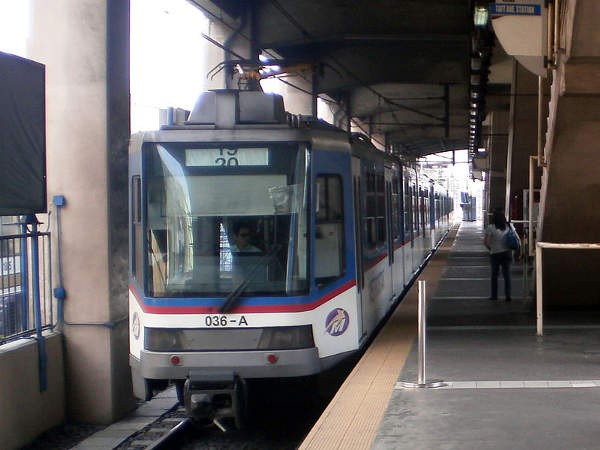

It’s better to be paranoid than dead. (Or should we just keep our mouths shut because people will accuse us of being “too negative”?)
“The issue at MRT-3 is not whether GM Al Vitangcol resigned or was fired Monday. He’s out, period. Focus now should be on the true issue: the railway’s maintenance—or the lack of it,” writes veteran journalist Jarius Bondoc in The Philippine Star.
Bondoc went on to say that “the MRT-3 is a disaster waiting to happen” because “the trains could collide, ignite, or fall off the elevated tracks.”
Bondoc then enumerated incidents thats served as proof of the MRT-3’s imminent doom. We’re re-posting what he wrote word-for-word below:
(1) Nov. 3, 2012, 3:30 p.m.: Fire broke out from explosions inside and underneath the middle tram of a three-tram train. Cause: electrical short-circuit of three electrical parts that, in periodic maintenance, PH Trams should have inspected and replaced.
(2) Mar. 19, 2013: MRT-3 stopped for two-and-a-half hours, as two high-voltage breakers at Magallanes and Taft stations tripped off. Cause: a surge arrester between the two stations snapped, cutting off power to the catenary (the stick atop that connects a train to the power line above). PH Trams’ initial excuse of a sagging Meralco power line proved false. Periodic inspection and replacement of surge arresters is among its contracted duties. Passengers had to be evacuated, commuters made to wait in long lines all over EDSA, and MRT-3 lost multimillion-pesos in ticket sales. It took days to replace the arrester, as PH Trams had none of the crucial spare part in its stock inventory, in breach of its contract.
(3) Nov. 25, 2013: A tram collided with a parked one at the depot. Reason: the APT Global driver was backing up from inside the tram, where he had no rearview, instead of from the holster outside. Damage reported on couplers, body, and chassis of both trams. It was not indicated if driver was authorized, much less trained.
(4) Mar. 20, 2014: Signal system flopped, particularly between Ayala and Buendia stations. APT Global ignored it. The signal system electronically connects each train to the central computers and to each other. It must never send wrong signals, lest trains automatically brake abruptly because misinformed that the tracks ahead are “Occupied” by others, when actually clear. Worse could occur — high-speed crash — if the system mis-signals a track to be “Unoccupied” and the train proceeds at full throttle.
(5) Mar. 22, 2014, 2:30 p.m.: System did mis-signal at the two busy stations, stopping all trains that needed to pass through and clogging the entire railway. MRT-3 lost revenues, as operations stood still for hours.
(6) Mar. 24, 2014, 6:30 a.m.: Mis-signaling recurred, again stopping MRT-3 operations. Until now it is unclear if the signal system maker, Bombardier, was called in to fix the problem. What’s known is that MRT-3 switched to manual signaling, that is, by walkie-talkie of personnel highly prone to human error.
(7) Mar. 26, 2014, 1 p.m.: A train leaving the Guadalupe station suddenly braked, slamming passengers against the tram walls and to the floors. Dozens were injured, some seriously, requiring hospitalization. Cause: the driver, who had to switch on the electronic signal system to open the tram doors at the station, forgot to switch it off again (to manual) before departure. The train mistakenly detected a red light, thus the sudden brake.
Photo by Philippine Railways (WikiCommons)