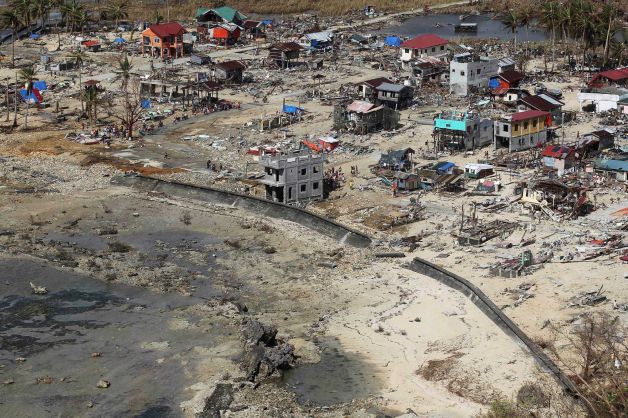

Two months before super typhoon Yolanda hit the Visayas, Mary Joy Escalante Ducusin and her husband decided to move to Tacloban with their six-year-old son to start a new life.
Ducusin and her husband, both Philippine nationals, moved to Britain several years ago to work as nurses in Harlow, near London.
Their only child, Jayro Den, was born there six years ago. He was a British passport holder and grew up speaking only English, she said.
The body of the six-year-old British boy was among around 1,000 corpses at a mass grave in Tacloban.
“For several days I kept on searching for him but now I have found him,” she cried. “No words could really explain how painful it is.”
On Tuesday, Ducusin recalled the events of Nov 8. “It was so quick,” she recalled. “All I remember was the water rising to the top of my house.”
Jayro Den, Ducusin, her husband and his mother climbed onto the roof, but were blown off by the 315kmh winds of Yolanda.
All but 37-year-old Ducusin perished.
“We were carried to the second floor of a house nearby. But I didn’t see my mother-in-law or my six-year-old boy again.” The 37-year-old said she had scoured the debris left by the monster flood for days in the desperate hope of finding him.
“One of my neighbours sent me a text message saying that they had found a boy, like six years old with the green shirt and the stuffed toy,” she said. “My baby loves the stuffed toy so much because when he was born, even in the hospital, he got that stuffed toy. He called it Coco.”
The unidentified bodies among the around 4,000 people known to have died in one of the most powerful storms ever recorded are bagged and taken away by firemen on trucks that patrol Tacloban.
They are then transported to a cemetery above the city for rudimentary identification by a forensic pathologist, who records the height and gender of each corpse, along with any distinguishing marks, and ascribes a number to each body.
Then they are put into the communal grave.
On Tuesday, more than 700 putrefying bodies lay piled on top of each other in the grave. Around 250 more were waiting to be processed. Among them was that of Jayro Den.
“I don’t want to think about tomorrow,” said his heartbroken mother. “I just want to live life day by day, I don’t know where to start, I don’t know where to pick up the pieces.”
Story: AFP
Photo from Coconuts Manila reader Belle Uy
Unicef’s relief efforts are geared towards children, you can donate online via unicef.ph