
1. Can earthquakes be predicted? If rains and droughts can be predicted, is there a way to anticipate an earthquake? It’s a question that crossed the minds of a couple of reporters who were covering the strong tremor in Bohol that has killed nearly 100 people and destroyed several heritage sites. We learned that a reporter for a media outfit had the guts to raise a similar question to Renato Solidum, the head of the Philippine Institute for Volcanology and Seismology, during the press conference in the morning. The official was gracious enough to explain why predicting earthquakes wasn’t possible to the curious reporter. Unfortunately for Solidum, he also had to answer that question on live TV, under the grilling of a veteran broadcast journalist from ABS-CBN, who has covered countless disasters in her sterling career. The official gave the presenter a similar answer.
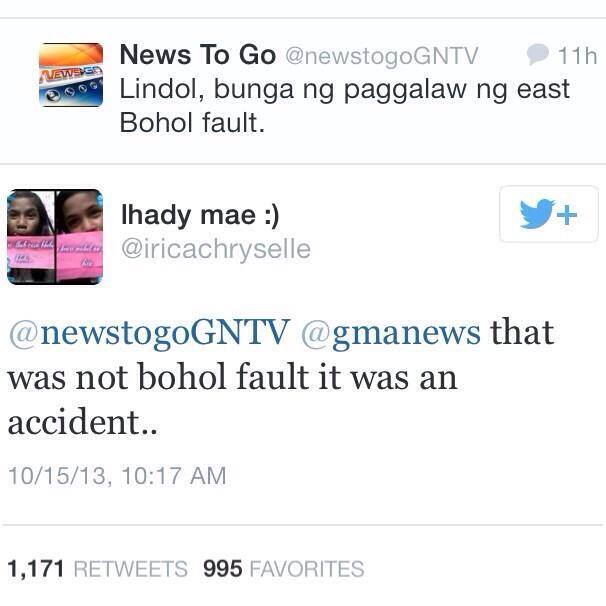
2. Whose fault is it anyway? The trouble with Twitter is its 140-character limit. That’s why media outfits take pains in composing short, meaningful messages. Unfortunately for GMA News, one user messed the entire post altogether. Here’s a screengrab that’s made the social media rounds yesterday: It’s hard to blame the media outfit because we think what they said was pretty clear. We likewise don’t want to blame the user who appeared to have been clueless about what faults are. We want to know whose fault is it.
3. How to see the quake’s epicenter? The weather has been very cray-cray in the past five years that reporting the comings and goings of a storm tends to be boxed. Here’s the usual formula media employs: (a) Name of weather disturbance; (b) where is it located, including the eye of the storm; (c) where is it heading; (d) how is it going to affect the weather in different areas. But it seems this reporter tried using the same formula on a different calamity. During a live report, she uttered the following: “Namataan ang epicenter …” We were flabbergasted and didn’t bother listening to the entire report. Depending on one’s translation, the reporter was basically saying that the epicenter of the quake “had been seen.” The last time we checked, quake epicenters are usually “napag-alaman” (discovered) or “natukoy” (pinpoint).