
(Updated with a statement from the Department of Education)
After a book praising the looks of white mestiza (mixed) Filipinos recently came in for heavy criticism online, the book’s publisher has told Coconuts Manila that its words were taken out of context.
READ: ‘Gov’t-approved’ textbook says Western features make a person more beautiful
Mestiza is a Filipino term usually referring to a mixed-race Filipino, specifically with European and/or Chinese ancestry.
Titled Philippines’ Pride, the textbook was published by Rex Publishing, one of the largest educational textbook suppliers in the country.
A representative from Rex Publishing told us in a phone interview on Saturday that they believe the highlighted passage doesn’t skin-shame Filipinos, and that only highlighting one passage “took the chapter out of context.”
In a follow-up letter sent to Coconuts Manila early yesterday evening, the textbook’s editorial coordinator, Susan dela Cruz, said the highlighted paragraph was part of a lesson chapter titled Know My Family.
“Each statement/paragraph is related to its preceding and succeeding parts,” she said.
She explained that the text was just meant to show that the presenter knows his family and is able to describe their features.
“Primarily, the lesson derives from the AP Curriculum Guide of the Department of Education, which developed the entire curriculum of Philippine basic education. The competency makes sure that the learner on the grade level could describe the members of one’s family artistically/creatively,” dela Cruz said.
“More so, the development of the lesson is described in the enriched Teacher’s Resource Material, which is an accompanying learning solution of the book,” she added.
The publisher also sent the pages preceding the portion about mestiza mothers.
“On the succeeding pages of the lesson, pupils are given the opportunity to emulate the aforementioned character and describe their own family members through an exercise,” dela Cruz said.
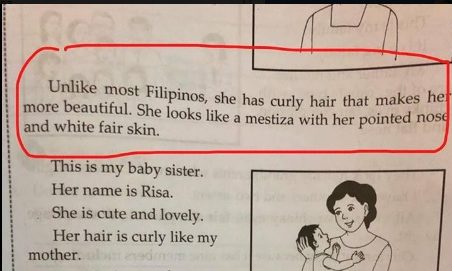
The book first came under fire online after Cebu City Mayor Tomas Osmeña shared an eyebrow-raising page from the book.
“Unlike most Filipinos, she has curly hair that makes her more beautiful. She looks like a mestiza with her pointed nose and white fair skin,” a portion of the text reads.
Netizen Aldave de los Reyes shared a common criticism of the book: “It hurts. Why are we all praise for white skin in these books? Why are we skin-shaming fellow Pinoys?”
The book is used to teach social studies for students in grades 1 to 6 and is being sold in Rex’s online bookstore and at its physical stores in Quezon City and Makati.
The publisher pointed out how, in the same section, features of “Chinitos” (Chinese-Filipino), “average Filipinos” and mestizos were also described.
When Coconuts Manila pointed out that the primary concern was because the mestiza mother was described as “more beautiful,” the publisher maintained that the activity was just for students to “creatively describe” their family.
PhD scholar E.J.R. David, author of Brown Skin, White Minds, who reviewed the text in question, doesn’t believe that the text was simply describing other types of Filipinos.
“It’s implied that fairer skin and being mestiza is more beautiful because such descriptions co-occur with each other. I don’t see ‘beautiful’ or other similar desirable terms attached to other descriptors such as ‘brown skin’ or ‘flat nose,'” David said.
READ: Life on the drip: Tapping into a country’s color obsession
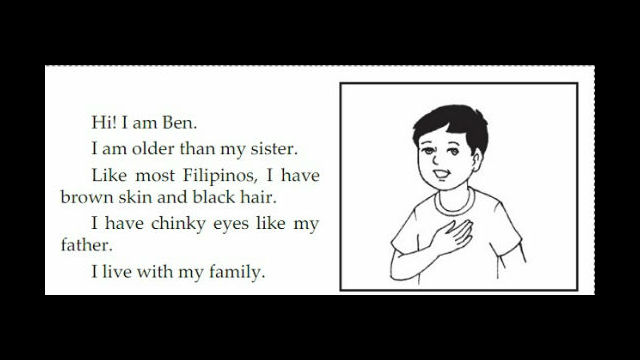
The text also uses the term “chinky,” a word that is commonly considered a derogatory term used to describe those with Chinese features, to describe another character in the book named Ben. David said that this term is inappropriate to use in textbooks. “Perhaps ‘almond shape’ is a better way to describe eyes of this shape, especially because eyes come in all shapes and many non-Chinese people have eyes of such shape,” he said.
According to guidelines for textbooks uploaded on DepEd’s website, content should “respect racial, ethnic, and cultural diversity in our society. Avoid bias and stereotypes in reference to any individual or groups and avoid inaccurate, unnecessary or inappropriate portrayal of or reference to racial/ethnic or cultural customs, symbols observances, festivals, dress, names or language.”
The Department of Education said in a letter to Coconuts Manila that it manages only the centrally procured textbooks being distributed to public schools nationwide.
“If the textbook you mentioned is used in a private elementary school in Cebu, it is not a government-approved textbook,” Undersecretary Lorna Dig Dino said in the statement.
Given the public backlash over the text, David questioned if the publisher was going to revise this section of the text.
“Given the historical and contemporary context of Filipinos — with light skin and being mestizaje (part white) being overly valued and associated with attractiveness to the detriment and inferiorization of the Filipino brown skin and lahing kayumanggi (native skin) – don’t educational institutions have a social responsibility to restore some equity and justice?” David asked.
“Don’t educational institutions have a responsibility to correct an oppressive status quo in order to help empower all of their students (a huge majority of whom are brown)?”
Dela Cruz said in her letter to Coconuts Manila that, on their end, the authors are working on an update of the book and would “gladly take into consideration all inputs to make the book even more responsive to the needs of our learners.”
Do you think this part of the textbook should be changed? Let us know in the comment section below or tweet us @coconutsmanila.