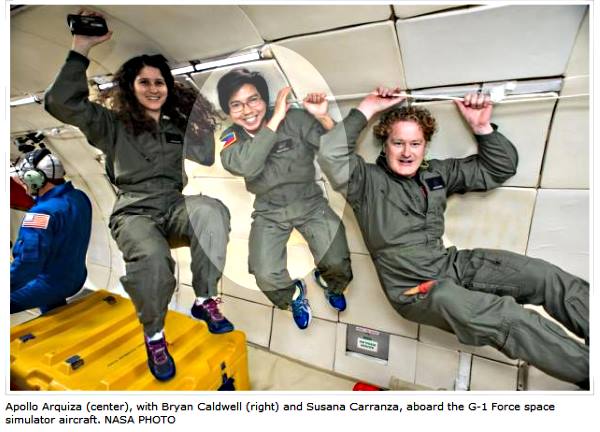

The man has a cool job.
“Apollo Arquiza, a postdoctoral research associate at Cornell University, was part of the team that designed the first low-gravity space galley ever recorded in history,” reports Anthony Advincula on Inquirer.net.
The report revealed that “after a series of rigorous research and testing that started since 2011, the team led by Jean Hunter, assistant professor and director of undergraduate programs at Cornell’s College of Biological and Environmental Engineering unveiled the result early this year: a prototype cooking device which, to the untrained eye, may just look like an ordinary oven enclosed in a giant stainless metal box.”
Then, last April, the team boarded a G-Force 1 space simulator aircraft to test the galley. The report said that “in a series of four flights from Houston, they sautéed tofu and potatoes in a frying pan.”
Arquiza said that while it got “a bit messy,” the results were crucial steps to improving the design of future terrestrial and extraterrestrial cooking technology.
The report indicated that the “space kitchen” may prove useful in future long-term space missions—such as the allaged mission to Mars that the National Aeronautics and Space Administration (NASA) will supposedly undertake in 2030.
Arquiza was quoted as saying, “Even daing [dried fish] can now be fried, if there’s a Filipino aboard the spacecraft.”
By the way, the report pointed out: “Before he came to Cornell University, an Ivy League school located in Ithaca, New York, to earn his doctoral degree in biological and environmental engineering, Arquiza was an adjunct professor at the University of the Philippines-Los Baños (UPLB) College of Engineering.”
Screengrab of photo from the National Aeronautics and Space Administration (NASA), as posted on Inquirer.net