
Language is an interesting and often complicated topic. More so in the Philippines, where there are more than 100 languages and dialects. English is also considered one of two official languages, creating a kind of English that is unique to the country, a way of speaking that is best exemplified in a tweet that went viral over the weekend.
Twitter user Cielo Alegre (@siyeloh) shared on Friday an encounter she had with an Australian that blew her — and Filipino netizens’ — minds.
Now, this particular exchange may not seem funny at all — an outsider might even find it boring — but many Filipinos found it hilarious because, finally, they know how to ask a question many thought could not be translated into English.
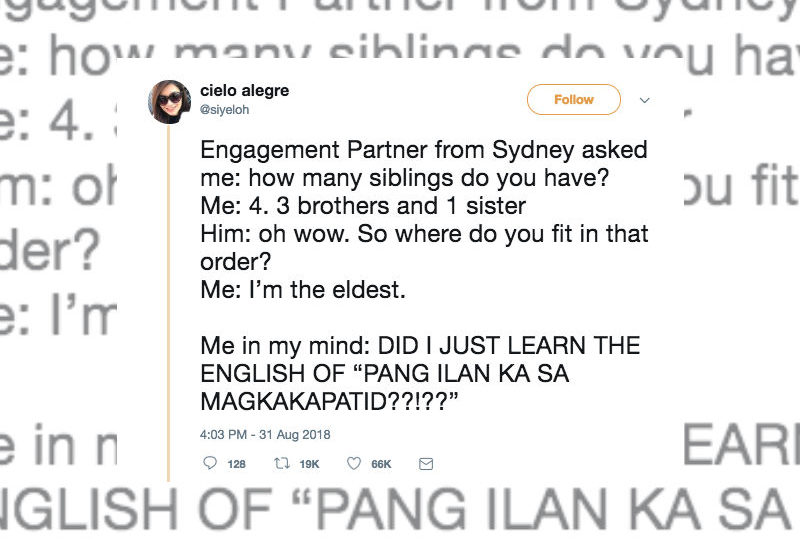
Her tweet reads:
Engagement Partner from Sydney asked me: how many siblings do you have?
Me: 4. 3 brothers and 1 sister
Him: oh wow. So where do you fit in that order?
Me: I’m the eldest.
Me in my mind: DID I JUST LEARN THE ENGLISH OF “PANG ILAN KA SA MAGKAKAPATID??!??”
Engagement Partner from Sydney asked me: how many siblings do you have?
Me: 4. 3 brothers and 1 sister
Him: oh wow. So where do you fit in that order?
Me: I’m the eldest.Me in my mind: DID I JUST LEARN THE ENGLISH OF “PANG ILAN KA SA MAGKAKAPATID??!??”
— Mary Sky (@iamMarySky) August 31, 2018
READ: Mind the gap: In the Philippines, language isn’t about words, it’s about class
When asking people where they fit in their family’s order of siblings, people usually ask “Pang ilan ka sa magkakapatid,” which literally translates into “You’re the how many in your siblings?”
While English is widely spoken throughout the Philippines, Filipinos have their own way of speaking the language, one that mimics Filipino sentence construction.
Another example of this is the phrase “for a while.” This is a direct translation of “sandali lang.” Most Filipinos know that this means “wait” or “hold on” but won’t make much sense to other people.
The language quirk showcased in Alegre’s tweet is so relatable that it now has 66,000 likes, 19,000 retweets, and 128 replies — numbers one would expect from a photo of a cute dog but somewhat unusual for a tweet about grammar.
Alegre was shocked by people’s response to her tweet. “Hahahahaha I was surprised by the people [reacting], I can’t [even],” she wrote.
Hahahahaha nagulat naman ako sa mga people. I kennat
— Mary Sky (@iamMarySky) September 1, 2018
Most just laughed in their comments but some netizens also weighed in with their own suggested translations.
“It’s actually ‘what’s your ordinal number from the siblings?’ You’re welcome,” @LoneCursedWolf said.
https://twitter.com/LoneCursedWolf/status/1035729670799470592
Another shared a screencap of a comment asking the same question but in a, er, roundabout way.
“What position are you in the choreography of your mother and father during versace on the floor?”
Wala da best parin to HAHAHHAHAHAHAHA :—( pic.twitter.com/vwqTNVnGPo
— channyyy (@jilliaaane) September 1, 2018
@pharzupha talked about how educational social media can be. “[T]he things I learn from [T]witter,” she said.
https://twitter.com/pharzupha/status/1035695551646298113
Apart from sentence construction, Philippine English also has colloquial meanings for common English words.
For example, “comfort room” means restroom and “barbecue stick” means skewer.
What are your favorite Philippine English quirks? Let us know in the comments section below or tweet us @CoconutsManila.