
Got a tip? Send it to us at manila@coconuts.co.
Philippine officials are calling for criminal penalties for factory owners who violate safety standards days after 72 people died in the fire at the Kentex Manufacturing Corporation factory in Valenzuela City.
Department of Labor and Employment (DOLE) Secretary Rosalinda Baldoz said that occupational safety standards were adopted by the country in 1978 but lack teeth because parliament has failed to pass a law imposing penalties against violators.
“I (can) not overemphasize its importance — and the timeliness of our plea to our lawmakers — in the light of accidents in our workplaces, some of which have injured and claimed the lives of our workers,” she said in a statement.
A huge fire that killed 72 people and gutted a flip-flop factory in a Manila suburb on Wed, May 13, exposed the unsafe conditions many work under across the nation.
Baldoz has called the factory’s owners “immoral” and accused them of a raft of illegal labour practices.
Relatives of the victims told AFP the workers were paid well below the minimum wage of PHP481 (US$10.90) a day and forced to toil 12-hour shifts, seven days a week without overtime pay.
They said legally required social security and health insurance payments were also withheld, and workers were forced to constantly inhale foul-smelling chemicals.
A lawyer for the gutted footwear factory has rejected allegations it had flouted labour laws.
Baldoz said the legislature has yet to act on three related bills, including one imposing criminal penalties for non-compliance with occupational safety and health standards.
The second bill calls for occupational safety regulations in the construction industry and the third would require protective equipment and uniform warnings at work places, she added.
Some of the proposed measures were drawn up as early as 2011, Baldoz added.
Rex Gatchalian, mayor of the industrial district of Valenzuela that hosted the footwear factory, also urged the government to outlaw the practice of paying workers only when they reach a certain production quota.
“This is a practice that we see everywhere. It’s technically illegal,” he said in an interview with ABS-CBN News.
Text: Agence France-Presse (AFP)
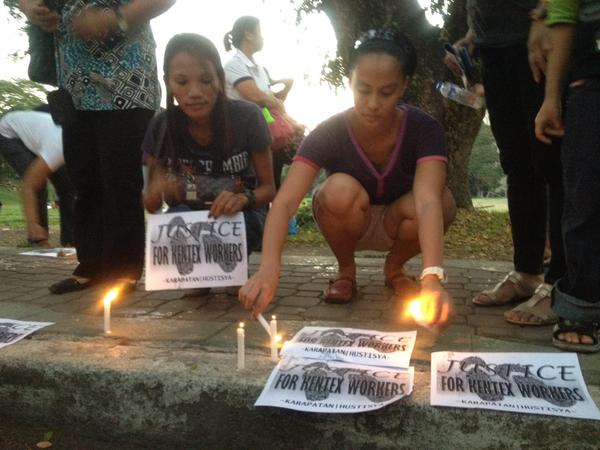
Photo: Dennis Datu, dzMM (Twitter)