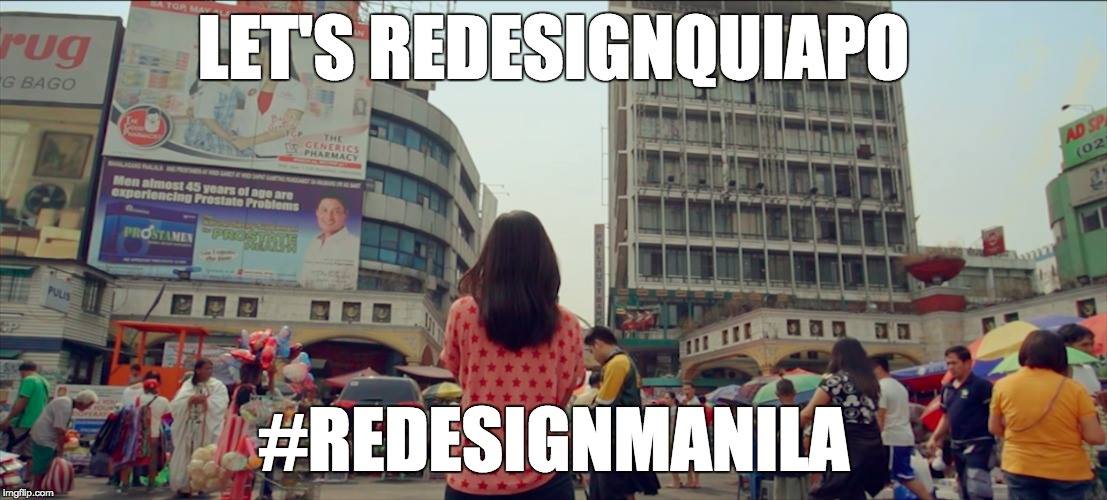

There are plenty of things wrong about Metro Manila, we know. That just means there are as many opportunities to make our metropolis right, correct?
That’s what the #RedesignManila campaign, an initiative by Go Motion Productions, is all about. It started on Feb 10 when a Facebook page was created and the group began posting photos.
The first was of the LRT tunnel. Instead of being the brutalist and bare concrete structure that it is now, it was decked with a wooden ceiling, and lined with green plants. Nice! In the next few days, the page showed photos of Quiapo and Cubao, both ugly high-density areas that have seen better days, but now strangely pleasant to the eye.
Late evening on Valentine’s Day, they released a two-minute video, set to Hotdog’s “Uuwi.” It shows key areas of Metro Manila transformed into gorgeous urban spots by just adding low-cost solutions. Some trees here, a bit of plants there, mosaic tiles on the bridge, arches and a statue by the bay. Also: Removing eyesores such as overhead electrical wirings (which the Intramuros Administration was able to do outside Manila Cathedral last November).
The video, truth to tell, will make you wistful. And hopeful, that this redesigned Manila won’t just be some wild idea, but something that is actually implemented.
The Makati-based video production house says it likes to create content that are socially relevant. (Before #RedesignManila they made “Boboto Na Ako” and “Edsa Same Story“.)
“We are a private group trying to champion this initiative of redesigning Manila so that hopefully people in the right places, who have the authority to implement this can pick this project up,” the group told Coconuts Manila.
The team behind RDM come from different schools that offer design courses like College of Saint Benilde and University of Santo Tomas. The man behind the concept and director of the video, Paolo Joaquin, is a graduate of UST College of Fine Arts and Design, while the rest are in their mid- to late-20s.
The idea was pitched internally around August, pre-production started in late October, and it was shot in November. “Making of art assets was from December to January. but we were already doing post-production pre-work during that time. Post production was from January to Feb,” they told us.
Were any urban planners or architects involved? “Our intention was not to create a perfect architectural design, but to give a glimpse that Manila is not hopeless and can still be improved. We wanted to give life to the passion people have for Manila.”
Watch the video below.
This story was updated on Feb 18, 2016, with quotes from Go Motion Productions.